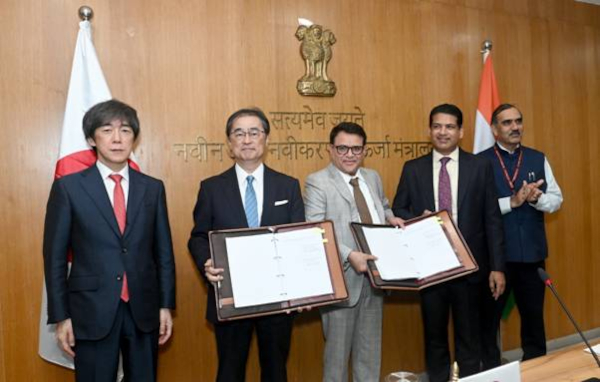
India’s ambition to become a global hub for green hydrogen and clean fuel exports received a major boost as ACME Cleantech Solutions Private Limited secured landmark long-term offtake agreements with leading Japanese companies for green ammonia and green methanol. The agreements, signed at Atal Akshay Urja Bhawan in New Delhi, mark a significant step forward under the National Green Hydrogen Mission and strengthen India’s position in the global clean energy transition.
ACME Group signed an agreement with IHI Corporation of Japan for the supply of green ammonia and another 10-year agreement with Mitsubishi Gas Chemical Company, Inc. for green methanol. Together, these partnerships represent one of the largest green ammonia and green methanol offtake commitments from India to Japan, creating a strong international market linkage for Indian clean fuels.
The National Green Hydrogen Mission, approved in January 2023 with an outlay of ₹19,744 crore, aims to make India a global centre for the production, use and export of green hydrogen and its derivatives. A key part of this mission is the Strategic Interventions for Green Hydrogen Transition Programme, better known as SIGHT, which provides financial support for green hydrogen production through a transparent bidding process conducted by the Solar Energy Corporation of India.
Under the SIGHT Programme, ACME Group has been awarded a production capacity of 3,70,000 tonnes per annum. This capacity forms the base for the export-oriented agreements with Japanese companies and gives India a strong commercial foothold in the emerging global green fuel market.
The agreement with IHI Corporation involves the supply of 4,05,000 tonnes per annum of green ammonia. This deal is supported by Japan’s Contract for Difference scheme for low-carbon ammonia, administered by Japan’s Ministry of Economy, Trade and Industry. The scheme provides price support to Japanese buyers, helping create long-term commercial confidence for clean fuel imports.
ACME has also entered into a 10-year agreement with Mitsubishi Gas Chemical Company for the supply of 1,00,000 tonnes per annum of green methanol from its Paradip facility. Green methanol is gaining importance as a cleaner marine fuel, especially as the global shipping industry moves towards decarbonisation. The project is designed to meet European Renewable Fuels of Non-Biological Origin requirements and International Maritime Organization standards for cleaner shipping fuels.
Union Minister for New and Renewable Energy Shri Pralhad Joshi welcomed Japan’s decision to extend Contract for Difference subsidy support to the ACME-IHI green hydrogen project. He said the development reflects growing global confidence in India’s green hydrogen ecosystem and highlights India’s emergence as a trusted partner in the worldwide clean energy transition.
The Minister also underlined that under the leadership of Prime Minister Shri Narendra Modi, the National Green Hydrogen Mission is building a future-ready ecosystem by attracting global investments, creating international partnerships and opening new export markets for Indian green hydrogen and its derivatives.
Secretary, Ministry of New and Renewable Energy, Shri Santosh Kumar Sarangi, said the agreements have delivered three important outcomes for the mission. They have created a clear market linkage with Japan for green ammonia and green methanol, strengthened investor confidence and shown that India’s green hydrogen sector is moving towards commercial maturity. He also highlighted that the agreements will help build international value chains for green hydrogen and green ammonia.
Mr. Takehiko Matsuo, Vice Minister of METI, Government of Japan, described the agreements as a flagship outcome of deepening India–Japan cooperation in clean energy. The presence of senior officials from India and Japan, along with representatives from ACME Group, IHI Corporation and Mitsubishi Gas Chemical Company, gave the event strong diplomatic and industrial significance.
These agreements are important for both India and Japan. For India, they demonstrate that green hydrogen projects supported under the National Green Hydrogen Mission are moving from policy vision to commercial execution. For Japan, they support energy transition goals by ensuring access to a stable supply of low-carbon fuels from India.
The partnerships also carry wider strategic value. Green ammonia can support cleaner power generation, industrial use and hydrogen transport, while green methanol can become a critical fuel for low-carbon shipping. By developing both products for export, India is positioning itself across multiple clean energy value chains.
The ACME agreements show that India’s green hydrogen ecosystem is now entering a decisive phase. With policy support, production incentives, international demand and strong private sector participation coming together, the country is building the foundation for a new clean energy export economy.
As the global demand for low-carbon fuels rises, India’s green hydrogen mission is opening a new chapter in energy diplomacy, industrial growth and climate leadership. The ACME-Japan agreements stand as a major milestone in this journey, placing India firmly on the map as a reliable supplier of green fuels for the future.
You may also like
-
ICAR Scientists Develop Indigenous Protective Gloves for Cotton Farmers, Sign Commercial Manufacturing Agreement
-
BHEL–Coal India Joint Venture Begins Construction of ₹25,016 Crore Indigenous Coal Gasification Project in Odisha
-
PM Modi to Inaugurate RBI’s Tier IV Data Centre and Cybersecurity Training Institute in Bhubaneswar
-
India Creates 11 Crore Digital Farmer IDs Five Months Ahead of Target, Strengthening AgriStack Infrastructure
-
Chak-Hao Black Rice of Manipur and Nagaland: The Aromatic Purple Heritage Grain with GI Recognition
