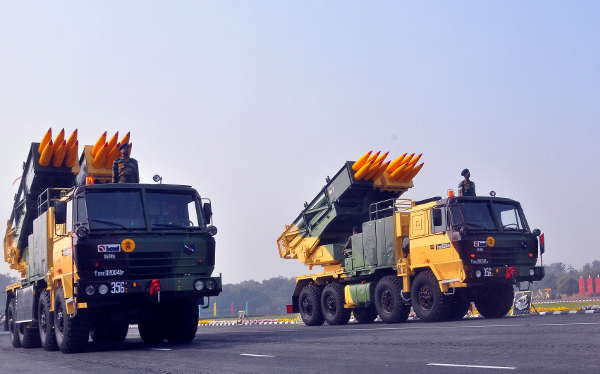
India’s defence export programme could reach the ₹50,000 crore mark by 2028, around two years ahead of the government’s longer-term target, as overseas demand grows for Indian missiles, artillery systems, mounted guns and other indigenously developed military equipment.
Speaking at the 13th Public Affairs Forum of India Annual Forum 2026, Defence Secretary Rajesh Kumar Singh said India’s combination of technological capability and competitive pricing is strengthening its position in the international defence market. He pointed in particular to missiles, where Indian systems can in some cases be offered at a fraction of the price charged by foreign original equipment manufacturers.
India recorded ₹38,424 crore in defence exports in FY 2025-26, the highest level achieved so far. The figure marked a sharp rise over the previous financial year and underlined the increasing scale of India’s defence manufacturing and export ecosystem.
Defence Secretary Expects ₹50,000 Crore Mark Within Two Years
Singh said the current trajectory could take Indian defence exports to ₹50,000 crore in less than two years.
The government has been working towards a defence export target of around ₹50,000 crore by the end of the decade, but the Defence Secretary’s latest assessment suggests the industry could reach that level earlier.
The scale of growth becomes clearer when compared with a decade ago. Defence exports stood at just ₹686 crore in FY 2013-14, against ₹38,424 crore in FY 2025-26. Indian defence products are now being supplied to a growing number of overseas customers, giving domestic manufacturers a much wider international footprint.
Missile Pricing Is Emerging as a Major Indian Advantage
One of the clearest advantages identified by the Defence Secretary is cost.
Singh said India can offer some missile systems at almost one-fourth the price of comparable products from foreign OEMs. For countries seeking modern military capability without the procurement costs associated with many established Western systems, that price difference can become commercially important.
Cost competitiveness alone, however, does not create a sustainable defence export market. Singh also stressed that foreign buyers look for technological reliability, proven performance and long-term support.
India’s export growth therefore reflects both manufacturing economics and increasing confidence in domestically produced systems.
BrahMos Remains India’s Most Visible Defence Export Product
Among India’s defence products, BrahMos remains the most internationally recognised example.
Singh said the missile is already being sold, or considered for sale, in several Southeast Asian markets. The programme has become a reference point for India’s effort to move from being predominantly a defence-importing country towards becoming a supplier of complete high-value weapon systems.
Interest is also extending beyond BrahMos. The Defence Secretary highlighted growing demand for artillery systems, mounted gun platforms and DRDO-derived products manufactured by private Indian companies.
He also referred to the Akash surface-to-air missile system as another area where overseas interest is increasing.
Artillery and DRDO-Based Systems Expand the Export Basket
India’s defence export market is no longer centred on a single platform.
Artillery, mounted gun systems, missiles and a range of products derived from Defence Research and Development Organisation technologies are becoming part of the country’s broader export offering.
The participation of private companies is particularly important because many Indian firms are now moving beyond component supply and entering areas that require full-system integration, manufacturing, testing and long-term support.
That expansion gives India a wider export basket and reduces dependence on a handful of flagship systems.
Private Sector Plays a Growing Role in Defence Exports
India’s defence export growth is being supported by a much wider industrial base.
In FY 2025-26, the private sector accounted for a substantial share of total defence exports, while Defence Public Sector Undertakings continued to contribute strongly.
The number of Indian companies involved in defence exports has also expanded significantly, reflecting broader participation across missiles, electronics, ammunition, artillery, aerospace systems, drones and other military technologies.
This balance is important for future growth. Private companies bring additional manufacturing capacity, specialist technologies and competition, while public-sector companies retain deep experience in complex military production.
Higher Domestic Production Supports Export Expansion
The rise in defence exports is taking place alongside a major increase in Indian defence manufacturing.
Defence production reached a record ₹1.78 lakh crore in FY 2025-26, giving the country a much larger industrial base from which to support both domestic procurement and overseas demand.
A larger manufacturing base also helps exporters maintain production continuity, expand capacity and support customers over longer periods.
For defence equipment, exports do not end with the first delivery. Buyers need spare parts, maintenance, technical support and upgrades throughout the life of the system.
Defence Exports Create Long-Term Strategic and Industrial Relationships
Singh emphasised that defence exports create relationships that extend well beyond the original contract.
Countries buying missiles, artillery or other complex systems require spares, maintenance, training, technical assistance and upgrades over many years. This creates continuing industrial engagement between the supplier and customer.
Such long-term support can strengthen commercial relationships and provide sustained business for Indian manufacturers.
The Defence Secretary also pointed to wider benefits, including foreign-exchange earnings, employment generation and stronger industrial capability.
AMCA Programme Reflects India’s Broader Manufacturing Expansion
During the same interaction, Singh referred to the Advanced Medium Combat Aircraft programme, where Indian defence companies are being considered for participation in development and production.
The reference reflects a broader push to increase the number of domestic companies capable of manufacturing sophisticated military platforms.
India’s emerging defence industrial structure is expected to include multiple production lines for aircraft, missiles, drones and other systems rather than concentrating manufacturing capacity within a small number of organisations.
That additional capacity will become increasingly important as India attempts to serve both domestic military demand and export customers.
A Larger Defence Industrial Base Is Taking Shape
The rise from ₹686 crore in defence exports in FY 2013-14 to ₹38,424 crore in FY 2025-26 shows that India’s defence export sector has moved into a different scale of operation.
The next stage will depend on production capacity, delivery schedules, reliability and long-term support rather than isolated export announcements.
Systems such as BrahMos and Akash, artillery platforms, DRDO-derived private-sector products and an expanding ecosystem of drone and aerospace manufacturers give India a much broader range of products to offer international customers.
The Defence Secretary’s expectation of reaching ₹50,000 crore by 2028 reflects an industry that is not only exporting more, but also manufacturing at greater scale and offering increasingly complex military systems to overseas buyers.
References
Ministry of Defence, Government of India — Official data on record defence exports of ₹38,424 crore in FY 2025-26.
Press Information Bureau, Government of India — Official release on defence production reaching ₹1.78 lakh crore in FY 2025-26.
Press Information Bureau / Ministry of Defence — Official data on India’s defence exporter base, export destinations and private-sector participation.
Moneycontrol — Report on Defence Secretary Rajesh Kumar Singh’s remarks at the 13th PAFI Annual Forum, September 25, 2026.
ANI — Report on Defence Secretary Rajesh Kumar Singh’s remarks on missile pricing, BrahMos, artillery, Akash and India’s defence export prospects, September 25, 2026.
You may also like
-
Bengaluru Startup Paar Autonomy Develops AI-Powered Drone Systems for GPS-Denied Environments
-
Sigma Advanced Systems Secures Fresh ₹973 Crore NATO Artillery Ammunition Order
-
India Advances Indigenous Defence and Space Technologies Through Naval Innovation, Drones and Advanced Electronics
-
Thales Seeks Indian Partnerships for Next-Generation Missiles, Radars and Electronic Warfare Systems
-
Indian and Australian Armies Conduct Jungle and Coastal Warfare Drills in AUSTRAHIND 2026
