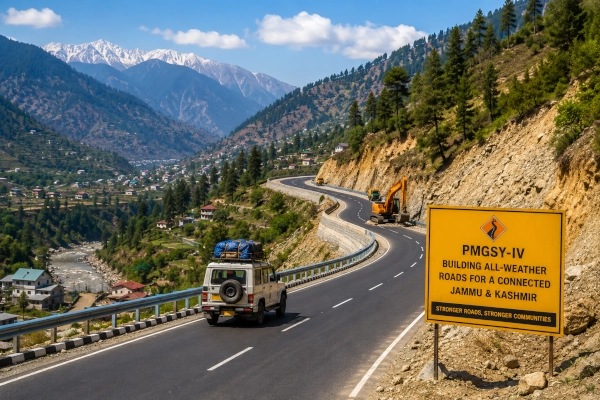
India has launched a major rural connectivity programme across the mountainous districts of Jammu, with foundation stones laid for 110 roads covering 598.455 kilometres under the first batch of the Pradhan Mantri Gram Sadak Yojana-IV for 2026-27. The projects have a combined sanctioned cost of ₹1,503.53 crore and will be implemented across Kathua, Udhampur, Ramban, Doda and Kishtwar, where difficult terrain continues to make dependable year-round mobility a major development challenge.
The new road package is expected to directly benefit 46,972 people living in remote settlements across the five districts. For many of these communities, the significance of an all-weather road extends far beyond easier travel. Reliable road access can determine whether students can reach schools throughout the year, whether patients can be transported quickly to hospitals, whether farmers can move produce to markets before it loses value, and whether essential goods and public services can reach villages during difficult weather.
The foundation stones for the projects were laid on 29 August 2026 by Union Minister Dr Jitendra Singh. The programme forms part of the latest expansion of PMGSY-IV, which is focused on bringing all-weather road connectivity to habitations that remain outside the regular road network, particularly in mountainous and geographically difficult regions.
Udhampur Receives the Largest Share of the Programme
The 110-road package is distributed across the five mountain districts according to connectivity requirements and the number of eligible habitations. Udhampur has received the largest allocation, with 44 projects covering 235.040 kilometres at an estimated cost of about ₹554.90 crore. The district’s large share reflects the extensive network of rural and mountain settlements spread across its interior.
Kathua will receive 24 roads covering 128.925 kilometres, with an estimated investment of around ₹307.12 crore. Doda has been allocated 13 projects extending over 90.180 kilometres at a cost of approximately ₹260.66 crore, while Kishtwar will receive 16 roads covering 83.950 kilometres with an expenditure of around ₹224.88 crore. Ramban will receive 13 projects covering 60.360 kilometres at an estimated cost of about ₹154.97 crore.
Taken together, the projects will create almost 600 kilometres of new rural connectivity across an area characterised by steep slopes, deep valleys, scattered settlements and frequently difficult climatic conditions.
Why Road Connectivity Is Critical in the Himalayan Region
Road construction in the Himalayan and sub-Himalayan regions has a very different development impact from similar projects in the plains. Settlements that appear geographically close to major towns can remain effectively isolated because of mountains, rivers and the absence of motorable roads. A short distance on a map may involve hours of travel along narrow tracks or across difficult slopes.
In such areas, road connectivity directly influences access to essential services. A village with a reliable all-weather road is more likely to receive regular public transport, ambulances, school vehicles, construction material and commercial supplies. Government departments can also deliver welfare programmes, maintain power and communication infrastructure and respond more effectively during emergencies.
For residents of remote Jammu, better roads can therefore reduce both physical and economic isolation. The benefits are particularly important for schoolchildren, elderly residents and women, who often face the greatest difficulties when essential services are located several kilometres away across difficult terrain.
PMGSY-IV Focuses on the Hardest Remaining Connectivity Gaps
The Jammu road package forms part of the fourth phase of the Pradhan Mantri Gram Sadak Yojana, which was approved by the Union Cabinet with an overall financial outlay of ₹70,125 crore. PMGSY-IV aims to construct approximately 62,500 kilometres of all-weather roads and provide new road connectivity to around 25,000 previously unconnected habitations between 2024-25 and 2028-29.
Earlier phases of PMGSY connected a large proportion of India’s eligible rural settlements. As a result, the villages still lacking dependable roads are increasingly concentrated in areas where construction is more difficult and expensive. These include mountainous regions, tribal areas, desert regions and locations affected by security challenges.
PMGSY-IV is therefore increasingly a last-mile infrastructure programme. Its purpose is not simply to increase India’s total road length, but to reach smaller and more difficult habitations that were not covered during earlier phases because of geography, population thresholds or construction challenges.
Special Population Norms Help Smaller Mountain Villages Qualify
Mountain settlements are generally smaller and more dispersed than villages in the plains. Recognising this, PMGSY-IV applies lower population thresholds in hill states, Union Territories, tribal regions and other difficult geographical areas.
While the normal eligibility threshold for unconnected habitations is 500 people, settlements in designated hill regions and other special categories can qualify with a population of 250 or more, based on Census 2011 data. The threshold can be even lower in specified Left-Wing Extremism-affected areas.
These relaxed norms are particularly important for Jammu and Kashmir because many mountain communities would otherwise remain excluded despite facing substantial difficulties in accessing basic infrastructure.
Agriculture and Horticulture Could Gain from Better Roads
Improved rural roads can have an especially important economic impact in areas where agriculture, horticulture and livestock remain major sources of livelihood. Farmers in Jammu’s mountain districts often depend on relatively small-scale production of fruits, vegetables, dairy products and other agricultural commodities.
Poor transport infrastructure can increase the cost of moving these goods and reduce the price farmers receive. Perishable produce is particularly vulnerable because delays can result in substantial losses before it reaches a market.
Better roads can shorten travel times, reduce vehicle operating costs and make remote villages more attractive to traders and transport operators. Over time, improved connectivity can also encourage investment in cold-storage facilities, collection centres, food-processing units and other rural enterprises.
The economic significance of the programme may therefore extend well beyond the initial construction expenditure.
Better Access Can Support Tourism and Local Enterprise
The districts covered by the programme contain some of Jammu’s most attractive mountain landscapes, forests, pilgrimage centres and relatively underdeveloped tourism destinations. Improved rural roads can make these areas more accessible to visitors and create opportunities for local businesses.
Kishtwar and Doda contain extensive mountain and forest regions with potential for trekking, nature tourism and village-based travel. Udhampur and Kathua have important religious and cultural destinations, while Ramban forms part of the wider mountain corridor connecting Jammu with the Kashmir Valley.
Tourism development requires much more than roads, including accommodation, safety infrastructure, waste management and environmental safeguards. Nevertheless, dependable road access is usually the first requirement for bringing visitors and investment into remote areas.
Connectivity Also Has a Strategic and Security Dimension
Road development across the mountainous districts of Jammu has an additional strategic importance. Difficult terrain and sparse road networks can complicate the movement of police, security forces and emergency personnel, particularly in forested and remote areas.
Improved road access can shorten response times and make it easier to maintain security infrastructure, conduct patrols and provide logistical support where required. At the same time, the same roads support civilian mobility, healthcare, education and disaster relief.
This dual-use character is particularly relevant in regions where difficult geography affects both development and security. Roads that integrate remote settlements with district headquarters can strengthen administrative presence while improving everyday life for local communities.
Mountain Road Construction Requires Complex Engineering
Constructing nearly 600 kilometres of roads in the Jammu hills will require considerably more engineering than simply laying pavement. Mountain roads frequently involve extensive slope cutting, retaining walls, drainage structures, culverts, bridges and erosion-control measures.
Slope stability is one of the greatest challenges. Cutting into a mountain can disturb naturally balanced rock and soil formations, increasing the risk of landslides if drainage and retaining systems are not designed properly. Contractors must therefore work with geological conditions that can vary substantially even across relatively short stretches.
Drainage is equally critical. Heavy monsoon rainfall can rapidly damage a poorly designed mountain road by washing away shoulders, weakening pavement foundations or triggering slope failures. Proper cross-drainage structures and water-management systems are therefore essential components of an all-weather road.
Climate Resilience Will Determine Long-Term Success
Extreme weather is becoming an increasingly important consideration in Himalayan infrastructure planning. Intense rainfall, flash floods, landslides and snowfall can cut road access with little warning and place enormous pressure on local maintenance systems.
For that reason, the quality of construction will be as important as the quantity of new roads. An all-weather road should be designed not merely to remain usable during normal conditions but also to withstand repeated exposure to severe rainfall, slope instability and seasonal temperature variations.
The government has emphasised adherence to prescribed construction standards and quality-control mechanisms. Long-term maintenance will also be crucial. Even a well-designed mountain road can deteriorate quickly if blocked drains, damaged retaining walls and small slope failures are not addressed before they become major problems.
Waste Plastic and Alternative Construction Technologies
Several roads within the new package are expected to incorporate waste plastic in road construction. The use of processed waste plastic in bituminous roads has been promoted under PMGSY as one of several alternative technologies intended to improve material efficiency and reduce certain forms of waste.
PMGSY-IV also encourages technologies such as cold-mix construction, panelled cement concrete, cell-filled concrete, full-depth reclamation, fly ash, steel slag and recycled construction material where these are technically suitable.
Such approaches can be particularly useful in remote areas where transporting conventional construction materials over long distances can add significantly to project costs. However, their effectiveness depends on careful engineering, material quality and site-specific suitability.
Digital Planning Is Becoming More Important
The fourth phase of PMGSY increasingly uses geospatial and digital planning tools to determine road alignments and identify eligible settlements. The PM Gati Shakti platform is being used to support infrastructure planning, while digital survey tools are helping map unconnected habitations and nearby public facilities.
This is particularly valuable in mountainous areas. A relatively small change in alignment can affect project cost, slope stability, forest impact and the number of settlements served. Better digital mapping allows planners to compare possible routes before committing to construction.
The objective is also to ensure that new roads connect not only individual villages but, wherever possible, nearby schools, healthcare centres, markets and other important facilities.
Jammu and Kashmir Has Become a Major PMGSY-IV Beneficiary
Jammu and Kashmir has emerged as one of the important beneficiaries of the latest phase of the rural-road programme. By March 2026, more than 300 PMGSY-IV roads covering around 1,780 kilometres had already been sanctioned for the Union Territory.
The latest 598.455-kilometre package therefore represents another substantial expansion of an already large rural-connectivity programme.
Officials have also indicated that the broader Udhampur-Kathua-Doda region accounts for a significant share of the PMGSY investment being directed towards Jammu and Kashmir. This reflects the large number of settlements spread across difficult terrain and the high cost associated with reaching them.
Rural Roads Can Strengthen Access to Education and Healthcare
Among the most immediate benefits of improved road connectivity is easier access to schools and healthcare facilities. In remote mountain settlements, poor roads can make regular school attendance difficult, particularly during periods of heavy rain or snow.
Healthcare access can be even more critical. Medical emergencies often require patients to travel considerable distances to reach district hospitals or specialised treatment facilities. Where motorable roads are absent, transporting patients can consume valuable time.
All-weather connectivity can allow ambulances and other emergency vehicles to reach villages more reliably. It can also make it easier for healthcare workers, teachers and other government employees to serve remote communities on a regular basis.
The effect of a rural road is therefore often reflected not only in traffic volumes but also in better access to public services.
The Economic Impact Extends Beyond the Road Itself
Road infrastructure can produce what is effectively a multiplier effect across the local economy. Once reliable access is available, transportation becomes cheaper and more predictable. Traders can reach villages more frequently, construction material becomes easier to deliver and households gain access to a wider range of goods and services.
Improved connectivity can also encourage young entrepreneurs to establish small businesses locally rather than moving permanently to larger towns. Repair workshops, retail outlets, food-processing units, transport services and tourism-related businesses all become more viable when villages are connected to larger markets.
Digital connectivity can also improve because telecommunications companies find it easier to build and maintain towers, fibre networks and associated infrastructure once road access exists.
The Final Miles Are Often the Most Expensive
India has already constructed one of the world’s largest rural-road networks. The remaining connectivity gaps are therefore often the most challenging.
Connecting a large village close to an existing highway may require relatively little additional infrastructure. Reaching a small settlement deep inside a mountain valley may require kilometres of winding road, retaining structures and multiple drainage crossings for a comparatively small population.
This inevitably increases the cost per kilometre and per beneficiary. However, the developmental impact on those communities can also be much greater because they begin from a much lower level of physical connectivity.
The latest Jammu package illustrates this shift clearly. It is aimed not at building another major highway between large cities, but at extending reliable access into some of the region’s most difficult settlements.
Nearly 47,000 Residents at the Centre of the Programme
The most important measure of the programme will ultimately be the lives of the nearly 47,000 people expected to benefit from it.
If completed to the required standards, the 110 roads could substantially reduce the isolation of mountain communities across Kathua, Udhampur, Ramban, Doda and Kishtwar. Better roads can improve school attendance, access to healthcare, agricultural marketing, tourism, emergency response and administrative reach while creating new opportunities for local businesses.
Implementation will nevertheless require close attention to construction quality, forest clearances, contractor performance and long-term maintenance. Mountain infrastructure remains particularly vulnerable to weather and geological instability, and roads must be engineered for the terrain rather than simply built through it.
The ₹1,503.53-crore PMGSY-IV programme therefore represents much more than a road-building exercise. It is an attempt to bring some of Jammu’s most remote Himalayan and sub-Himalayan settlements into a dependable transport network and ensure that difficult geography does not permanently restrict their access to the wider economy and essential public services.
For the communities that currently remain on the margins of the road network, those final kilometres may prove among the most consequential infrastructure investments of all.
You may also like
-
India’s Economic Warfare Challenge: Strategic Autonomy, Energy Security and the Rise of a Global Power
-
India-US Trade Deal Stalemate: Why Washington’s Tariff Pressure Has Failed to Secure an Agreement
-
US Double Standards in Foreign Policy: 16 Recent Cases Involving India, Russia, China and Global Trade
-
India’s Arctic Energy Ambitions: Russian Oil, LNG and a New Sea Route to Indian Ports
-
India and Russia Explore Joint Icebreaker Construction as Maritime Industrial Cooperation Expands
