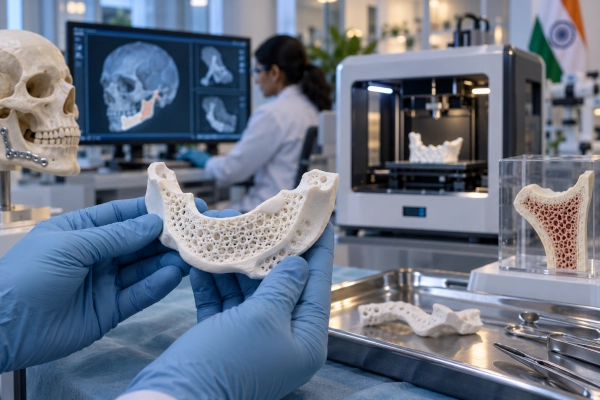
India is moving to commercialise patient-specific bone grafts made through additive manufacturing, with the Technology Development Board under the Department of Science & Technology extending financial assistance to Maharashtra-based Ceramat Private Limited.
The support, announced on 9 September 2026, is for a project combining indigenous calcium phosphate bioceramics with 3D printing to produce both standard bone grafts and customised grafts designed around the anatomy of individual patients. Ceramat is based in Palghar and already works with advanced biomaterials used in orthopaedics and related applications.
From Conventional Bone Grafts to Patient-Specific Structures
Ceramat already manufactures bone-graft materials using conventional processes, including hydroxyapatite, beta-tricalcium phosphate and biphasic calcium phosphate. These are calcium phosphate-based biomaterials widely used because their mineral composition resembles that of natural bone. The company also works with bioactive glass and other advanced ceramic materials.
The new project is intended to take Ceramat beyond standard grafts and granules into anatomically customised structures. Instead of producing the same shape for every patient, digital design and 3D printing can be used to create grafts that follow the geometry required for a particular clinical case.
That shift is important in situations where bone defects are irregular or difficult to reconstruct using standard shapes. Patient-specific manufacturing can allow the graft geometry to be planned around the defect rather than forcing the surgeon to adapt a generic product during the procedure.
Two 3D-Printing Routes Will Be Used
Ceramat plans to use two additive-manufacturing approaches: Digital Light Processing, or DLP, and extrusion-based 3D printing. Each method offers different advantages for producing complex ceramic structures.
DLP uses patterned light to cure successive layers of a printable material and is well suited to producing fine geometries with high dimensional control. Extrusion printing deposits material layer by layer through a nozzle and can be useful for producing larger or more porous structures.
Using both methods gives Ceramat greater flexibility in matching the manufacturing technique to the required graft size, geometry and material behaviour. The project is intended to support both standardised products and customised patient-specific grafts.
Why Calcium Phosphate Matters
Bone grafts need more than the correct external shape. The material must also be compatible with the biological environment in which it will be placed.
Hydroxyapatite and beta-tricalcium phosphate have been used extensively in bone-repair applications because they are chemically similar to the mineral component of natural bone. They can serve as scaffolds around which new bone can grow, although their behaviour differs according to composition, porosity and clinical application.
Biphasic calcium phosphate combines hydroxyapatite and beta-tricalcium phosphate to balance stability and resorption characteristics. Ceramat’s ability to manufacture these materials domestically gives the project an important local supply-chain component rather than relying entirely on imported ceramic feedstocks.
The Real Advance Is the Combination of Material and Geometry
The important feature of the project is not 3D printing alone. Medical 3D printing is already used in several areas, including surgical planning, dental applications and customised implants.
What Ceramat is attempting to commercialise is the combination of indigenous bioceramic material production with patient-specific digital manufacturing. This means the company controls both the material and the geometry of the graft rather than importing finished orthobiological products.
That integrated approach could help reduce costs, shorten supply chains and allow designs to be adapted more quickly for Indian hospitals and surgeons.
Reconstructive Surgery Could Benefit Most
Patient-specific bone grafts are particularly relevant when surgeons are dealing with complex defects created by trauma, tumour removal, congenital abnormalities or difficult reconstructive procedures.
Standard graft blocks or granules can work well in many cases, but more complicated defects may require extensive shaping during surgery. A digitally designed graft can instead be produced before the operation to more closely correspond to the required anatomy.
This can potentially improve surgical planning and reduce the amount of manual modification needed during the procedure. The actual clinical benefit, however, will depend on regulatory approval, manufacturing consistency, surgeon experience and patient outcomes rather than on printing precision alone.
Orthopaedics and Dental Reconstruction Are Natural Applications
Ceramat’s existing materials already serve orthopaedic and oral-care applications, making these fields obvious targets for the new manufacturing platform.
In orthopaedics, bone grafts may be required in trauma reconstruction, spinal procedures and treatment of bone defects. In oral and maxillofacial surgery, customised grafts could be relevant for jaw reconstruction, dental implantation and craniofacial procedures.
The ability to print porous structures is particularly important because porosity can influence how tissue grows into a graft. This makes additive manufacturing useful not just for reproducing an external shape but also for controlling internal architecture.
Reducing Dependence on Imported Products
The Technology Development Board has emphasised the import-substitution aspect of the project. A significant proportion of advanced bone-graft products used in India are still imported, particularly in specialised and high-value applications.
Domestic production of both the ceramic materials and the final patient-specific grafts could reduce that dependence. It could also give Indian manufacturers more control over lead times, product customisation and supply availability.
This is especially relevant for personalised products, where importing a customised device can add time and logistics costs to an already complex clinical process.
A Medical Manufacturing Story, Not Just a Healthcare Story
The project also reflects a broader change in Indian medical technology. Personalised healthcare increasingly depends on precision manufacturing, materials science, imaging and digital design working together.
A patient-specific graft typically begins with medical imaging data. That information is converted into a digital model, the required geometry is designed, and the graft is then manufactured under controlled conditions.
This places the technology at the intersection of radiology, biomedical engineering, ceramics, additive manufacturing and surgery. It is therefore as much an advanced-manufacturing project as a medical-device project.
Commercialisation Is the Current Milestone
The September announcement should be understood correctly. It does not mean that the technology was invented in September 2026, nor does it establish that the grafts are already widely available in hospitals.
The fresh development is that the Technology Development Board has agreed to support commercialisation of the platform. Ceramat already had experience in conventional bone-graft materials, while the current project is intended to move patient-specific 3D-printed products towards manufacturing and market deployment.
The official announcement does not disclose the amount of financial assistance, the total project cost, regulatory approval status, clinical trial data or a commercial launch date. Those milestones will be important in judging how quickly the technology reaches routine clinical use.
Regulatory Approval Will Be Critical
Customised medical implants require rigorous control over materials, manufacturing processes and product consistency.
A graft may have to meet requirements relating to biocompatibility, sterility, mechanical performance and manufacturing quality before it can be used routinely in patients. Customisation adds another layer because each product may have a different geometry even when the underlying material and manufacturing process remain the same.
For Ceramat, successful commercialisation will therefore depend not only on the ability to print a convincing structure but also on establishing a repeatable medical-device manufacturing process that satisfies regulatory requirements.
Clinical Evidence Will Matter More Than Printing Sophistication
Additive manufacturing can create geometries that are difficult or impossible to produce through conventional methods, but the clinical value of a bone graft cannot be judged from its shape alone.
Long-term outcomes depend on how the graft integrates with surrounding bone, how it behaves mechanically, whether it resorbs appropriately where intended and whether complications remain acceptably low.
The Technology Development Board announcement concerns the move towards commercial production. It does not present clinical outcome data demonstrating superiority over existing products, and that distinction is important when assessing the maturity of the technology.
Potential for a Broader Domestic Bioceramics Industry
Ceramat’s work could have implications beyond a single product line. A domestic capability in medical-grade bioceramics can support a broader range of orthopaedic, dental and regenerative-medicine products.
The company already works with hydroxyapatite, beta-tricalcium phosphate, biphasic calcium phosphate and bioactive glass, creating a materials platform that can potentially support several categories of implants and grafts.
Combining this materials base with digital manufacturing could help India build greater capability in customised medical devices rather than remaining mainly a buyer of high-value imported products.
Additive Manufacturing Is Moving Deeper Into Medicine
3D printing has gradually moved from prototype-making into end-use manufacturing, and medicine is one of the areas where its ability to produce unique geometries is particularly valuable.
Mass manufacturing works best when every unit is identical. Patient-specific medicine presents the opposite requirement because anatomy varies from person to person.
Additive manufacturing is naturally suited to this problem because changing the digital model does not require an entirely new mould or production line for every case.
That is why bone reconstruction has become one of the more promising medical applications of 3D printing.
The Next Milestones Will Determine Its Impact
The Technology Development Board’s support gives Ceramat a pathway from development towards industrial production, but the most important milestones still lie ahead.
Regulatory clearances, validated manufacturing processes, clinical use, surgeon adoption and evidence from patient outcomes will determine whether the technology becomes a meaningful part of Indian reconstructive medicine.
If those steps are completed successfully, India could gain a domestic source of patient-specific bioceramic grafts while building expertise in a field that combines materials science, precision manufacturing and personalised healthcare.
The September 2026 development is therefore best understood as a transition point. Ceramat is moving from manufacturing conventional bone-graft materials towards a platform where indigenous ceramics and digital design can be combined to make grafts for individual anatomical requirements.
For Indian medical manufacturing, that is a more important advance than 3D printing alone. It represents an attempt to build the entire chain, from biomaterial to customised medical product, within the country.
References
Technology Development Board, Department of Science & Technology — TDB-DST Supports Ceramat Private Limited for Commercialisation of 3D-Printed Patient-Specific Bone Grafts, 9 September 2026.
Department of Science & Technology — Technology Development Board commercialisation initiatives in indigenous medical technology.
Ceramat Private Limited — Indigenous bioceramics and patient-specific 3D-printed bone-graft commercialisation materials, September 2026.
You may also like
-
Ayurveda on Cold Foods and Iced Drinks: Why Food Temperature Matters for Digestion
-
Serum Institute of India-Manufactured Ebola Vaccine Enters Clinical Trial in Uganda
-
Ayurveda and Hydration: How Much Water Should We Really Drink?
-
Warm Water in Ayurveda: When and Why It Is Recommended
-
Women Make Up 43% of India’s Ayush Workforce as Sector Supports 17.6 Lakh Livelihoods
