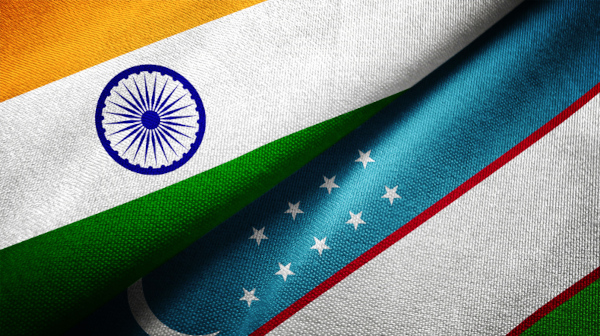
India and Uzbekistan held the 17th round of Foreign Office Consultations in New Delhi on May 13, 2026, reviewing the full range of bilateral relations at a time when New Delhi’s engagement with Central Asia is gaining greater strategic and economic importance. The meeting was co-chaired by Secretary (West) Sibi George and Uzbekistan’s First Deputy Minister of Foreign Affairs Bakhromjon Aloev.
The discussions covered a wide agenda, with both sides focusing on trade and investment, tourism, technology, innovation, energy, education, culture and consular matters. The consultations also provided an opportunity to assess ongoing cooperation and identify new areas where the India-Uzbekistan partnership can be expanded.
The meeting reflects the steady institutional rhythm in India-Uzbekistan relations. Foreign Office Consultations are an important diplomatic mechanism because they allow both countries to review existing cooperation, address pending issues and prepare the ground for higher-level political and economic engagement. The previous 16th round of consultations was held in Tashkent in August 2023, making the latest New Delhi meeting the next step in a continuing bilateral dialogue process.
Trade and investment remain central to the relationship. India is among Uzbekistan’s top ten trade partners, but the economic relationship is still considered below its full potential. According to official bilateral data, India-Uzbekistan trade stood at about USD 980.4 million in 2024, while Indian investments in Uzbekistan amount to around USD 451 million. Indian business interests in Uzbekistan include pharmaceuticals, healthcare, education and residential construction.
The emphasis on technology and innovation is also important. Uzbekistan has been seeking to modernise its economy and attract foreign partnerships in digital systems, industry, education and services. India, with its strength in information technology, digital public infrastructure, pharmaceuticals and start-up ecosystems, is well placed to support this transition. Cooperation in these areas can help both countries move beyond traditional trade into knowledge-driven economic engagement.
Education is another growing pillar of the relationship. Indian universities already have a presence in Uzbekistan, and the country has become an increasingly visible destination for Indian students, especially in professional and medical education. Stronger academic cooperation can support student mobility, institutional partnerships, skill development and people-to-people ties.
Tourism and culture also featured in the consultations, reflecting the deeper civilisational links between India and Central Asia. Uzbekistan’s cities such as Samarkand, Bukhara and Tashkent have long historical associations with trade routes, Islamic scholarship, architecture and cultural exchange. For India, tourism cooperation with Uzbekistan is part of a wider Central Asia outreach that combines connectivity, heritage, business travel and cultural diplomacy.
Energy cooperation is another area with long-term promise. Uzbekistan’s energy resources, India’s growing demand and the broader search for reliable Eurasian connectivity make this sector strategically relevant. The relationship also fits into India’s wider engagement with Central Asia through mechanisms such as the India-Central Asia dialogue, connectivity initiatives and regional consultations.
The consular dimension is equally significant because travel, education, business activity and tourism are expanding between the two countries. Easier consular processes, better coordination and regular official-level communication can help support students, business travellers, tourists and diaspora-linked movement.
The New Delhi consultations show that India-Uzbekistan relations are no longer limited to formal diplomacy. They now span trade, investment, connectivity, technology, education, culture, tourism and regional coordination. As India deepens its Central Asia policy and Uzbekistan looks for trusted partners in Asia, the relationship has the potential to become a stronger bridge between South Asia and the heart of Eurasia.
You may also like
-
India and Ghana Expand Agricultural Partnership Through New ICAR–CSIR-CRI Agreement
-
India Hands Over Three Tonnes of Anti-Tuberculosis Medicines to Sri Lanka
-
India and Austria Move to Deepen Security and Strategic Cooperation
-
India Offers Space-Based Climate Monitoring and Ocean Science Expertise to Pacific Partners at Pre-COP31
-
India and Switzerland Move to Deepen Strategic Science and Technology Partnership
