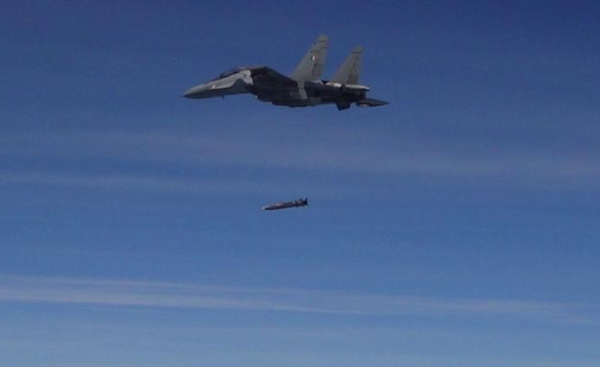
India’s indigenous missile programme has taken another important step forward with the successful flight tests of the RudraM-II air-to-surface missile by the Defence Research and Development Organisation and the Indian Air Force. The trials were conducted from an airborne platform under extreme release conditions, with the missile following a critical trajectory that validated the performance of its major subsystems. According to the Ministry of Defence, the missile was guided to a pre-defined target with pin-point accuracy, and all test objectives were confirmed through flight data captured by range instruments deployed by the Integrated Test Range at Chandipur.
The importance of the test lies in the maturity it demonstrates. A missile released from a combat aircraft has to perform through a demanding sequence: safe separation from the aircraft, stable transition into powered flight, accurate navigation, mid-course control, terminal guidance and final impact. The latest RudraM-II test established this chain under challenging release conditions, giving the Indian Air Force greater confidence in the weapon’s behaviour across operational envelopes. The earlier May 2024 RudraM-II test from a Su-30 MK-I platform had validated its propulsion system and control-and-guidance algorithm, showing steady progress in the missile’s development cycle.
RudraM-II is an indigenously developed, solid-propelled, air-launched missile system designed for the air-to-surface role. Its purpose is to give combat aircraft the ability to strike enemy assets from stand-off distances, allowing the launch aircraft to engage targets while remaining outside the most dangerous zones of hostile air defence. The system incorporates advanced indigenous technologies developed by multiple DRDO laboratories, making it a significant addition to India’s growing family of precision strike weapons.
The missile has been developed with Research Centre Imarat, Hyderabad, serving as the nodal laboratory. Other DRDO establishments, including Defence Research and Development Laboratory, High Energy Materials Research Laboratory, Armament Research & Development Establishment and Integrated Test Range, have contributed to the programme. The development ecosystem also includes Hindustan Aeronautics Limited, Regional Centre for Military Airworthiness, Missile System Quality Assurance Agency, development-cum-production partners and several Indian industries.
For the Indian Air Force, weapons like RudraM-II expand the reach and flexibility of strike aircraft. Modern air warfare increasingly depends on the ability to hit high-value targets with speed, precision and survivability. A fighter carrying such a weapon can threaten enemy radar-linked assets, command nodes, hardened positions, logistics hubs and other battlefield targets from a safer launch distance. This strengthens the Air Force’s ability to shape the battlespace before larger operations begin.
The RudraM family also carries a deeper strategic meaning. India’s earlier RUDRAM test in 2020 was described by the Ministry of Defence as the country’s first indigenous anti-radiation missile capability for the Indian Air Force. That system was designed to engage radiation-emitting targets such as enemy radars, communication sites and other radio-frequency emitters, supporting suppression of enemy air defence missions from stand-off ranges.
In modern combat, suppression of enemy air defences is one of the most decisive opening moves. Enemy radar networks, surface-to-air missile batteries and communication emitters form the nervous system of an air defence grid. Once these systems are threatened, blinded or destroyed, friendly aircraft gain greater freedom to operate. A missile family that can support such missions gives India a stronger tool for offensive air operations, deep strikes and theatre-level deterrence.
The latest test also highlights the growing maturity of India’s defence-industrial chain. Missile development today is a combined effort involving laboratories, aircraft integration teams, quality agencies, production partners and private industry. RudraM-II’s success shows that India is building capability across the entire cycle of design, testing, integration, production readiness and operational validation. Defence Minister Rajnath Singh described the tests as evidence of the growing maturity of indigenous defence technologies and their contribution to self-reliance in advanced weapon systems.
The wider message is clear: India is steadily moving from imported dependence to indigenous precision-strike depth. RudraM-II adds another layer to the country’s air-launched missile capability, alongside systems such as Astra, BrahMos air-launched variants, glide bombs and other DRDO precision weapons. Each successful test builds confidence, improves aircraft integration, strengthens production pathways and gives the armed forces more Indian-made options for future conflict scenarios.
With the June 2026 flight tests, RudraM-II has crossed another major developmental milestone. The missile’s accurate performance, validated trajectory and successful subsystem behaviour point toward a more capable future air-strike arsenal for India. As the system moves further through trials, refinement and eventual operational pathways, it stands as another symbol of India’s advancing missile technology and the steady rise of Aatmanirbhar Bharat in high-end defence systems.
You may also like
-
Indian Navy Vice Chief Inspects Japan’s Mogami-Class Stealth Frigate as India-Japan Shipbuilding Cooperation Expands
-
Philippine Marine Wargames Reportedly Show BrahMos Can Penetrate Chinese Destroyer Air Defences
-
Safran Signs 18 Agreements with Indian Aerospace Suppliers, Expanding Make in India Manufacturing Partnerships
-
Indian Army’s Vajra Corps Certifies First Batch of Drone Operators, Strengthens Battlefield Surveillance
-
India to Seek 35% Increase in Defence Modernisation Budget for FY 2027–28
