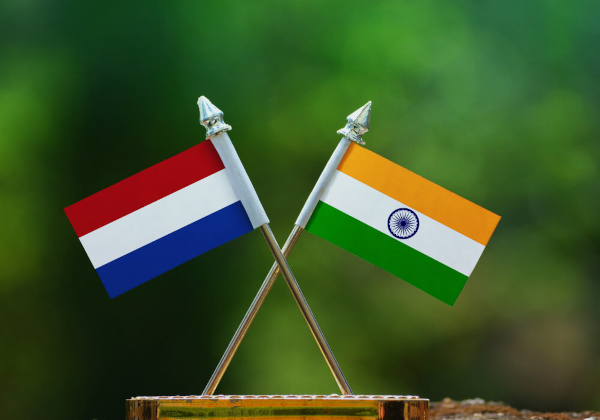
India and the Netherlands have formally elevated their bilateral relationship to a Strategic Partnership, adopting a five-year roadmap for deeper cooperation from 2026 to 2030. The decision was taken during the meeting between Prime Minister Narendra Modi and Netherlands Prime Minister Rob Jetten at The Hague on May 16, 2026, with both sides agreeing to pursue focused, time-bound initiatives across trade, technology, water, agriculture, health, defence, maritime cooperation, clean energy, education, migration and culture.
The Roadmap of the India-Netherlands Strategic Partnership marks a significant broadening of a relationship that has traditionally been strong in trade, investment, water management and agriculture. Under the new framework, the two countries will maintain regular high-level political exchanges, including meetings between heads of government, foreign ministers and other cabinet-level leaders. A new annual Foreign Ministers’ mechanism will also review the progress of the roadmap and provide strategic direction for future cooperation.
Economic cooperation forms one of the central pillars of the roadmap. India and the Netherlands plan to use the Joint Trade and Investment Committee to expand bilateral trade, market access and investment in high-potential sectors such as renewable energy, telecommunications, maritime development, infrastructure, urban development, innovation, electronics, semiconductors, agriculture, pharmaceuticals, medical technology, textiles, steel and aluminium. The roadmap also places emphasis on joint ventures, industrial partnerships and technology collaboration to strengthen supply-chain resilience.
Critical raw materials have emerged as another important area of cooperation. Both sides will explore a strategic partnership across the critical minerals value chain, including exploration, research, innovation, circularity, ESG standards and supply-chain diversification. This is particularly important as countries look to reduce dependence on narrow supply chains for materials needed in semiconductors, batteries, renewable energy systems and advanced manufacturing.
Water cooperation remains a natural strength in India-Netherlands relations. The two countries expressed their intention to renew the Strategic Partnership on Water, originally signed in March 2022 and running until March 2027. The roadmap includes collaboration in integrated water resources management, coastal zone management, urban water management, flood resilience, river basin management and sustainable water quality in the Ganga Basin. It also supports Urban River Management Plans in Indian cities and cooperation through the National Mission for Clean Ganga.
Agriculture and health are also major components of the partnership. The two countries will continue the Joint Agriculture Working Group, strengthen cooperation in climate-resilient agriculture, support responsible value chains and promote food security. In health, cooperation will focus on infectious diseases, antimicrobial resistance, non-communicable diseases, digital health, AI in healthcare, cybersecurity, climate-health links and capacity building. The roadmap also refers to cooperation between the Dutch National Institute for Public Health and the Environment and the Indian Council of Medical Research in areas such as One Health, disease surveillance and vector-borne diseases.
The technology section of the roadmap gives special importance to semiconductors, artificial intelligence, cybersecurity, photonics, quantum technologies, energy materials and biomolecular sciences. India and the Netherlands will work to build trusted semiconductor supply chains and connect the Dutch Semicon Competence Centre with the Indian Semiconductor Mission. The agreement also supports cooperation between Eindhoven University of Technology, University of Twente and leading Indian institutions including IISc Bangalore and IITs at Bombay, Delhi, Gandhinagar, Guwahati and Madras, with industry support from NXP, ASML, Tata and CG Semi.
Clean energy and maritime development are another major focus. The roadmap calls for a Joint Working Group on Renewable Energy, cooperation in green hydrogen, bioenergy, battery storage, circular feedstocks and renewable energy ecosystems. Both countries will also draft an action plan for renewable hydrogen, including the concept of a green corridor between India and the Netherlands. In the maritime sector, the two sides will work towards a Green and Digital Sea Corridor, aimed at creating an environmentally sustainable, digitally integrated and economically efficient maritime link.
Defence cooperation has also received a sharper structure under the roadmap. India and the Netherlands plan to develop structured tri-services interaction between their defence ministries, expand maritime cooperation through naval exercises and involvement in the Information Fusion Centre–Indian Ocean Region, and explore technology collaboration in defence platforms and equipment. The two sides will also work towards a Defence Industrial Roadmap involving industry bodies from both countries.
The security chapter includes cooperation on counterterrorism, cyber threats, maritime security, economic security and emerging technologies. Both countries also intend to continue work towards a Mutual Legal Assistance Treaty and a new Extradition Treaty. This gives the partnership a stronger law-enforcement and security dimension, beyond its traditional economic and developmental focus.
Migration, mobility and people-to-people ties are also included in the five-year plan. India and the Netherlands will cooperate to facilitate fair mobility for students, academics, researchers, doctoral candidates, highly skilled professionals and young professionals, while also working together to counter irregular migration. Cultural cooperation will cover heritage preservation, museums, design, visual arts, performing arts, cultural exchanges and continued discussions on the return and restitution of cultural artefacts.
Overall, the 2026–2030 roadmap moves India-Netherlands ties from a sector-specific partnership into a broader strategic framework. It connects India’s priorities in semiconductors, clean energy, water security, agriculture, maritime development and defence industrialisation with Dutch strengths in technology, ports, water management, green innovation and high-end manufacturing. If implemented with discipline, the roadmap could make the Netherlands one of India’s most important European partners in the coming decade.
You may also like
-
US Double Standards in Foreign Policy: 16 Recent Cases Involving India, Russia, China and Global Trade
-
Indian Navy Vice Chief Inspects Japan’s Mogami-Class Stealth Frigate as India-Japan Shipbuilding Cooperation Expands
-
INS Trishul Arrives in UK for Exercise KONKAN 2026 as India and Royal Navy Expand Maritime Cooperation
-
INS Sahyadri Arrives in Russia for Exercise INDRA 2026 to Strengthen India-Russia Naval Cooperation
-
India and Qatar Deepen Strategic Partnership with Focus on Energy Security, Trade and West Asia
