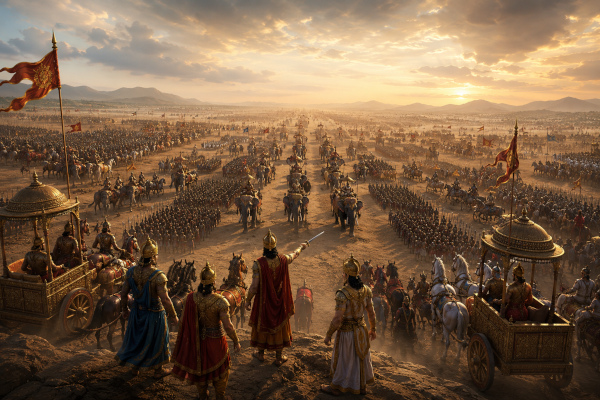
At dawn on Kurukshetra, the battlefield would have looked like a moving continent of steel, leather, banners, horses, elephants and chariots. Conches rolled across the plain, drums set the marching rhythm, royal standards rose above the dust, and commanders watched whole formations move like living geometry. The Mahabharata presents this great war as a clash of courage, duty, strategy and destiny, yet beneath the heroic duels sits a surprisingly ordered military world. Armies were counted, grouped, placed, signalled and deployed through a hierarchy that gave ancient Indian warfare its structure and rhythm. Britannica describes the Mahabharata as a vast epic arranged around the struggle between the Kauravas and Pandavas, while the epic’s own Adi Parva gives detailed numerical descriptions of military scale.
The first key to understanding the battlefield is Chaturanga Bala, the four-limbed army. The four arms were ratha, the chariot force; gaja, the elephant force; ashva, the cavalry; and padati, the infantry. The Mahabharata repeatedly presents armies as mixed forces, and Adi Parva gives a precise mathematical structure for the Akshauhini, beginning with one chariot, one elephant, three horses and five foot soldiers as one Patti. This creates a battlefield system where mobility, shock power, speed and ground-holding capacity move together as one fighting organism.
A chariot in the Mahabharata was more than a vehicle. It was a mobile combat platform carrying an elite warrior, a driver, weapons and a visible command presence. Great warriors such as Arjuna, Bhishma, Karna and Drona fought from chariots because the platform gave height, speed, visibility and space for archery. In modern military language, the chariot can be compared conceptually with a combination of armoured mobility, mobile fire support and command visibility. A tank or infantry combat vehicle has armour, engine power, radios and heavy weapons; the ancient chariot had speed, trained horses, archery reach and a warrior whose reputation could raise morale across a formation.
The elephant force represented shock, mass and psychological pressure. An elephant towered above men and horses, carried warriors or commanders, and could break crowded formations through sheer momentum. Its modern parallel is best understood through the battlefield role of heavy armour and breach forces. Tanks, assault vehicles and engineer columns today create fear, open routes and punch through strong points. The elephant did this in an older material world, where size, sound and pressure could shake the courage of soldiers before weapons even met.
Cavalry gave the army movement across the edges of the battlefield. Horsemen could scout, screen, pursue, harass, carry messages and exploit gaps. In modern terms, this resembles armoured reconnaissance, light mechanised units, fast-moving patrols, helicopter-borne troops and mobile strike groups. Cavalry gave commanders the ability to stretch the battle beyond the front line and turn a static contest into a moving contest.
Infantry formed the living foundation of the army. Foot soldiers held ground, guarded camps, filled formations, protected chariots and elephants, and absorbed the hardest pressure of war. Even in modern armies, infantry remains the force that occupies, secures and physically controls terrain. Aircraft may strike, artillery may soften, armour may break through, yet infantry gives victory a human footprint on the ground.
The Mahabharata’s army hierarchy begins with the Patti and rises by multiplication into the Akshauhini. The traditional account gives a clear sequence: Patti, Senamukha, Gulma, Gana, Vahini, Pritana, Chamu, Anikini and Akshauhini. Each level grows from the previous level, mostly by a factor of three, while ten Anikinis form one Akshauhini. The final Akshauhini contains 21,870 chariots, 21,870 elephants, 65,610 horses and 109,350 infantry in the traditional reckoning.
| Mahabharata unit | Rough modern comparison | Chariots | Elephants | Cavalry | Infantry |
|---|---|---|---|---|---|
| Patti | Small tactical detachment | 1 | 1 | 3 | 5 |
| Senamukha | Platoon-level grouping | 3 | 3 | 9 | 15 |
| Gulma | Company-level grouping | 9 | 9 | 27 | 45 |
| Gana | Battalion-level grouping | 27 | 27 | 81 | 135 |
| Vahini | Regiment / task-force scale | 81 | 81 | 243 | 405 |
| Pritana | Brigade-level grouping | 243 | 243 | 729 | 1,215 |
| Chamu | Division-level grouping | 729 | 729 | 2,187 | 3,645 |
| Anikini | Corps-level grouping | 2,187 | 2,187 | 6,561 | 10,935 |
| Akshauhini | Field-army scale | 21,870 | 21,870 | 65,610 | 109,350 |
This table should be read as a conceptual bridge rather than a fixed equality with modern armies. Modern formations are built around rifles, tanks, artillery, missiles, air defence, engineers, signals, cyber systems, drones, logistics and aviation. The Mahabharata’s army grew from the fourfold logic of chariot, elephant, cavalry and infantry. Even so, the deeper military idea feels familiar: small units combine into larger formations; larger formations serve theatre objectives; commanders need hierarchy, reserves, signals and specialised arms to turn strength into victory.
The Akshauhini also shows the epic’s love for scale and order. The Pandavas are traditionally described with seven Akshauhinis and the Kauravas with eleven, creating the famous total of eighteen Akshauhinis at Kurukshetra. The larger Kaurava army gives the battlefield its sense of overwhelming scale, while the Pandava side shows how cohesion, leadership, morale and strategic clarity can make a smaller force highly effective.
Modern army organisation follows the same broad principle of scaling command. A team or section grows into a platoon, a platoon into a company, a company into a battalion, a battalion into a brigade, a brigade into a division, and divisions into corps or field armies. The names, numbers and equipment vary by country and arm, yet the command logic is clear: a battlefield becomes manageable when a commander can divide force into layers, assign responsibility, maintain communication and bring reserves at the right moment.
The closest modern idea to the spirit of Chaturanga Bala is combined-arms warfare. A modern formation gains strength by combining infantry, armour, artillery, air defence, engineers, surveillance, electronic warfare, aviation and logistics. Each arm covers the limits of the others. Armour gives shock, infantry secures terrain, artillery shapes the battle, engineers open routes, air defence protects the force, signals carry command, and logistics keeps the machine alive. In the Mahabharata, chariots, elephants, cavalry and infantry played a similar relational role within the technology of their age.
Battlefield structure in the Mahabharata also depended on Vyuhas, or formations. Once the army had been counted and grouped, commanders shaped it into battlefield geometry: broad fronts, deep centres, wings, reserves, traps, spearheads and defensive circles. Formations such as Chakra, Garuda, Vajra, Makara and Krouncha reveal a sophisticated imagination of space. The army was treated as a body with a head, wings, flanks, heart and striking edge. Kautilya’s Arthashastra also discusses arrays such as staff-like, snake-like, circular and detached formations, showing that ancient Indian military thought gave serious attention to the arrangement of troops in space.
The battlefield flag system also mattered. In an age of dust, noise and close combat, banners and emblems helped soldiers locate commanders and rally points. Arjuna’s ape-banner, Bhishma’s standard, Duryodhana’s royal presence and the visible chariots of great warriors carried practical and psychological value. Modern forces use radios, satellite communication, digital maps, transponders and command networks; ancient forces used standards, conches, drums, messengers and visible leadership. The technology changed, while the need for command awareness remained constant.
The Mahabharata’s military structure also reminds us that war is a system rather than a collection of heroes. Popular memory celebrates the duel between Arjuna and Karna, the fall of Bhishma, the courage of Abhimanyu and the strength of Bhima, yet those moments occurred inside a vast organised machine. Horses needed care, elephants needed handlers, chariots needed maintenance, archers needed arrows, soldiers needed food, commanders needed intelligence and camps needed protection. The splendour of heroic warfare rested on discipline, logistics and layered organisation.
This is where the ancient and modern worlds meet most strongly. A modern brigade moving with tanks, infantry vehicles, drones, artillery, engineers, fuel trucks, medical teams and communication vehicles depends on planning as much as bravery. In the same way, an Akshauhini moving across Kurukshetra required food, fodder, water, animal care, weapons, armour, camp space, marching order and command discipline. The lesson is timeless: courage wins moments, organisation wins campaigns.
A positive reading of the Mahabharata’s army structure gives India a deep civilisational memory of strategic thinking. The epic preserves the idea that power should be organised, command should be layered, arms should complement one another, and victory should arise from clarity of purpose as much as force. Kurukshetra is remembered for tragedy and sacrifice, yet it also teaches discipline, preparation, alliance management and the duty of leadership under pressure.
For modern readers, the Akshauhini is more than a number from an ancient epic. It is a window into how early Indian imagination understood scale, hierarchy and combined action. From Patti to Akshauhini, from chariot to modern armour, from Vyuhas to integrated battle groups, the core lesson remains vivid: an army becomes powerful when many different strengths move under one plan, one command rhythm and one larger purpose.
Reference
The Mahabharata, Book 1: Adi Parva, Section II — Akshauhini composition
https://sacred-texts.com/hin/m01/m01003.htm
The Mahabharata, Book 1: Adi Parva, Section I — references to seven Pandava Akshauhinis and wider war context
https://sacred-texts.com/hin/m01/m01002.htm
The Mahabharata, Book 1: Adi Parva, Section LXIX — example of fourfold force in epic narrative
https://sacred-texts.com/hin/m01/m01070.htm
Kautilya’s Arthashastra, Book X — battlefields and roles of infantry, cavalry, chariots and elephants
https://www.wisdomlib.org/hinduism/book/kautilya-arthashastra/d/doc366165.html
Kautilya’s Arthashastra, Book X — arrays of the army
https://library.bjp.org/jspui/bitstream/123456789/80/1/R.%20Shamasastry-Kautilya%27s%20Arthashastra%20%20%20%281915%29.pdf
Britannica — Mahabharata overview
https://www.britannica.com/topic/Mahabharata
Britannica — Military unit overview
https://www.britannica.com/topic/military-unit
U.S. Army — Army organisational elements and ranks
https://www.army.mil/ranks/
You may also like
-
Indian Navy Vice Chief Inspects Japan’s Mogami-Class Stealth Frigate as India-Japan Shipbuilding Cooperation Expands
-
Philippine Marine Wargames Reportedly Show BrahMos Can Penetrate Chinese Destroyer Air Defences
-
Safran Signs 18 Agreements with Indian Aerospace Suppliers, Expanding Make in India Manufacturing Partnerships
-
Indian Army’s Vajra Corps Certifies First Batch of Drone Operators, Strengthens Battlefield Surveillance
-
India to Seek 35% Increase in Defence Modernisation Budget for FY 2027–28
