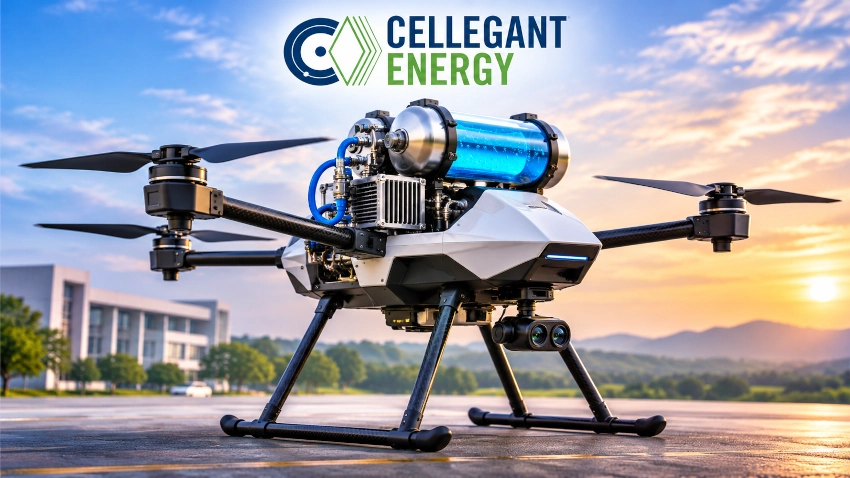
Indian deep-tech startup Cellegant Energy Systems has secured ₹2.61 crore in funding to accelerate the development of indigenous hydrogen fuel-cell propulsion systems designed to substantially increase the flight endurance of unmanned aerial vehicles (UAVs). Founded by IIT Gandhinagar Professor Dr. Atul Bhargav, the company is developing advanced hybrid hydrogen-electric drivetrains that could support longer-duration drone operations across defence, surveillance, agriculture, emergency response and industrial applications.
The investment includes participation from GVFL Prarambh Fund Trust, CoCreate Aarambh and the Innovation and Incubation Entrepreneurship Centre (IIEC) at IIT Gandhinagar. The funding will support the development of integrated hydrogen-powered propulsion systems, intellectual property protection, technical recruitment and the company’s next phase of technology validation. Cellegant’s immediate objective is to demonstrate a 35-kilogram hydrogen-powered drone and advance its technology towards operationally relevant testing over the coming months.
Indigenous Hydrogen Propulsion to Address Drone Endurance Limitations
Flight endurance remains an important limitation for conventional battery-powered drones, particularly in applications requiring prolonged surveillance, infrastructure monitoring or extended operations over large geographical areas. While lithium-ion batteries offer efficient and relatively simple propulsion systems, their energy-storage capacity and associated weight can restrict the time an unmanned aircraft remains airborne before returning for recharging.
Cellegant Energy Systems is addressing this challenge through hydrogen fuel-cell electric propulsion, which generates electricity through an electrochemical reaction between hydrogen and oxygen. Unlike conventional batteries, which store electrical energy internally, fuel cells continuously generate electricity as long as an adequate hydrogen supply is available. This provides an alternative approach to powering unmanned aircraft, with the potential for improved endurance and reduced operational downtime.
The company’s technology integrates hydrogen fuel cells with batteries through a hybrid power-management architecture. This arrangement allows the propulsion system to combine the sustained electrical output of fuel cells with the ability of batteries to respond to sudden changes in power demand. Such integration is particularly important for drones, which may require increased power during take-off, manoeuvring and changes in flight conditions.
According to Cellegant’s published technical information, its hydrogen-powered UAV systems are being developed to provide substantially longer flight durations than comparable battery-powered platforms. The company identifies endurance improvements of approximately three times as a potential advantage of its technology, alongside faster refuelling and reduced downtime between missions.
Startup Targets 35-Kilogram Hydrogen-Powered Drone Demonstration
A central objective of the newly funded development programme is the demonstration of a hydrogen-powered drone weighing approximately 35 kilograms. The project will integrate the company’s fuel-cell propulsion technology with the electrical, mechanical and flight-control systems required for a functional unmanned aircraft.
Cellegant intends to advance the programme from Technology Readiness Level 3 to Technology Readiness Level 6 over the next six to twelve months. This progression would move the technology from experimental proof-of-concept validation towards the demonstration of a prototype in a relevant operating environment.
The startup has already demonstrated hydrogen fuel-cell systems for UAV applications and developed a customised drone platform intended for long-endurance power systems. Its CH-35 hydrogen-powered drone was also showcased at AeroDef India 2026, demonstrating the company’s progress in translating research into an integrated unmanned aircraft platform.
The proposed development phase will focus on improving system reliability, validating propulsion performance and strengthening the engineering required for operation beyond controlled laboratory conditions. These activities are essential for converting fuel-cell research into propulsion products suitable for practical aerospace applications.
Advanced Hydrogen Storage Technology Forms Core of Innovation
One of the important aspects of Cellegant’s research is its effort to improve how hydrogen is stored and supplied to fuel-cell systems. Conventional compressed-hydrogen storage requires specialised pressure vessels that add weight to an aircraft, potentially reducing the endurance advantages offered by hydrogen propulsion.
The company is developing alternative approaches involving solid-state chemical hydrogen storage, alongside technologies for hydrogen recirculation and hybrid energy management. These systems are intended to improve the amount of usable energy available relative to the weight of the complete propulsion assembly.
One approach under investigation uses solid chemical materials that release hydrogen when combined with water. By reducing dependence on conventional high-pressure storage cylinders, this method could improve the energy-storage characteristics of future UAV propulsion systems.
In an earlier interview published by IIT Gandhinagar, Dr. Bhargav explained that conventional compressed-hydrogen systems could provide approximately two-and-a-half times the endurance of comparable battery-powered platforms. He also indicated that more advanced powder-based hydrogen storage could potentially increase endurance to five or six times that of battery-powered drones, subject to successful technical development.
Cellegant’s work therefore extends beyond fuel-cell manufacturing into the broader engineering challenge of integrating hydrogen generation, storage, electrical conversion and propulsion into compact, lightweight systems.
Defence, Surveillance and Emergency Response Applications
Hydrogen-powered drones could provide important operational advantages in applications requiring extended flight durations. For defence and border-security agencies, longer-endurance unmanned aircraft can support sustained surveillance, monitoring of remote areas and reconnaissance operations where frequent battery replacement or recharging may be impractical.
The technology is also relevant to emergency response, particularly during natural disasters, search-and-rescue missions and infrastructure inspections. Drones capable of remaining airborne for longer periods can potentially cover larger areas and reduce interruptions during time-sensitive operations.
Agricultural applications represent another potential market, with longer-endurance UAVs offering opportunities for crop monitoring, mapping and precision agricultural services. Industrial operators could similarly use hydrogen-powered drones to inspect transmission corridors, pipelines, large facilities and other infrastructure spread across extensive geographical areas.
Cellegant is also investigating applications beyond aerial platforms, including autonomous ground vehicles, quadruped robots, underwater systems, marine vessels and stationary power installations. The company’s research has included methanol-based fuel-cell technologies and fuel-reforming systems relevant to specialised industrial and maritime applications.
These developments illustrate the potential for hydrogen-electric propulsion technology to serve as a common energy platform across several categories of autonomous and remotely operated systems.
IIT Gandhinagar Research Supports Indigenous Deep-Tech Development
Cellegant Energy Systems emerged from research conducted at IIT Gandhinagar, where Dr. Atul Bhargav and his collaborators investigated the practical engineering challenges associated with hydrogen fuel-cell technologies. The company’s origins reflect the growing role of Indian academic institutions in translating scientific research into commercially relevant products.
Dr. Bhargav previously worked on fuel-cell product development at Ballard Power Systems, gaining experience in the engineering and commercialisation of hydrogen technologies. His research at IIT Gandhinagar subsequently explored opportunities to develop complete fuel-cell systems suitable for Indian industrial and technological requirements.
The startup initially examined stationary power applications before shifting greater attention towards UAV propulsion in response to growing demand for longer-endurance unmanned aircraft. Since 2023, the company has concentrated heavily on developing hydrogen-based energy systems for drones.
The programme draws upon expertise from mechanical engineering, electrical engineering, chemical engineering and advanced energy systems. This interdisciplinary approach is necessary because the successful development of a hydrogen-powered UAV requires the coordination of multiple subsystems rather than the production of a fuel cell alone.
The startup has also received earlier support through research and innovation programmes, including NIDHI PRAYAS and the Government of Gujarat. Its latest investment provides additional resources to strengthen the transition from research-stage technologies towards integrated engineering products.
GVFL Investment Supports Development of Indigenous Energy Technologies
GVFL’s participation reflects growing investor interest in research-led Indian startups developing specialised technologies with potential applications across strategic and commercial sectors. The investment focuses on Cellegant’s ability to address a practical technological challenge: extending the operating duration of autonomous systems while reducing dependence on conventional batteries and imported propulsion technologies.
Mihir Joshi, Managing Director of GVFL, highlighted the importance of developing engineering solutions capable of addressing real-world operational requirements. He identified longer-duration power systems for unmanned platforms as an area where indigenous technological capabilities could contribute to both commercial and strategic applications.
The ₹2.61 crore investment will support further engineering development, intellectual property protection and expansion of Cellegant’s technical team. These activities will help the company strengthen its propulsion technologies and progress towards the demonstration of its 35-kilogram hydrogen-powered UAV.
The funding also reflects the wider importance of India’s emerging deep-tech investment ecosystem, particularly for startups developing hardware-intensive technologies that require extensive research, prototyping and validation before reaching commercial deployment.
Hydrogen-Powered Drones Strengthen India’s Indigenous Technology Ecosystem
Cellegant’s development programme represents an important contribution to India’s growing capabilities in advanced unmanned systems and alternative propulsion technologies. By combining hydrogen fuel cells, specialised storage systems and hybrid electrical engineering, the startup is working towards a domestic technology platform capable of supporting applications across aviation, defence, industrial automation and renewable energy.
The project also complements India’s broader efforts to promote hydrogen technology and establish domestic capabilities in advanced energy systems. While much of the country’s hydrogen development has concentrated on industrial decarbonisation and large-scale energy applications, specialised fuel-cell systems for UAVs and autonomous equipment represent another area of technological opportunity.
The successful development of lightweight hydrogen propulsion could expand the operational possibilities of Indian-manufactured drones, particularly where endurance, payload capacity and rapid turnaround are important considerations. It could also create opportunities for domestic suppliers of fuel-cell components, power electronics, hydrogen-storage materials and specialised aerospace equipment.
With fresh investment and a defined technology-development programme, Cellegant Energy Systems is advancing the translation of IIT Gandhinagar’s research into indigenous propulsion products. Its work highlights the growing contribution of Indian deep-tech startups to advanced engineering and the development of technologies intended to strengthen the country’s capabilities in unmanned aviation, autonomous mobility and strategic energy systems.
You may also like
-
Indian Fintech Startup Decentro Launches Advanced UPI Soundboxes with Dynamic QR and Contactless Payment Capabilities
-
OneStack Enables Indian Cooperative Banks to Access UPI Network Directly Through Indigenous Banking Technology
-
IIT Bombay-Incubated Peppermint Robotics Raises ₹100 Crore to Expand Indigenous Robot Manufacturing and Global Operations
-
HAL Initiates Raw Material Procurement for Indigenous LCA Mk2 Fighter Aircraft Programme
-
NALCO Advances ₹30,000 Crore Aluminium Smelter Expansion in Odisha, Targets One Million Tonnes of Annual Capacity
