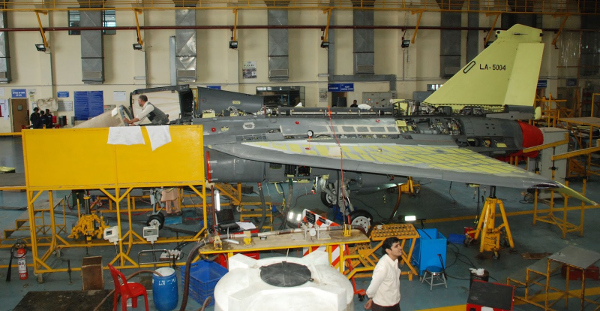
Hindustan Aeronautics Limited has imposed penalties on GE Aerospace after prolonged delays in the supply of F404-IN20 engines, the powerplant required for India’s LCA Tejas Mk-1A fighters. The delay has become the single biggest bottleneck in the Mk-1A programme, even as HAL says multiple aircraft are already built and ready in substantial form for delivery. According to recent reporting, HAL has received only a small fraction of the engines originally expected by now, forcing a mismatch between airframe production and actual induction into Indian Air Force service.
The issue is strategically significant because the Tejas Mk-1A is supposed to be the Indian Air Force’s near-term answer to falling fighter squadron strength. The IAF signed the major contract for 83 Tejas Mk-1A fighters in 2021, with first deliveries originally expected much earlier. But engine supply disruptions from GE pushed the schedule repeatedly to the right. HAL had already said in February that five Tejas Mk-1A aircraft were fully ready for delivery, with additional aircraft built and flown earlier, but without engines arriving on time the programme could not move at the intended pace.
What has changed now is HAL’s response. Instead of treating the delay as a generic supply-chain inconvenience, the company has begun imposing liquidated damages or penalty clauses on GE for each delayed engine, according to multiple reports. That signals a harder contractual line from the Indian side and reflects growing frustration within the defence establishment over slippages in a programme that is central to both IAF force regeneration and the wider Aatmanirbhar Bharat aerospace narrative.
Recent reporting suggests that GE delivered only six F404 engines to HAL in the last fiscal year, short of revised expectations. Moneycontrol reported that GE has now promised 20 engines by the end of 2026, with the sixth engine expected by month-end in that reporting cycle, though even that revised timeline remains far behind the original programme assumptions. The result is that HAL’s production capacity and assembly readiness have not translated into timely squadron induction, because completed aircraft cannot enter service at scale without the engines that make them operational.
Separate from the Mk-1A engine shortfall, HAL has indicated that the issue that grounded part of the Tejas fleet related to a brake system problem has been resolved, and some media reports say the IAF is expected to clear those aircraft to return to the skies shortly. That means the immediate airworthiness issue and the long-term induction delay are not the same problem. One is a fleet-specific technical rectification; the other is a production-and-supply-chain choke point tied to imported engines.
The deeper lesson is uncomfortable but important. India has made real progress in building an indigenous fighter ecosystem around Tejas, integrating radar, avionics, weapons and mission systems domestically or through adapted supply partnerships. But the programme still depends critically on imported propulsion. That dependence turns the engine into the pacing item for the entire fighter line. Even if HAL can assemble airframes at a rate of up to 24 aircraft annually, that capacity means little unless the propulsion pipeline is predictable.
This is also why the GE story extends beyond the Mk-1A. HAL and GE are simultaneously engaged in discussions related to the more powerful F414 engine for the future LCA Mk2 programme. So the current dispute over F404 delays sits alongside a larger strategic relationship that India does not want to rupture entirely. In effect, New Delhi and HAL are trying to do two things at once: penalise failure on the current contract while preserving a pathway for deeper engine cooperation on future platforms.
For the Indian Air Force, the cost of delay is measured in combat mass and time. The Tejas Mk-1A is a key bridge between legacy fleet retirement and the arrival of more advanced future aircraft. Every delay keeps pressure on squadron numbers and slows the replacement cycle for older fighters.
HAL appears confident that aircraft production can move quickly once engines arrive in numbers. Until then, the programme remains caught in an awkward state.
Reference:
https://www.business-standard.com/external-affairs-defence-security/news/hal-penalises-ge-aerospace-as-engine-delays-stall-tejas-mk-1a-deliveries-126040300271_1.html
https://economictimes.indiatimes.com/news/defence/hal-imposes-penalties-on-ge-for-f404-delays/articleshow/129988036.cms
https://www.livemint.com/news/india/tejas-mk-1a-engine-delivery-delay-hal-imposes-delay-on-ge-aerospace-chairman-says-jets-to-return-to-skies-next-week-11775186262696.html
https://www.moneycontrol.com/news/india/ge-promises-twenty-f404-engines-by-year-end-hal-to-receive-6th-engine-by-month-end-13878563.html
https://theprint.in/defence/ge-delivers-sixth-f404-engine-for-tejas-mk1a-to-hal-cites-war-in-gulf-for-delay/2894360/
https://www.newsonair.gov.in/hal-clarifies-delay-in-lca-tejas-mark-1a-delivery-cites-awaited-ge-engines/
https://timesofindia.indiatimes.com/defence/news/lca-mark-1a-what-is-holding-up-deliveries-and-how-the-tejas-upgrade-fits-into-iaf-plans-explained/articleshow/127915237.cms
https://www.indiatoday.in/india/story/after-air-chief-raps-delays-hal-to-hand-over-tejas-mk-1a-by-june-end-sources-2734929-2025-06-03
You may also like
-
Exercise Tarang Shakti 2026 Concludes in Jodhpur, Showcasing India’s Air Power, Indigenous Defence Technology
-
Indian Navy Vice Chief Inspects Japan’s Mogami-Class Stealth Frigate as India-Japan Shipbuilding Cooperation Expands
-
Philippine Marine Wargames Reportedly Show BrahMos Can Penetrate Chinese Destroyer Air Defences
-
Safran Signs 18 Agreements with Indian Aerospace Suppliers, Expanding Make in India Manufacturing Partnerships
-
Indian Army’s Vajra Corps Certifies First Batch of Drone Operators, Strengthens Battlefield Surveillance
