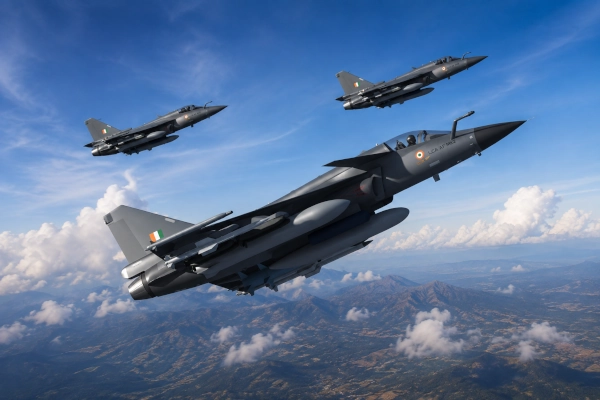
India’s Tejas Mk2 programme has gained another layer of indigenous technology, with Hindustan Aeronautics Limited developing optical fuel-level sensing and RS422-based data-acquisition systems for the Medium Weight Fighter. The technologies are designed to improve fuel-system monitoring, collect critical electrical-system parameters and strengthen the aircraft’s onboard health-monitoring and maintenance capabilities.
The developments were disclosed in HAL’s latest annual report, which identifies them among technologies designed and developed from the ground up for the LCA Mk2 platform. While neither system attracts the attention normally associated with radar, electronic warfare or weapons, they represent the kind of underlying aircraft technology that determines reliability, safety, maintainability and operational availability over a fighter’s service life.
HAL’s work is particularly significant because the company is moving beyond manufacturing the airframe and integrating externally supplied equipment. It is increasingly developing the individual sensors, electronic units, control systems and data interfaces that allow an advanced combat aircraft to understand its own condition and communicate that information to the pilot and maintenance system.
Optical Technology for Tejas Mk2 Fuel Tanks
One of the newly disclosed developments is an Optical Level Sensing system for the Tejas Mk2’s fuel tanks.
HAL states that the technology has been developed to provide low-level and high-level fuel warning indications with improved accuracy, replacing the capacitance-based sensing approach previously used for these particular functions.
The distinction is important. The new optical technology should not simply be described as replacing the aircraft’s entire fuel-quantity gauging architecture. HAL’s disclosure specifically identifies it as a technology for detecting predetermined high and low fuel levels inside the tanks.
HAL’s own aerospace technology documentation provides further detail. The Fuel Tank Low Level and High Level Switches developed for the LCA Mk2 are solid-state devices based on optical liquid-level sensors installed inside the aircraft’s fuel tanks. Their outputs provide discrete high-or-low signals to an aircraft controller.
Those signals can then be used for important fuel-management functions, including determining when fuel-transfer pumps should start or stop, declaring a tank full or empty and generating a reserve-fuel warning when fuel in the supply tank falls below a predetermined level.
This makes the apparently simple sensor an integral part of the aircraft’s wider fuel-management architecture.
Why Optical Fuel-Level Detection Matters
Fuel management is a critical function aboard a combat aircraft. Fuel is distributed between multiple fuselage and wing tanks, and the aircraft must continuously manage how it is consumed and transferred as the mission progresses.
A fighter cannot treat fuel merely as a quantity available for propulsion. The location and movement of fuel can affect the aircraft’s centre of gravity, endurance calculations, reserve margins and the sequence in which tanks are emptied.
Accurate detection of predetermined fuel levels therefore provides the aircraft’s control systems with essential information needed to manage transfer pumps and alert the pilot when critical thresholds are reached.
Optical liquid-level sensors work by using changes in the behaviour of light at the sensor interface to determine whether the sensing element is surrounded by fuel or exposed to air. This allows the system to generate a clear indication when the liquid reaches or falls below a specific physical level.
For a military aircraft, such a solid-state approach can offer advantages because it avoids mechanically moving sensing elements and can be designed for the vibration, temperature changes and demanding operating environment found inside a fighter.
HAL specifically states that its optical technology has been introduced to improve accuracy compared with the existing capacitance-based sensing used for these level-warning functions.
Part of a Broader Indigenous Fuel-Gauging Architecture
The optical switches are only one element of HAL’s work on the Tejas Mk2 fuel system.
Earlier HAL technical documentation shows that the company has also worked on Fuel Content Gauging probes for the Mk2, comprising multiple probe types installed at different locations in fuselage and wing tanks. These use a combination of capacitance-based and optical sensing technologies to monitor fuel.
This creates an important distinction between continuous fuel-quantity measurement and discrete level detection.
Capacitance-based probes can be used to determine the quantity of fuel present over a range, while optical switches can provide highly defined indications when fuel crosses particular high or low thresholds. Combining the two approaches allows the aircraft to maintain detailed fuel information while retaining dedicated sensors for critical events such as low-fuel conditions and fuel-transfer sequencing.
HAL documentation also indicates that a set of six optical Low Level and High Level switches had already completed testing and been supplied for LCA Mk2 flight-trial requirements.
The latest annual-report disclosure therefore reflects a development programme that has progressed through design, testing and integration work rather than merely a conceptual proposal.
HAL Develops RS422 Data Acquisition for Electrical Systems
The second major technology disclosed by HAL concerns the way the Tejas Mk2 collects information about the condition of its electrical system.
HAL has introduced Data Acquisition technology into the aircraft’s electrical Line Replaceable Units, specifically its AC and DC Power Management Units.
According to the company, the system gathers parameters including contactor status, AC and DC source input current, essential-bus voltage and electrical frequency. This information is transmitted over an RS422 communication line for health monitoring and recording.
This essentially gives the fighter an improved ability to observe what its electrical power-distribution system is doing while the aircraft is operating.
Instead of maintenance crews having to rely solely on a fault becoming obvious after a component fails, operating parameters can be recorded and examined to identify abnormalities, intermittent problems or gradual deterioration.
Understanding the Importance of RS422
RS422 is a digital serial communication standard widely suited to environments where reliable data transfer is required despite electrical noise.
Aircraft contain powerful electrical equipment, radios, radar systems, actuators, computers and other electronics operating within a confined structure. Data networks therefore have to function reliably in an electromagnetically demanding environment.
RS422 uses differential signalling, in which information is represented through the voltage difference between paired conductors. This provides strong resistance to common electrical interference and makes the interface useful for transmitting data between electronic systems.
For the Tejas Mk2, HAL is using the RS422 link to transmit diagnostic and operational parameters from the electrical LRUs for recording and health monitoring.
The technology itself is an established communication standard; the important indigenous achievement is HAL’s development and integration of the aircraft-specific data-acquisition architecture, electronics and monitoring functions around it.
Monitoring the Fighter Rather Than the Pilot
This aircraft health-monitoring technology is distinct from systems developed in India for monitoring the physiological condition of fighter aircrew.
The Tejas Mk2 development concerns the health of aircraft equipment. It records parameters from electrical systems so that the condition and behaviour of components can be assessed.
Aircrew physiological monitoring, by contrast, measures the condition of the human pilot through parameters such as oxygen saturation, heart activity, respiration and other biomedical indicators.
Both technologies ultimately contribute to flight safety, but they address entirely different problems: one watches the machine, while the other watches the person flying it.
Electrical Health Monitoring Can Improve Maintenance
Modern military aviation increasingly depends upon condition-based and predictive maintenance rather than relying exclusively on fixed servicing intervals.
Aircraft systems generate enormous quantities of operating information. When that information is recorded systematically, engineers can compare parameters over time and identify patterns associated with degradation.
For example, changes in voltage, current or frequency may help reveal abnormal behaviour within an electrical subsystem. A changing parameter does not necessarily mean that a component is about to fail, but sufficiently detailed historical data can give maintenance engineers much greater insight into the condition of an aircraft than a simple functioning-or-failed indication.
This has important consequences for combat availability.
Unscheduled faults can remove an aircraft from operations at short notice while technicians diagnose the problem. Better health-monitoring data can reduce the time needed to locate faults and, as systems mature, potentially allow components to be replaced before they cause an operational failure.
For a fighter fleet, this contributes directly to serviceability, sortie generation and lifecycle support.
Line Replaceable Units Are Central to Fighter Maintainability
HAL specifically refers to the AC and DC Power Management Units as Line Replaceable Units, or LRUs.
Modern aircraft are divided into modular electronic and mechanical assemblies that can be removed and replaced relatively quickly when faults occur. Instead of attempting extensive component-level repairs while the aircraft remains on the flight line, technicians can replace the affected LRU and return the aircraft to service while the defective module is repaired separately.
But this approach works most effectively when the aircraft can accurately identify which unit is malfunctioning.
By collecting operational parameters directly from electrical LRUs and feeding them into the health-monitoring and recording system, the Tejas Mk2 can provide maintenance personnel with better diagnostic information.
The result is not merely a more sophisticated aircraft in flight. It can also become an aircraft that is easier to troubleshoot on the ground.
Indigenous Subsystems Matter Beyond Their Individual Size
Fuel sensors and data-acquisition electronics may appear comparatively minor beside the Tejas Mk2’s engine, AESA radar or weapon systems, but indigenous development of such subsystems has significant strategic value.
A modern fighter contains thousands of individual components and multiple layers of electronics, sensors, software and control systems. An aircraft cannot achieve high indigenous content merely by producing its wings, fuselage and landing gear domestically while remaining dependent on imported equipment throughout its internal systems.
True aerospace sovereignty depends upon progressively mastering those lower-level technologies as well.
Every domestically designed sensor or electronic unit reduces one area where India must depend on a foreign supplier for spares, technical documentation, redesigns, obsolescence management or future upgrades.
This becomes particularly important because combat aircraft remain in service for several decades.
During such a long lifecycle, electronic components become obsolete, suppliers discontinue products and mission requirements change. Owning the design knowledge allows HAL and other Indian organisations to modify systems without repeatedly returning to an overseas original equipment manufacturer.
HAL Expanding Its Design Role in Tejas Mk2
The fuel-sensing and data-acquisition technologies are part of a much broader indigenous subsystem effort for the Medium Weight Fighter.
HAL’s technology-development work associated with the aircraft includes fuel-system components and other avionics and aircraft systems, while the wider Tejas Mk2 programme brings together the Aeronautical Development Agency, HAL, DRDO laboratories, Indian industry and numerous public and private suppliers.
HAL’s latest annual report explicitly describes the new systems as ab-initio designed and developed technologies for the LCA Mk2 platform, highlighting that the work involves original engineering rather than only licensed production.
That distinction is important for India’s future combat-aircraft programmes because engineers who design these systems for Tejas Mk2 can carry the accumulated knowledge into subsequent aircraft and subsystem developments.
Tejas Mk2 Prototype Assembly Is Progressing
The Tejas Mk2 is being developed as a larger and more capable evolution of the Tejas family for the Indian Air Force.
Structural integration of the first prototype is currently underway. HAL’s latest publicly reported programme timeline places the first flight in a window between March and July 2027, following completion of assembly, system integration and the necessary ground and taxi testing.
The aircraft will use the GE F414-GE-INS6 turbofan, a considerably more powerful engine than the F404 family used by the earlier Tejas variants. GE originally selected the INS6 configuration for India’s Mk2 programme, with the engine incorporating Full Authority Digital Electronic Control and features tailored to the Indian requirement.
The Mk2 is intended to occupy the medium-weight category above the Tejas Mk1A and provide the Indian Air Force with a modern multirole platform as older fighter fleets are progressively retired.
Small Technologies Build a Sovereign Fighter Ecosystem
The significance of HAL’s latest development therefore lies less in the size of the individual hardware and more in the engineering capability it represents.
The optical level-sensing system gives the Tejas Mk2 an indigenous means of accurately detecting critical fuel-level conditions, supporting fuel-transfer management and reserve warnings.
The RS422 data-acquisition system gives the aircraft an indigenous means of collecting electrical-system parameters from AC and DC Power Management Units and transmitting them for onboard health monitoring and recording.
One helps the fighter understand the state of its fuel system. The other helps it understand the condition of important parts of its electrical system.
Together, they demonstrate the gradual movement of India’s combat-aircraft programme from indigenous airframe production towards indigenous control over the intricate subsystems hidden inside the aircraft.
Radars, missiles and engines understandably dominate discussion of fighter capability, but operational aircraft depend just as heavily on fuel switches, power-management units, sensors, data buses, control electronics and diagnostic systems working reliably on every sortie.
For Tejas Mk2, developing these technologies domestically means India is not simply building more of the aircraft itself. It is progressively acquiring the design knowledge required to understand, maintain and improve the fighter throughout its operational life.
That capability may ultimately prove as important to India’s aerospace self-reliance as the individual sensors themselves.
You may also like
-
Exercise Tarang Shakti 2026 Concludes in Jodhpur, Showcasing India’s Air Power, Indigenous Defence Technology
-
Indian Navy Vice Chief Inspects Japan’s Mogami-Class Stealth Frigate as India-Japan Shipbuilding Cooperation Expands
-
India and Russia Explore Joint Icebreaker Construction as Maritime Industrial Cooperation Expands
-
Philippine Marine Wargames Reportedly Show BrahMos Can Penetrate Chinese Destroyer Air Defences
-
Safran Signs 18 Agreements with Indian Aerospace Suppliers, Expanding Make in India Manufacturing Partnerships
