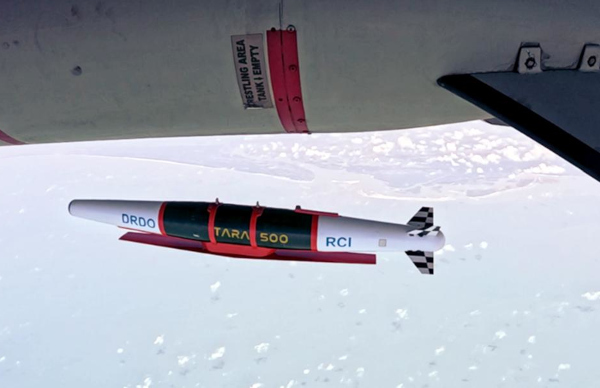
India has taken another important step in indigenous precision-strike capability with the successful maiden flight trial of the Tactical Advanced Range Augmentation weapon, better known as TARA. The flight trial was conducted jointly by the Defence Research and Development Organisation and the Indian Air Force off the coast of Odisha on May 7, 2026. The Ministry of Defence announced the success on May 8, calling TARA India’s first indigenous glide weapon system designed to convert unguided warheads into precision-guided weapons.
TARA is a modular range-extension kit, meaning it can be fitted to existing unguided warheads to improve their accuracy and effectiveness. In simple terms, it gives a conventional weapon a guided glide capability, allowing it to hit ground-based targets with far greater precision than a standard free-fall bomb. This is significant because it allows the armed forces to upgrade existing low-cost warheads into smarter, more accurate strike weapons without depending entirely on expensive imported precision munitions.
The weapon system has been designed and developed by Research Centre Imarat, Hyderabad, along with other DRDO laboratories. RCI is one of DRDO’s key laboratories working on advanced missile, guidance and avionics technologies. According to the Ministry of Defence, TARA has been developed to enhance the lethality and accuracy of a low-cost weapon for neutralising ground-based targets.
One of the most important aspects of the programme is its indigenous industrial base. The development of the TARA kit has been carried out with Development-cum-Production Partners and other Indian industries. The Ministry has also stated that production activity has already started, indicating that the project has moved beyond a purely experimental stage and is entering the production ecosystem.
The successful test gives the Indian Air Force a major tactical advantage. Modern air warfare increasingly depends on precision, stand-off capability and cost-effective strike options. A glide kit like TARA can help aircraft release weapons from a safer distance while improving the chances of accurately striking enemy positions, ammunition dumps, command posts, radar sites or other ground targets.
The key benefit of such a system is that it converts older “dumb” warheads into smarter weapons. This approach is widely used by advanced air forces because it allows large existing inventories of unguided bombs to be upgraded into precision weapons. For India, developing this capability indigenously reduces dependence on foreign-origin guided bomb kits and strengthens the domestic defence technology base.
TARA also fits into India’s larger push for self-reliance in critical defence systems. Over the past decade, India has been increasing investment in indigenous missiles, precision-guided weapons, electronic warfare systems, radars, anti-drone technologies and air-launched strike systems. The successful test of TARA adds another layer to this expanding ecosystem of home-grown combat technologies.
Defence Minister Rajnath Singh congratulated DRDO, the Indian Air Force, Development-cum-Production Partners and industry for the maiden flight trial. He described the achievement as a significant development in advancing India’s indigenous defence capabilities. DRDO Chairman Dr. Samir V Kamat also congratulated the teams associated with the successful trial.
The strategic value of TARA lies not merely in one successful test, but in what it represents for India’s future airpower. Precision-guided munitions are expensive, and sustained operations require large inventories. A low-cost indigenous glide kit can give the Indian Air Force a more affordable way to build precision-strike depth across multiple aircraft platforms.
The successful maiden flight trial also shows the growing role of Indian industry in advanced weapon development. By involving production partners early, DRDO is trying to reduce the gap between design, testing and manufacturing. This approach is essential if India wants to move from one-off technology demonstrations to large-scale operational induction.
TARA’s development is therefore an important milestone in India’s defence modernisation journey. It strengthens the IAF’s precision-attack options, improves the value of existing weapon stocks, supports Indian industry and contributes to the broader Atmanirbhar Bharat vision in defence. With production activity already underway, the system could become an important addition to India’s future air-launched strike arsenal.
Sources:
https://www.pib.gov.in/PressReleasePage.aspx?PRID=2258934®=3&lang=1
https://www.newsonair.gov.in/drdo-indian-air-force-conduct-maiden-flight-trial-of-tara-weapon-off-coast-of-odisha/
https://timesofindia.indiatimes.com/defence/news/india-is-making-its-dumb-bombs-smart-what-drdos-tara-glide-kit-means-for-the-iaf/articleshow/130952855.cms
You may also like
-
PRAHAAR: India’s First National Counter-Terrorism Policy and Strategy
-
Takshak Heavyweight Torpedo: How India’s Indigenous Submarine Weapon Compares With the World’s Leading Torpedoes
-
Embraer Builds Dual Aerospace Strategy in India Through C-390 Military and E175 Regional Aircraft Programmes
-
NextLeap Tests Indigenous Jet Engine for Long-Range Stryker Kamikaze UAV
-
Côte d’Ivoire Military Delegation Visits HAL, Shows Interest in India’s Indigenous Aerospace Platforms
