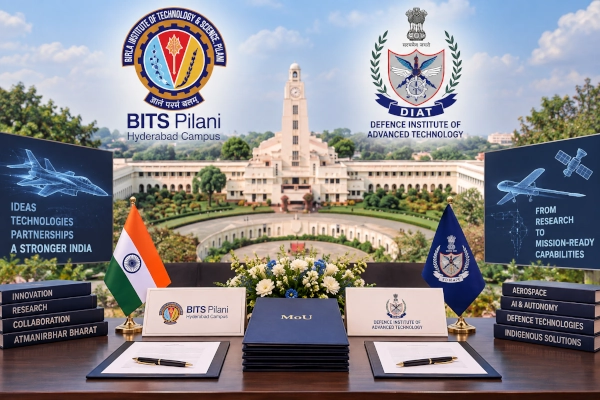
India’s defence research ecosystem has taken another step towards connecting laboratory innovation with industrial production, with BITS Pilani and the Defence Institute of Advanced Technology (DIAT), Pune, signing 20 Memoranda of Understanding with defence and aerospace industry partners.
The agreements were exchanged during Defence & Aerospace Industry Day 2026, held at the BITS Pilani Hyderabad campus on 22 September 2026. The programme also showcased 48 indigenous defence and aerospace technologies, creating a platform for researchers and manufacturers to identify technologies that could be developed into operational systems.
20 Agreements Connect Research With Industry
Of the 20 MoUs announced during the programme, 19 were signed with BITS Pilani and one with DIAT. The agreements are intended to support collaborative research, technology development, technology transfer and commercialisation.
The initiative is designed to address an important stage in defence technology development: moving promising research beyond laboratories and prototypes into engineering development, testing and eventual production.
By involving manufacturers at an earlier stage, researchers can incorporate practical considerations such as manufacturability, cost, supply chains, certification and scalability into the development process.
48 Indigenous Defence Technologies Showcased
BITS Pilani and DIAT jointly presented 48 indigenous technology capabilities to participating companies and strategic-sector organisations.
The technologies covered areas including artificial intelligence, autonomous systems, advanced materials, electronics, sensors and aerospace engineering. These are increasingly important fields as modern military platforms become more dependent on software, automation, sophisticated electronics and advanced materials.
The technology showcase gave participating companies an opportunity to examine research that could potentially be developed further through joint programmes, technology transfers or industrial partnerships.
Major Indian Defence Companies Participate
The programme brought together established defence manufacturers as well as companies operating in India’s emerging space and deep-technology sectors.
Companies identified among the participating organisations included L&T Precision Engineering & Systems, Bharat Forge, Paras Defence, VEM Technologies, Zen Technologies, Centum Electronics, Skyroot Aerospace, Digantara Technologies, Sigma Aerospace and Abyom.
Their participation gives the initiative a broad industrial base extending from conventional defence manufacturing and electronics to space systems, autonomous technologies and advanced aerospace engineering.
DRDO, HAL and BEL Ecosystems Represented
The Defence & Aerospace Industry Day also brought together representatives from major strategic institutions and government organisations.
Participants included representatives associated with DRDO, the Department of Space, Department of Atomic Energy, Hindustan Aeronautics Limited, Bharat Electronics Limited and MIDHANI, alongside private companies, researchers and academic institutions.
The gathering therefore connected several layers of India’s strategic technology ecosystem — government laboratories, defence PSUs, universities, private manufacturers and emerging technology companies.
DIAT Brings Specialised Defence Research Expertise
DIAT occupies a distinctive position within India’s defence research network. Based in Pune, the institution operates under the Department of Defence Research and Development, Ministry of Defence, and specialises in education and research connected with defence and strategic technologies.
Its involvement strengthens the connection between university research, the broader DRDO ecosystem and companies capable of industrialising technologies.
DIAT Vice Chancellor Dr B.H.V.S. Narayana Murthy highlighted the importance of closer convergence between DRDO, academia and industry in responding to increasingly complex military requirements.
Focus on Mission-Ready Technologies
The theme of the programme — “Bridging Academia and Industry for Mission-Ready Defence and Aerospace Innovation” — reflected its emphasis on converting research into usable capabilities.
Former DRDO Chairman and National Security Advisory Board member Dr G. Satheesh Reddy participated in the programme and highlighted the potential for institutions such as BITS Pilani and DIAT to contribute to translational defence research.
BITS Pilani Vice Chancellor Prof. V. Ramgopal Rao also emphasised the importance of converting research capabilities into deployable technologies through sustained interaction between academia and industry.
Discussions during the event called for stronger industry participation, collaborative research laboratories, skill-development programmes and time-bound implementation of the newly signed agreements.
Building a Faster Route From Laboratory to Production
India already possesses a substantial network of DRDO laboratories, universities, IITs, specialised institutions, defence startups and established manufacturers. The challenge is increasingly to connect these organisations through development pathways capable of taking a technology from laboratory research to prototype, trials, certification and serial production.
The new partnerships provide an opportunity for industry to participate earlier in this process. Manufacturers can contribute expertise in production engineering, supply-chain development, quality control and scaling while academic institutions concentrate on research and technology development.
Such collaboration becomes particularly important for technologies such as artificial intelligence, autonomous platforms, sensors and advanced materials, where development cycles can be significantly shorter than those associated with traditional military platforms.
Private Industry Becomes a Larger Part of Defence Innovation
The Hyderabad initiative also reflects the changing structure of India’s defence-industrial ecosystem.
Defence PSUs and DRDO laboratories increasingly operate alongside private manufacturers, startups and academic institutions. Companies specialising in electronics, artificial intelligence, space technologies, robotics and advanced materials are becoming part of a broader national defence innovation network.
The participation of companies ranging from Bharat Forge and L&T to Skyroot Aerospace and Digantara illustrates this widening industrial base.
Rather than concentrating defence innovation within a small group of government organisations, the emerging model allows specialised capabilities from across India’s technology sector to contribute to strategic programmes.
From MoUs to Deployable Indigenous Systems
The significance of the 20 agreements and 48 showcased technologies will ultimately depend on how successfully they progress beyond the initial collaboration stage.
The next steps will involve identifying suitable technologies, defining joint development programmes, building prototypes, undertaking testing and qualification and establishing manufacturing arrangements where appropriate.
Successful projects could eventually lead to technology transfers, field-tested systems and commercial production by Indian companies.
The Defence & Aerospace Industry Day therefore represents an effort to create a more direct bridge between Indian research laboratories and Indian manufacturing capability, with the larger objective of accelerating the development of mission-ready indigenous defence and aerospace technologies.
References
BITS Pilani — Defence & Aerospace Industry Day 2026, Hyderabad Campus, 22 September 2026.
Defence Institute of Advanced Technology (DIAT), Pune — Defence research and industry collaboration.
You may also like
-
Cochin Shipyard and Synergy Marine Partner for Shipbuilding, Repair and Vessel Conversion in India
-
Flying Wedge’s Indigenous Kaala Bhairav Lite Completes 100 Hours of Flight Testing
-
USAF F-35A Stealth Fighters to Exercise With Indian Air Force for First Time at Tarang Shakti 2026
-
Tripathi Aerotech Secures Multi-Billion-Dollar 155mm ERFB-BB Ammunition Contract From Western Nation
-
RFLY Innovations Delivers Indigenous RFLY-PRO High-Altitude Surveillance UAVs to Indian Army
