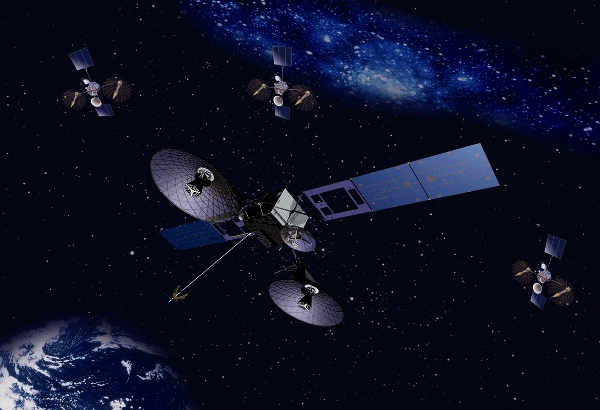
India’s Defence Space Agency, or DSA, is the country’s principal tri-service military organisation for operational space functions, created as part of a broader push toward jointness in the armed forces and formally operationalised under Headquarters Integrated Defence Staff. Publicly available Indian defence literature describes the DSA as the body meant to plan, execute, control and manage tri-service space-related functions, including military communications, position-navigation-timing, and space-based intelligence, surveillance and reconnaissance. HQ IDS has also officially described the DSA as one of the joint organisations whose operationalisation marked a key milestone in India’s integration reforms.
The institutional logic behind the DSA is straightforward: modern military power is now inseparable from orbital infrastructure. Satellite networks support secure communications, beyond-line-of-sight command links, navigation, force tracking, precision targeting, meteorology, missile warning, maritime domain awareness, and real-time ISR fusion. In effect, the DSA exists because space has become a contested operational domain that shapes outcomes across land, air, sea and cyber warfare. That is also how India’s top military leadership now frames the issue. In February 2024, Chief of Defence Staff Gen Anil Chauhan said space acts as a force multiplier across land, sea, air and cyber, and called for building counter-space capabilities as a deterrent to safeguard Indian space assets.
In organisational terms, the DSA appears to be an agency rather than a full-fledged unified command. Indian defence commentary linked to HQ IDS notes that the structure had originally been envisaged as a command, but was raised “for now” as an agency. A Manohar Parrikar IDSA explainer says the earlier Integrated Space Cell was upgraded in 2019 into the Defence Space Agency and that the DSA is headed by a two-star officer. A 2024 Gazette notification under the Inter-services Organisations framework further shows the “DG Defence Space Agency” as the designated officer-in-command of the organisation, reinforcing that the agency today has a formal legal standing inside the inter-service command-and-discipline architecture.
Technically, the DSA’s mission set can be understood in four broad layers. The first is space support: ensuring assured access to satellite-enabled services such as communication, navigation and timing, weather inputs, and remote sensing data for joint operations. The second is space control: protecting friendly space systems and preparing options to deny, degrade, deceive or disrupt adversary use of space in crisis or conflict. The third is space situational awareness, meaning persistent knowledge of the orbital environment, conjunction risks, hostile interference and unusual behaviour in space. The fourth is space force integration, which means translating orbital data into battle management effects for the Army, Navy and Air Force. While the Government of India does not publicly release a detailed DSA doctrine, these mission areas are directly implied by official descriptions of the DSA’s role in communication, PNT, ISR, and “space control and management.”
India’s technical ecosystem for those missions does not sit inside the DSA alone. It rests on a larger national stack that includes ISRO, DRDO, service headquarters, HQ IDS, and increasingly private industry. ISRO’s own space situational awareness architecture is especially relevant. ISRO states that SSA involves comprehensive knowledge of the space environment, assessment of threats to space activities, and mitigation measures to safeguard space assets. Its NETRA programme includes a radar, an optical telescope facility and an SSA control centre at ISTRAC, intended to function as a hub for orbit determination, catalogue generation, close-approach analysis, conjunction alerts, collision avoidance support and re-entry prediction. ISRO’s 2024 assessment also warns that orbital congestion, especially in low Earth orbit, is intensifying sharply. For the DSA, that means military space operations are about operating reliably in an increasingly crowded and contested orbital battlespace.
The DSA also sits downstream of India’s growing counter-space knowledge base. The single most visible public milestone here was Mission Shakti in March 2019, when DRDO used a three-stage interceptor with two solid rocket boosters to destroy an Indian satellite in low Earth orbit in a hit-to-kill anti-satellite test. That event mattered less as a one-off demonstration than as proof that India had crossed the threshold from passive dependence on space to active thinking about orbital deterrence. Since then, official messaging has steadily moved toward the language of resilience, deterrence and protection of national space assets. When the CDS called for counter-space capabilities in 2024, he was effectively placing the DSA within a broader military requirement: protect India’s own orbital systems while building credible options to impose costs if those systems are threatened.
A major technical shift around the DSA is the move from a purely government-built model to a government-plus-industry model. Mission DefSpace, launched in 2022, opened 75 defence space challenges for industry, start-ups and MSMEs across five buckets: launch systems, satellite systems, communication and payload systems, ground systems, and software systems. That categorisation is revealing because it maps almost the full military space kill chain, from getting payloads into orbit to operating them, securing links, exploiting data and networking ground infrastructure. One early Mission DefSpace contract led by the DSA focused on a micropropulsion system for cubesats, meant to enable precise manoeuvring and orbit correction for small satellites used in imagery, ISR and communications. Officially, the solution was intended to feed into a cubesat swarm being developed under Mission DefSpace. That is a strong indicator that India’s defence-space thinking is moving toward proliferated small-satellite architectures rather than dependence on a handful of exquisite, high-value platforms alone.
That trend matters operationally. A proliferated LEO architecture offers higher resilience, lower replacement cost, shorter refresh cycles and better scalability for tactical ISR, maritime surveillance, communication relay and electronic intelligence support. Public information is still sparse on the precise systems the DSA is fielding or controlling, but the innovation themes now visible in Mission DefSpace suggest India is prioritising launch-on-demand logic, smallsat manoeuvrability, distributed sensing and software-defined architectures. That is consistent with how militaries worldwide are redesigning space power for contested conditions. The important caveat is that India has not publicly disclosed a detailed DSA order of battle, constellation plan or command-and-control blueprint, so any deeper architectural description beyond these official breadcrumbs would be speculative.
Another technical frontier for the DSA is cybersecurity. In February 2026, CERT-In and SIA-India released joint space cybersecurity guidelines, explicitly noting that satellite communication systems are vital to national security operations and that the framework is intended to protect satellite networks, ground infrastructure, supply chains and space assets against a rapidly evolving threat landscape. For a military space agency, this is not a peripheral issue. A satellite can be mission-killed without being physically destroyed: uplinks can be jammed, payload data spoofed, ground stations compromised, software supply chains hacked, and terminals geolocated or denied. In practical military terms, cyber hardening is now part of mission assurance, not an afterthought.
The DSA therefore represents more than a new badge on India’s defence organisation chart. It is the institutional bridge between national space infrastructure and combat power. Its importance lies in converting India’s expanding civil and strategic space base into something militarily usable, survivable and increasingly responsive under joint command logic. Yet it is still clearly an evolving organisation. Public sources show the direction of travel—tri-service integration, counter-space deterrence, smallsat innovation, SSA expansion, cyber hardening and private-sector participation—but not the full classified picture. That is typical for a sensitive military domain. Even so, enough is visible now to draw a firm conclusion: the Defence Space Agency is the core of India’s emerging military space architecture, and its long-term trajectory points toward a much more mature orbital warfighting enterprise than India had even a decade ago.
You may also like
-
Bengaluru Startup Astrome Wins Indian Army iDEX Challenge to Develop Indigenous Portable Electronic Intelligence System
-
DRDO’s Shakti Electronic Warfare System: India’s Indigenous Shield Against Radar and Missile Threats at Sea
-
DRDO Develops Generative AI Framework to Improve Military Object Recognition with Limited Training Data
-
Indian Startup Decouvertes Unveils Vision Nano 250g Drone with 25-Minute Flight Endurance
-
Exercise Tarang Shakti 2026 Concludes in Jodhpur, Showcasing India’s Air Power, Indigenous Defence Technology
