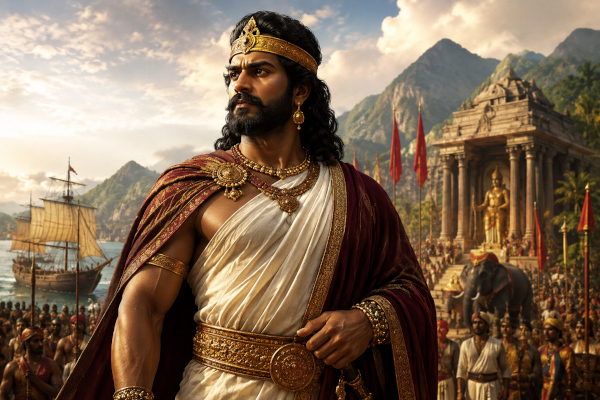
Cheran Senguttuvan, also known as Cheran Chenkuttuvan, Kadal Pirakottiya Senguttuvan, or Vel Kezhu Kuttuvan, stands among the most celebrated rulers of the early Chera line. His memory survives not merely as that of a warrior-king, but as a cultural force who connected Kerala, Tamilakam, Sri Lanka, maritime trade, Sangam poetry and the sacred Kannagi/Pattini tradition into one civilisational story. He is remembered in early Tamil literature, especially in the fifth decad of Pathitrupathu, where the poet Paranar praises him, and in the later Tamil epic Silappadikaram, where he appears as the great Chera monarch who consecrates Kannagi as the goddess Pattini. Historians generally place him around the early historic Sangam period, often near the 2nd century CE, though exact dates remain debated.
The first thing to say clearly is that Senguttuvan’s exact birth date and birthplace are not preserved in the way later royal biographies preserve them. Sangam history comes to us through poems, praise literature, epic memory and later interpretation, not through neat birth records or stone inscriptions naming the day and hour of a king’s birth. What can be said with reasonable confidence is that he was born into the ancient Chera royal house, probably connected with the Muchiri–Karur/Vanchi political world, a Chera sphere that linked the Malabar coast of present-day Kerala with the Kongu region of western Tamil Nadu. His reign belongs to the age when the Chera country was deeply tied to the Indian Ocean trade, western coastal ports, inland hill products, elephant forests and the great exchange of spices, pearls, gems and Roman or Yavana gold.
Senguttuvan’s father was the famous Chera ruler Imayavaramban Nedum Cheralathan, one of the major early Chera kings praised in Tamil literature. His mother is remembered as Chola Manakkilli, a princess from the Chola family of Uraiyur, which makes Senguttuvan politically important from birth: he was a Chera prince with a maternal link to the Chola line. This kind of royal marriage mattered deeply in ancient Tamilakam, where the Cheras, Cholas and Pandyas fought, negotiated, intermarried and competed for prestige. Senguttuvan was therefore not just a Chera heir; he was a prince whose bloodline connected two of the great crowned houses of the Tamil south.
His family circle also included notable brothers and half-brothers. Sangam tradition connects him with rulers such as Kalankayakkanni Narmudi Cheral and Adu Kottu Pattu Cheralathan. The most famous literary connection, however, is with Ilango Adigal, the traditional author of Silappadikaram. According to literary tradition, Ilango Adigal was a Chera prince who renounced royal life and became an ascetic, later composing the epic of Kannagi and Kovalan. Modern scholarship treats this tradition with some caution, because the historical identity of Ilango and the dating of the epic are debated, but culturally the association is extremely powerful: the king and the poet-prince together stand at the heart of the Kannagi story. Britannica identifies Silappathikaram as the earliest Tamil epic, traditionally written by Prince Ilanko Adikal, and notes that its third book deals with the expedition to bring Himalayan stone for an image of Kannagi.
Senguttuvan’s queen is remembered as Illanko Venmal, described in the tradition as the daughter of a Velir chieftain. His son is known in literary references as Kuttuvan Cheral, possibly connected with the Umpar Kadu region. This gives us a picture of a royal family built through alliances: Chera on the father’s side, Chola through the mother, Velir through marriage, and linked to the wider political geography of Tamilakam.
As a ruler, Senguttuvan is said to have reigned for 55 years, a remarkably long reign in early South Indian political memory. A scholarly account in Chera Kings of the Sangam Period notes this 55-year reign and describes his consecration of a Pattini temple as an event of “international significance,” especially because the Sri Lankan king Gajabahu is traditionally said to have attended the ceremony. The same account also highlights that Hindus, Jains and Buddhists lived together in his kingdom, giving Senguttuvan’s reign an image of religious coexistence and cultural plurality.
His military reputation was formidable. The Pathitrupathu tradition presents him as a king who defeated northern enemies, occupied Idumbil, won at Viyalur, destroyed Kodukur, defeated the chieftain of Mokur, and intervened in a Chola succession dispute, placing his preferred claimant on the throne. These accounts show him not as a passive coastal monarch, but as an active power-broker of Tamilakam, capable of projecting Chera influence into neighbouring regions and shaping the politics of other crowned houses.
His title Kadal Pirakottiya or Kadalottiya is especially striking. It is often interpreted in connection with maritime prowess — a king who “drove back the sea” or “left the sea behind,” a poetic way of marking his naval or coastal strength. This matters because the Chera kingdom was not only a land power. Its strength came from ports, trade routes, pepper-producing hills, inland routes to Kongu, and links with foreign merchants. The ancient Tamil world remembered the arrival of Yavana gold by sea, and Senguttuvan’s reign belongs to that larger maritime economy of Muziris/Muchiri, western coastal trade and Roman-era commercial contact.
The most famous event associated with Senguttuvan is his role in the Kannagi/Pattini tradition. In Silappadikaram, Kannagi is the chaste wife of Kovalan, who is unjustly executed in Madurai after being falsely accused of stealing the queen’s anklet. Kannagi proves his innocence, condemns the Pandya king’s injustice, and Madurai is destroyed by the force of her righteous anger. Later, the Chera king hears of her story and resolves to honour her not merely as a tragic woman, but as a goddess of chastity, justice and moral fire. The third book of the epic describes the king’s expedition to bring stone from the Himalayas for an image of Kannagi.
This is where Senguttuvan becomes larger than a battlefield ruler. According to the epic tradition, he does not simply build another royal shrine; he transforms Kannagi into Pattini, a goddess whose worship travels across regions. He is said to have brought the sacred stone, consecrated the image at Vanchi, and invited other rulers to witness the installation. The Bhagavati temple at Kodungallur in Kerala is traditionally believed by some to be connected with this Kannagi/Pattini consecration, though the historical and archaeological identification remains a matter of tradition rather than settled proof.
From the architectural point of view, Senguttuvan is not associated with surviving stone monuments in the way later Pallava, Chola or Pandya kings are. The early Chera age did not leave behind the kind of massive structural temples that dominate later South Indian history. His architectural legacy is therefore more sacred-cultural than monumentally visible. The most important structure linked to him is the Pattini/Kannagi shrine at Vanchi mentioned in the epic tradition. If we understand architecture broadly as the creation of sacred space, cult-centre and ritual institution, Senguttuvan’s contribution was immense: he gave Kannagi a royal temple, a divine image, ritual legitimacy and a place within the religious geography of the Chera land.
The Pattini consecration also had international cultural consequences. The tradition that King Gajabahu of Lanka attended the ceremony is central to what scholars call the Gajabahu synchronism, a method often used to place Senguttuvan around the 2nd century CE. The same tradition helps explain the later spread of Pattini worship in Sri Lanka, where Pattini became an important goddess in Sinhala Buddhist religious culture. The dating method is debated, but the cultural memory is powerful: Senguttuvan’s act linked Kerala/Tamilakam and Sri Lanka through a shared goddess of chastity, suffering and justice.
Another important dimension of Senguttuvan’s rule was patronage. He lived in a world where poets were not casual entertainers; they were keepers of fame, memory and political legitimacy. Paranar, one of the great Sangam poets, praised him in the fifth decad of Pathitrupathu. The survival of Senguttuvan’s name owes much to this poetic world. His court appears as one where martial prestige, gift-giving, ritual honour and literary excellence were deeply connected. A king became immortal not only by winning wars, but by being sung by the right poet in the right words.
The death of Cheran Senguttuvan is one of the areas where we must be careful. No reliable ancient source gives us a clear, dramatic account of how he died. Unlike some rulers who are remembered as dying in battle, exile or assassination, Senguttuvan’s end is not preserved with certainty. Since the tradition credits him with a long reign of 55 years, it is reasonable to imagine that he died after a long period of rule, perhaps in old age, but that remains an inference rather than a documented fact. His legacy, however, clearly continued through his family line, through the memory of Kuttuvan Cheral, through the Chera political tradition, and most powerfully through the Kannagi/Pattini cult.
Senguttuvan’s greatness lies in the unusual combination of qualities attached to him. He was a warrior who defeated enemies, a maritime ruler connected with the western sea, a political actor who influenced Chola affairs, a patron of poets, a king of a plural religious world, and a sacred builder who turned the moral anger of Kannagi into a goddess tradition. He belongs to that early South Indian world where history and poetry are intertwined so closely that every fact arrives wearing the ornaments of legend.
In Kerala’s cultural memory and Tamil literary imagination, Cheran Senguttuvan remains far more than an ancient king. He is the monarch of Vanchi who heard the story of an innocent woman wronged by royal injustice and responded not with indifference, but with consecration. That is why his name survived. Many kings won battles; Senguttuvan gave a throne to justice itself.
References:
https://www.britannica.com/topic/Silappathikaram
https://www.britannica.com/topic/Chilappatikaram
https://ia801505.us.archive.org/10/items/in.ernet.dli.2015.277483/2015.277483.1097_W_O_text.pdf
https://www.projectmadurai.org/pm_etexts/pdf/pm0404.pdf
https://www.projectmadurai.org/pm_etexts/utf8/pmuni0404.html
https://en.wikipedia.org/wiki/Chenkuttuvan
https://ta.wikipedia.org/wiki/%E0%AE%9A%E0%AF%87%E0%AE%B0%E0%AE%A9%E0%AF%8D_%E0%AE%9A%E0%AF%86%E0%AE%99%E0%AF%8D%E0%AE%95%E0%AF%81%E0%AE%9F%E0%AF%8D%E0%AE%9F%E0%AF%81%E0%AE%B5%E0%AE%A9%E0%AF%8D
https://ta.wikipedia.org/wiki/%E0%AE%AA%E0%AE%A4%E0%AE%BF%E0%AE%B1%E0%AF%8D%E0%AE%B1%E0%AF%81%E0%AE%AA%E0%AF%8D%E0%AE%AA%E0%AE%A4%E0%AF%8D%E0%AE%A4%E0%AF%81
You may also like
-
Kasmira: The Kashmir Valley and the Northwestern Himalayan World of the Mahabharata
-
Narendra Modi Completes 25 Years in Government: From Gujarat to the Mission of Viksit Bharat
-
Nepala: The Kathmandu Valley and the Central Himalayan World of the Mahabharata
-
Kirata: The Himalayan and Eastern Hill Peoples of the Mahabharata
-
Flydubai FZ1073 Attack: Captain Smit Machchhar’s Calls With Modi and Netanyahu as UAE Probe Names Terror Plot
