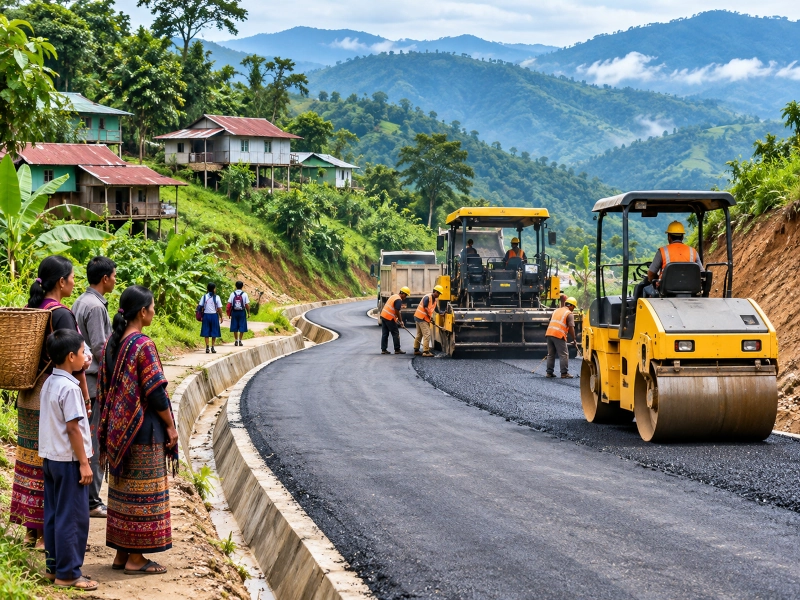
The Government of India has approved 45 rural road projects covering 509.54 kilometres in Mizoram, with a combined estimated investment of ₹710.40 crore. Sanctioned under the fourth phase of the Pradhan Mantri Gram Sadak Yojana (PMGSY-IV), the projects are intended to provide all-weather connectivity to 48 previously unconnected habitations across the northeastern state. The initiative marks another step towards improving transportation infrastructure in Mizoram’s mountainous regions, where difficult terrain, heavy seasonal rainfall and geographically dispersed settlements have historically presented substantial challenges to rural connectivity.
The Ministry of Rural Development announced the approvals on October 31 under the first batch of PMGSY-IV projects for the financial year 2026–27. The proposed roads are expected to improve access to healthcare facilities, educational institutions, agricultural markets and administrative centres while creating better opportunities for economic activity in remote communities. The new projects will also complement earlier road development initiatives sanctioned for Mizoram under the national rural connectivity programme, strengthening the state’s efforts to connect settlements that remain outside the established all-weather road network.
New Road Projects to Connect 48 Previously Unconnected Habitations
The latest approval encompasses 45 road works extending across a combined distance of 509.54 kilometres, specifically targeting 48 habitations that currently lack the required all-weather road connectivity. These settlements are located in a state where mountainous geography often makes transportation difficult, particularly during the monsoon season when heavy rainfall can affect road surfaces, slopes and drainage systems. Establishing dependable connections to the wider transportation network is therefore important for improving everyday mobility and ensuring that communities can access essential services throughout the year.
For residents of remote villages, inadequate transportation infrastructure can create difficulties that extend well beyond the inconvenience of travel. Families seeking medical treatment may need to undertake lengthy journeys to reach hospitals, while students attending schools outside their settlements can face disruptions caused by unreliable road conditions. Farmers and small businesses may also encounter higher transportation costs when moving produce and supplies between villages and commercial centres. The newly sanctioned roads are intended to reduce these barriers by creating more dependable connections between previously isolated habitations and the surrounding road network, although their practical benefits will emerge only after construction is completed.
₹710.40 Crore Investment Under PMGSY-IV
The Ministry of Rural Development has sanctioned an estimated ₹710.40 crore for the new Mizoram road projects under PMGSY-IV, Batch 1, for 2026–27. The investment will support road construction across geographically challenging areas where engineering requirements can differ significantly from those encountered in relatively level terrain. Projects in mountainous regions frequently require careful alignment planning, stable foundations, adequate drainage and protective structures to maintain road functionality during periods of intense rainfall. The design and construction of these roads will therefore need to account for Mizoram’s geographical conditions to ensure that the infrastructure provides dependable long-term connectivity.
Road development in remote hill areas also involves logistical challenges associated with transporting construction materials, machinery and personnel to locations where existing access may be limited. Steep slopes, narrow valleys and forested terrain can increase construction complexity, while heavy rainfall may affect work schedules and create additional requirements for slope stabilisation and erosion control. These conditions underline the importance of appropriate engineering standards and project supervision throughout implementation. Although the government has approved the overall road length and estimated expenditure, the October 31 announcement does not provide individual project completion dates or a detailed district-wise construction schedule.
PMGSY-IV Targets 25,000 Unconnected Habitations Across India
The Mizoram projects form part of the broader PMGSY-IV programme approved by the Union Cabinet on September 11, 2024, to extend all-weather road connectivity to approximately 25,000 previously unconnected habitations across India. The programme has an approved financial outlay of ₹70,125 crore and envisages the construction of approximately 62,500 kilometres of roads, together with associated bridges, culverts and drainage infrastructure. Scheduled for implementation between 2024–25 and 2028–29, the fourth phase builds upon earlier initiatives under the Pradhan Mantri Gram Sadak Yojana while focusing on settlements that remain outside the established rural road network.
A notable feature of PMGSY-IV is its recognition of the geographical and demographic differences between regions. While the general eligibility threshold covers previously unconnected habitations with populations of 500 or more, the threshold is reduced to 250 people in northeastern and hill states, based on Census 2011. These provisions are particularly relevant to Mizoram, where settlements may have relatively small populations but face substantial transportation difficulties because of their location. By accommodating such conditions, the programme seeks to ensure that infrastructure investment reaches communities whose geographical isolation might otherwise limit their eligibility for road development projects.
Improved Connectivity Could Strengthen Healthcare and Education
The construction of all-weather rural roads can contribute to improving access to healthcare services, particularly for communities located far from established medical facilities. Residents of remote habitations may depend on transportation to nearby towns or district centres for consultations, diagnostic services, emergency treatment and specialised medical care. During the monsoon, unreliable roads can make such journeys more difficult and delay the movement of ambulances, medical personnel and essential supplies. The newly approved projects could improve access to healthcare facilities by strengthening connections between remote settlements and the wider transportation network, provided that appropriate transport services and medical infrastructure are available.
Educational access is another important area in which reliable rural connectivity can make a difference. Students living in smaller settlements may need to travel considerable distances to attend secondary schools, higher secondary institutions or colleges located outside their immediate villages. Poor road conditions can affect attendance, complicate daily travel and make it difficult for educational institutions to receive supplies and equipment. Improved all-weather roads could support more dependable transport arrangements for students and teachers while facilitating the delivery of educational materials. Although transportation infrastructure alone cannot resolve every challenge affecting education in remote areas, it provides an important foundation for improving access to learning opportunities.
Better Roads to Support Agriculture and Rural Markets
Agriculture and related activities remain important sources of livelihood in Mizoram’s rural economy, making reliable transportation infrastructure essential for connecting producers with markets. Farmers often need to transport crops, obtain agricultural inputs and move goods between villages and commercial centres, but inadequate roads can increase costs and create delays that affect the movement of perishable produce. These challenges can become more pronounced during periods of heavy rainfall, when difficult terrain and deteriorating road conditions may disrupt normal transportation activities. The sanctioned projects are intended to improve accessibility and could help agricultural communities participate more effectively in regional markets.
Better rural connectivity may also support small enterprises and other economic activities by improving access to suppliers, customers and employment opportunities. Local businesses depend on dependable transportation for the movement of goods and the delivery of services, while residents seeking work or vocational training often need to travel beyond their immediate settlements. Improved roads can reduce some of the logistical constraints associated with geographical isolation and create opportunities for closer economic interaction between villages and nearby towns. However, the extent of these benefits will depend on complementary factors such as market demand, transport availability, agricultural productivity and the successful completion and maintenance of the proposed infrastructure.
Mizoram’s Mountainous Terrain Requires Specialised Engineering
Mizoram’s landscape presents substantial challenges for road development because much of the state consists of steep hills, narrow valleys and extensive forested areas. Infrastructure constructed across these conditions must be designed to withstand environmental pressures, particularly the heavy seasonal rainfall that can contribute to erosion, slope instability and drainage problems. Road construction may therefore require retaining walls, cross-drainage structures, culverts and other protective measures suited to specific locations. These engineering considerations are essential to ensuring that new roads provide reliable connectivity rather than becoming vulnerable to repeated disruptions.
The long-term effectiveness of rural road infrastructure also depends on appropriate maintenance after construction. In mountainous regions, drainage systems must remain functional, road surfaces require periodic attention and vulnerable slopes may need continuing inspection to prevent deterioration. Without adequate maintenance, even newly constructed roads can experience damage that reduces their accessibility and increases future repair costs. The implementation of the latest PMGSY-IV projects will therefore require attention not only to construction quality but also to the arrangements necessary for preserving the infrastructure over its intended service life.
Earlier PMGSY Approvals Cover Nearly 4,935 Kilometres in Mizoram
The latest sanctions add to an extensive programme of rural road development already approved for Mizoram under the Pradhan Mantri Gram Sadak Yojana. According to the Ministry of Rural Development, earlier approvals covered 367 road works extending across approximately 4,935 kilometres, together with seven bridges, at an estimated cost of ₹3,412 crore. These figures demonstrate the scale of infrastructure development being pursued to improve accessibility across the state, where geographical conditions make the expansion of reliable road networks particularly important. The addition of 45 new projects under PMGSY-IV will further strengthen the pipeline of sanctioned infrastructure works, with particular emphasis on habitations that remain without the required all-weather connectivity.
It is important, however, to distinguish between projects that have received administrative approval and infrastructure that has already been completed. The Ministry’s October 31 announcement provides the cumulative length and estimated value of earlier road sanctions but does not establish that every previously approved road and bridge has become operational. Similarly, the newly sanctioned 509.54 kilometres represent approved works rather than completed roads. Their implementation will need to be monitored through subsequent government updates and the official project tracking mechanisms maintained under PMGSY.
Strengthening Rural Infrastructure Across Northeast India
The Mizoram approvals reflect the wider importance of developing dependable transportation infrastructure across India’s northeastern region. The Northeast includes extensive mountainous landscapes, remote settlements and areas where geographical conditions can make access to markets and public services difficult. While national highways and major regional roads connect cities and district centres, rural roads provide the essential links that allow smaller habitations to benefit from these wider transportation networks. The development of both forms of infrastructure is therefore important for improving accessibility and supporting economic activity across geographically dispersed communities.
For Mizoram, the expansion of rural road connectivity could strengthen the relationship between remote settlements and larger centres of education, healthcare, commerce and administration. Improved access may also support tourism, local enterprises and other economic activities where suitable opportunities exist. The benefits are particularly relevant to communities that currently face significant transportation difficulties because of their location. By focusing on previously unconnected habitations, PMGSY-IV seeks to ensure that the continuing expansion of India’s road network reaches settlements that have not yet obtained reliable year-round access.
Construction Quality and Monitoring Will Determine Project Outcomes
The approval of the 45 road projects establishes the administrative and financial basis for their development, but the intended improvements in rural accessibility will depend on successful implementation. Construction will require appropriate engineering assessments, procurement arrangements, quality supervision and coordination among the agencies responsible for executing the works. Mizoram’s geographical conditions make these requirements especially important because inadequate drainage, unstable slopes or poor construction practices could affect the durability of roads intended to provide all-weather connectivity. Ensuring that infrastructure meets the necessary standards will therefore be essential to achieving the programme’s objectives.
The Ministry of Rural Development maintains monitoring mechanisms under PMGSY, including the Online Management, Monitoring and Accounting System, which provides information on sanctioned projects, construction progress and completed works. Such systems support the tracking of rural road development and help distinguish administrative approvals from physical implementation. For the latest Mizoram projects, the government has not announced specific completion dates for individual roads, making subsequent progress reports important for assessing their implementation. The effectiveness of the investment will ultimately depend on whether the new infrastructure is completed to appropriate standards and maintained in a condition that provides dependable access throughout the year.
Towards Greater Rural Accessibility and Economic Development
The approval of ₹710.40 crore for 45 rural road projects covering 509.54 kilometres represents an important addition to Mizoram’s infrastructure development programme. By targeting 48 previously unconnected habitations, the initiative seeks to improve access to essential services and reduce some of the transportation challenges faced by communities living in the state’s mountainous regions. The projects also build upon earlier PMGSY sanctions involving nearly 4,935 kilometres of road works and seven bridges, reflecting the continuing investment required to strengthen rural connectivity across geographically difficult areas.
The development has significance beyond the construction of individual roads because dependable transportation is closely connected to healthcare access, educational opportunities, agricultural markets and rural economic activity. For isolated communities, an all-weather road can provide a more reliable link to services and commercial opportunities that may otherwise remain difficult to reach. However, these outcomes will depend on the successful completion of the sanctioned projects, appropriate engineering standards and sustained maintenance after construction. As PMGSY-IV progresses, the Mizoram approvals demonstrate the government’s continuing focus on extending basic infrastructure to settlements where geographical barriers have limited access to the wider transportation network.
References
Ministry of Rural Development, Press Information Bureau, Government of India, 31 October 2026. Official announcement confirming the approval of 45 rural road projects covering 509.54 kilometres in Mizoram at an estimated cost of ₹710.40 crore under PMGSY-IV. The projects are intended to provide first-time all-weather road connectivity to 48 habitations.
https://www.pib.gov.in/PressReleseDetailm.aspx?PRID=2330725
Ministry of Rural Development, Press Information Bureau, Government of India, 10 March 2026. Official parliamentary response providing information on PMGSY-IV, including its national financial outlay, road development targets, eligible habitations and special eligibility provisions for northeastern and hill states.
https://www.pib.gov.in/PressReleasePage.aspx?PRID=2237674
Ministry of Rural Development, Press Information Bureau, Government of India, 24 July 2026. Official parliamentary response concerning the implementation of PMGSY, including project monitoring, physical targets and progress in rural road connectivity.
https://www.pib.gov.in/PressReleasePage.aspx?PRID=2288999
Ministry of Rural Development, Government of India. Online Management, Monitoring and Accounting System for the Pradhan Mantri Gram Sadak Yojana, providing information on sanctioned projects, construction progress and completed rural road works.
https://pmgsy.dord.gov.in/dbweb
You may also like
-
India Plans EV Charging and Battery-Swapping Stations on Panchayat Land to Expand Rural Electric Mobility
-
India Expands Electric Vehicle Research Infrastructure as ARAI Inaugurates Advanced Testing Facilities
-
India Launches DEPA Framework to Enable Secure AI Training While Protecting Data Sovereignty
-
Sun Pharma Reportedly Secures Indian Regulatory Approval for Generic Oral Semaglutide Tablets
-
India’s Startup Ecosystem Expands as Technology Companies Gain Greater Access to Public Capital Markets
