Intelligence from Defectors: Vibhishana, Rama and the Battlefield Value of Inside Knowledge
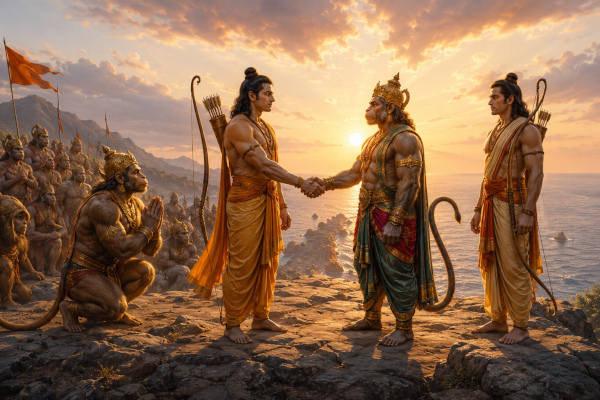
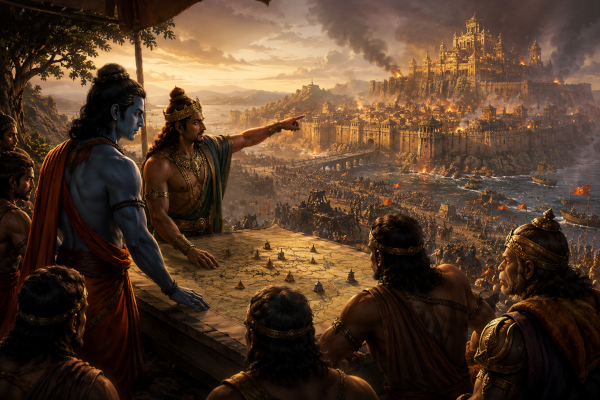
In the Yuddha Kanda of the Ramayana, Vibhishana’s arrival in Rama’s camp is one of
In the Yuddha Kanda of the Ramayana, Vibhishana’s arrival in Rama’s camp is one of
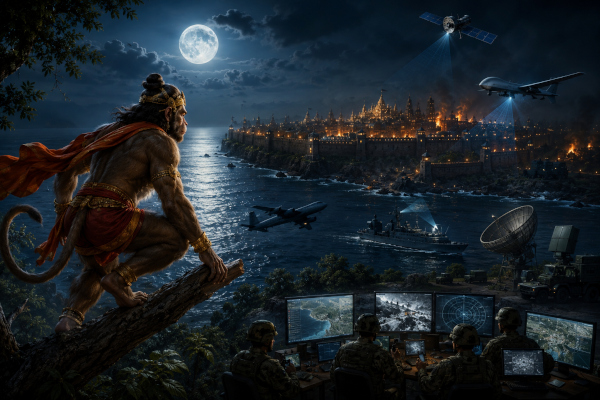
One of the major war tactic in the Ramayana is long-range reconnaissance. Before Rama’s army
Modern India follows a similar strategic logic, though in a very different geopolitical setting. It is not pretending that self-reliance means isolation. Instead, India is building partnerships to fill capability gaps while steadily strengthening its own base.
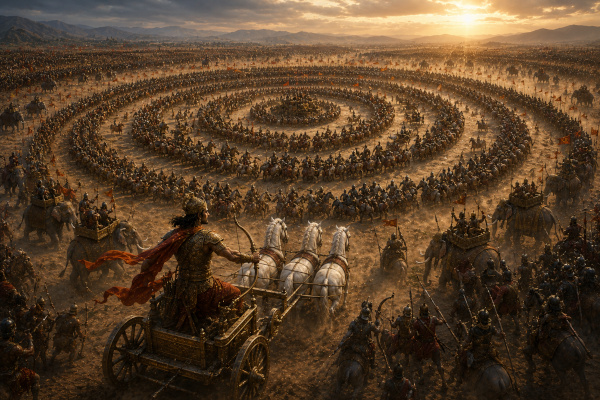
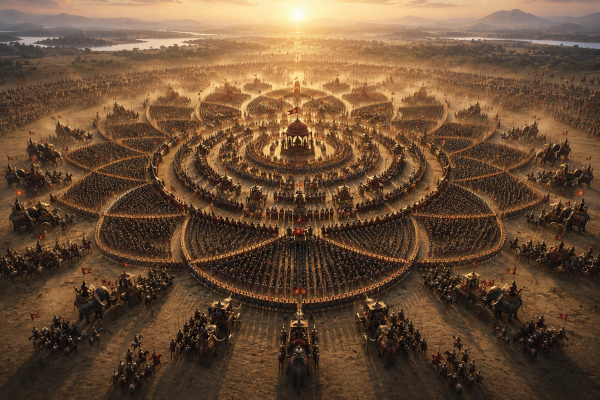
The original Mahabharata passages describe the formation as a firm, fierce, foremost and impenetrable circular array formed by Drona. Abhimanyu openly says he has been taught by Arjuna how to penetrate and strike such an array, but he also admits that if danger overtakes him, he does not know how to come out. This single admission gives the episode its entire military depth: Abhimanyu has entry knowledge, but lacks complete exit doctrine.
The epic describes the war as a clash of enormous scale, with eighteen Akshauhinis gathered at Samanta-panchaka and destroyed in the conflict. One Akshauhini itself was counted as 21,870 chariots, 21,870 elephants, 65,610 horses and 109,350 foot soldiers, giving the war a military scale that naturally invites comparison with modern corps-level and theatre-level planning.
The Mahabharata’s battlefield ethics arose from a kshatriya honour code rather than treaty law, yet the underlying concern is familiar: even in war, power requires limits.
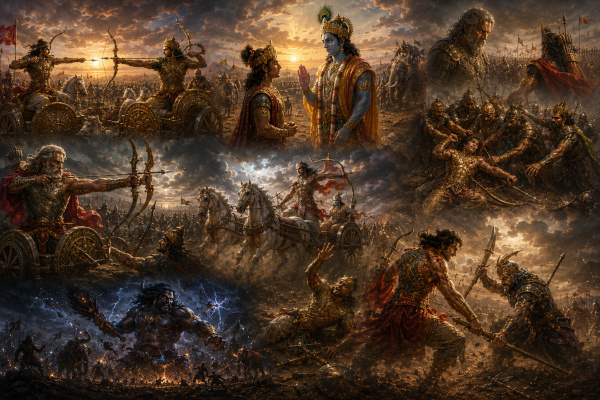
The Mahabharata shows that armies require information, commanders need psychological understanding, and victory often depends on making the enemy see, think and act in a predictable way.
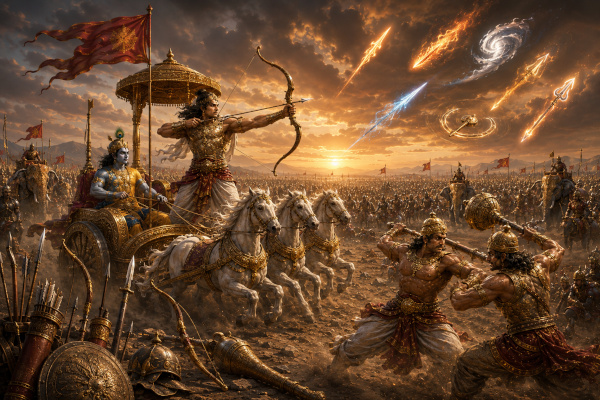
The ordinary weapons of the epic represent different combat functions. The bow gave reach, precision and speed. The mace gave crushing power in close combat. The sword served as a secondary weapon when distance collapsed. The spear or lance gave thrusting and anti-cavalry value. The chariot served as a mobile fighting platform. The elephant acted as a shock platform, while cavalry enabled movement, pursuit and screening. Together, these weapons formed the ancient equivalent of combined arms.
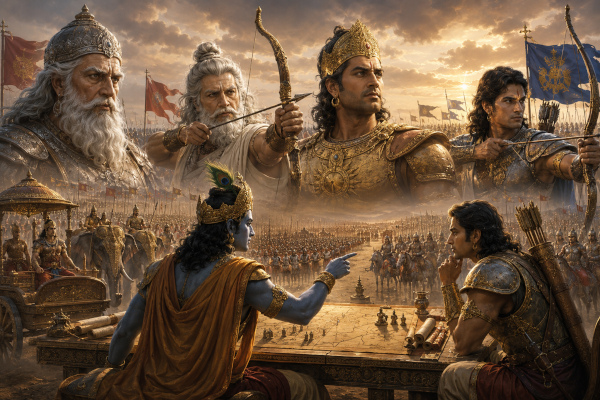
At Kurukshetra, an army did not simply march as a crowd of warriors. It moved
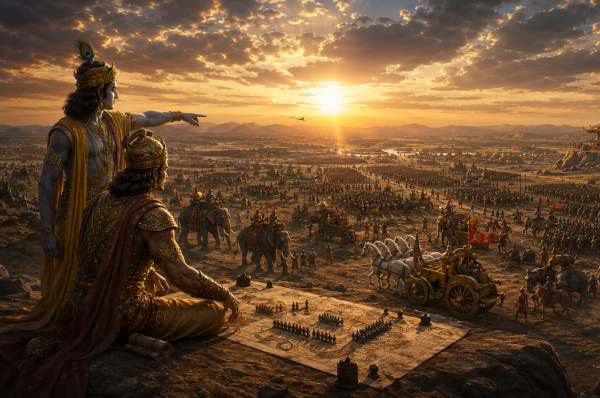
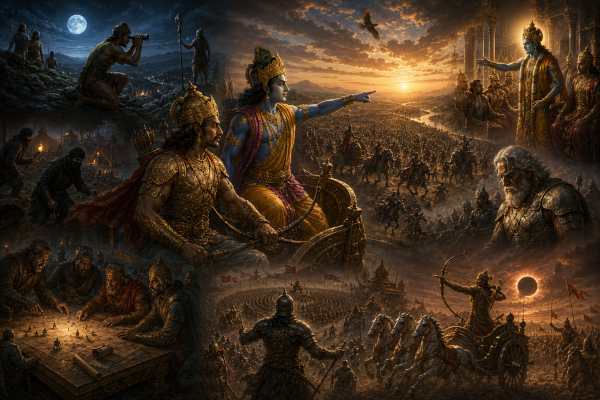
Krishna’s strategic brilliance begins before Kurukshetra. He reads personalities clearly: Duryodhana’s ambition, Yudhishthira’s moral hesitation, Arjuna’s sensitivity, Bhima’s force, Karna’s pride, Bhishma’s restraint and Drona’s emotional weakness. This is advanced strategic intelligence. Modern defence planning values the same ability through political assessment, adversary profiling, intelligence fusion and red-team analysis. A war is shaped by weapons, terrain and logistics, but also by temperament, ego, fear, legitimacy and morale.