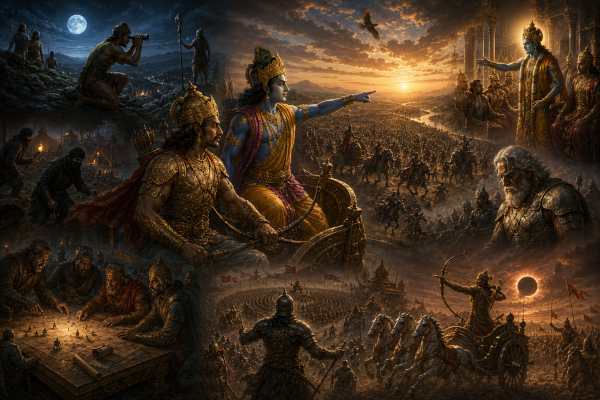
Kurukshetra was never only a battlefield of arrows, maces, chariots and elephants. It was also a battlefield of perception. Before warriors struck, they watched. Before commanders attacked, they judged morale. Before formations moved, messengers carried intent. Before decisive blows landed, minds were shaped by fear, vows, rumours, omens, diplomacy, personal grief and calculated timing. The Mahabharata, centred on the struggle between the Pandavas and Kauravas, preserves war as a human system where intelligence, deception and psychological pressure often mattered as much as weapons. The opening of the Bhagavad Gita itself is framed through battlefield observation, with Dhritarashtra depending on Sanjaya’s narration to understand what is happening at Kurukshetra.
A modern defence reader can therefore approach the Mahabharata as an ancient study in battlefield awareness, strategic messaging, morale warfare and decision manipulation. This does not mean the epic should be forced into modern technology. Sanjaya is not a satellite, Krishna is not a modern intelligence agency, and a conch is not a radio network. The correct comparison is conceptual. The Mahabharata shows that armies require information, commanders need psychological understanding, and victory often depends on making the enemy see, think and act in a predictable way.
Spies, Scouts and Battlefield Intelligence in the Mahabharata
In ancient warfare, intelligence began with the human eye. Scouts observed movement, messengers carried battlefield updates, charioteers watched enemy formations, warriors read standards and banners, and kings relied on envoys to understand political mood. The Mahabharata’s world clearly recognises that a ruler must know what is happening inside his own camp, inside the enemy’s camp and among the wider population.
This is especially visible in the Shanti Parva, where Bhishma instructs Yudhishthira on kingship after the war. The passage speaks of the king employing spies in forts, frontiers, cities, gardens, public spaces, courts and even among groups such as beggars and citizens. It also advises that spies should work in ways that prevent them from knowing one another, a detail that shows an awareness of compartmentalisation and counter-intelligence.
Kautilya’s Arthashastra later develops this world of espionage into a highly organised statecraft system, describing different categories of disguised agents, including those appearing as students, householders, merchants, ascetics and mendicant women. Together, the Mahabharata and Arthashastra show that ancient Indian political thought treated intelligence as a permanent arm of governance, not merely as battlefield gossip.
The modern comparison is ISR — Intelligence, Surveillance and Reconnaissance. NATO describes ISR as foundational to military operations and separates it into intelligence as fused knowledge, surveillance as persistent monitoring, and reconnaissance as information-gathering for a specific military question. NATO also notes that modern observation may come from soldiers on the ground, aircraft, ships, satellites, uncrewed aircraft and sensors. The UK’s Joint Doctrine Note 1/23 similarly presents ISR as an integrated process that tasks assets, collects information, processes it and sends it to decision-makers, intelligence analysts and effectors.
The Mahabharata’s equivalent was human-heavy rather than sensor-heavy. A commander read dust clouds, troop noise, banner movement, messenger reports, the morale of soldiers, the position of elite warriors and the behaviour of opposing kings. In modern war, drones may track armour columns and satellites may map supply routes; in Kurukshetra, charioteers, scouts, spies and commanders performed the same conceptual duty through direct observation and human reporting. The principle remains timeless: the army that sees clearly decides faster.
Krishna’s Diplomacy Before War: Strategic Signalling and Last-Chance Negotiation
Before Kurukshetra became a battlefield, it was a diplomatic theatre. Krishna’s peace mission to the Kuru court is one of the most important strategic episodes in the Mahabharata. He does not go as a helpless petitioner. He goes as a messenger, mediator, moral witness and strategic signal. His objective is peace, but his presence also tests the political will of the Kauravas, exposes Duryodhana’s inflexibility and gives the Pandavas moral legitimacy before war.
The famous demand for five villages captures the essence of last-chance negotiation. Vidura tells Dhritarashtra that the Pandavas desire only five villages, while the Kaurava side refuses even that limited settlement. This episode gives the coming war a political frame: the Pandavas appear prepared to accept a minimal compromise, while Duryodhana’s refusal makes escalation look like the result of obstinacy rather than Pandava aggression.
In modern defence language, Krishna’s mission performs three functions. First, it is strategic signalling: the Pandavas show that they prefer settlement, yet possess the will to fight if justice is denied. Second, it is deterrence messaging: Krishna’s presence warns the Kauravas that war will carry consequences. Third, it is legitimacy-building: when war begins, the moral burden falls heavily on the side that rejected a reasonable peace.
Modern states follow similar logic before military escalation. Diplomatic missions, back-channel talks, public statements, mobilisation warnings, military exercises, sanctions and alliance consultations all shape the political battlespace before firing begins. A country that demonstrates patience before force often enters conflict with stronger international credibility. Krishna understands this deeply. He gives peace a final chance, while ensuring that the moral record is clear if war follows.
This is why Krishna is more than a charioteer. He is the strategist who knows that wars are fought in three arenas: the battlefield, the court of public judgment and the conscience of history.
Psychological Warfare: Fear, Morale and Battlefield Perception
Psychological warfare in the Mahabharata is subtle and constant. A warrior’s fall could shake an entire army. A vow could create pressure across a whole day of battle. A rumour could break a commander’s will. A visible banner could rally troops. The sound of a conch could announce confidence. The sight of Bhishma fallen on the bed of arrows altered the emotional structure of the war. The death of Abhimanyu ignited Arjuna’s rage and reshaped the next day’s operational objective. Drona’s grief made him vulnerable. Karna’s curses weighed on his confidence at decisive moments.
Modern militaries recognise that information can influence behaviour, not merely inform it. U.S. joint doctrine on Military Information Support Operations describes planned communications intended to influence emotions, motives, reasoning and behaviour of foreign audiences, while also stressing credibility, legitimacy and alignment with broader policy. That modern framing helps us read the Mahabharata’s psychological dimension with discipline.
In Kurukshetra, morale was a combat system. Bhishma’s presence gave the Kauravas confidence. Arjuna’s Gandiva gave the Pandavas psychological assurance. Krishna’s counsel prevented emotional collapse. Duryodhana repeatedly tried to speak strength into his camp, even when the battlefield reality turned grim. Fear, pride, shame and oath-bound identity shaped tactical choices.
The Mahabharata also shows how battlefield perception can become self-fulfilling. When troops believe a commander is invincible, they fight differently. When they believe the day is lost, panic spreads faster than arrows. When an elite warrior breaks through a formation, the enemy sees danger beyond the physical damage. Modern armies still study morale, cohesion, fear, combat stress and information effects because war is a contest of minds under pressure.
The fall of Bhishma is a perfect example. Militarily, it removes the Kauravas’ first commander. Psychologically, it removes the oldest pillar of their confidence. The Kaurava army still has Drona, Karna, Kripa, Ashwatthama and Shalya, yet Bhishma’s fall changes the emotional weather of the war. Modern equivalents can be seen when the loss of a flagship, airbase, commander, capital city, command centre or elite unit causes psychological shock beyond its immediate material value.
The Killing of Jayadratha: Time Pressure, Deception and Operational Planning
The Jayadratha episode is one of the finest operational case studies in the Mahabharata. After Abhimanyu is killed inside the Chakravyuha, Arjuna vows to kill Jayadratha before sunset the next day. This vow immediately converts grief into a time-bound military objective. It also creates danger: if Arjuna fails, he has pledged self-destruction. The enemy understands this and turns the day into a defensive operation built around delaying him.
Duryodhana and the Kaurava commanders recognise that they do not need to defeat Arjuna outright. They only need to protect Jayadratha until sunset. This is a classic defensive-time problem. In modern warfare, many operations work this way: delay an armoured thrust until reinforcements arrive, protect an airbase until aircraft disperse, hold a bridge until demolition succeeds, preserve a leadership target until evacuation, or deny an objective until the political deadline passes.
The Drona Parva shows the intensity of this operation. Arjuna tells Krishna that his vow must be fulfilled before sunset, and Krishna drives the chariot toward Jayadratha while major Kaurava warriors rush to block the advance. After Jayadratha is killed, the text describes the Pandavas rejoicing and Arjuna continuing to fight after fulfilling the vow.
The defence lesson here is extraordinary. Krishna turns Arjuna’s vow into an operational campaign. He manages movement, morale, timing, battlefield navigation and psychological pressure. Arjuna supplies the combat power; Krishna supplies the campaign intelligence. The target is one man, but the mission requires breaking through layers of protection, conserving momentum, reading the enemy’s delay strategy and striking before the deadline.
Modern parallels are easy to see. Special operations raids, hostage rescue missions, airstrikes against mobile targets, counter-leadership operations and battlefield breakthrough missions all depend on the same ingredients: intelligence, speed, route selection, deception, suppression of enemy resistance, time discipline and target confirmation. Krishna’s role resembles the strategic mission commander who knows that a single objective can decide the morale of an entire theatre.
The Jayadratha episode also shows the power of deadline warfare. A deadline concentrates emotion. It gives the attacker urgency and gives the defender a measurable success condition. Arjuna must kill Jayadratha; the Kauravas must preserve him until sunset. The entire day becomes a contest between breakthrough and delay. That is modern operational planning in epic form.
“Ashwatthama is Dead”: Information Warfare and the Morality of Half-Truths
The Ashwatthama episode is perhaps the Mahabharata’s most morally charged information operation. Drona is devastating the Pandava forces. Krishna concludes that Drona can be defeated only when he lays aside his weapons. The plan turns on his deepest emotional vulnerability: his son, Ashwatthama.
Bhima kills an elephant named Ashwatthama and announces that Ashwatthama has been slain. Drona distrusts Bhima and turns to Yudhishthira, whose reputation for truth is unmatched. Yudhishthira says that Ashwatthama is dead, adding indistinctly that it was the elephant. Drona, shaken by grief and by the authority of Yudhishthira’s word, loses his will to fight. The Drona-vadha Parva lays out this sequence with striking clarity, including Krishna’s calculation, Bhima’s killing of the elephant, Drona’s inquiry and Yudhishthira’s difficult half-truth.
In modern terms, this is information warfare aimed at a commander’s decision-making centre. The message works because it is tailored to the target. Drona’s vulnerability is paternal attachment. The delivery channel is credible because Yudhishthira is trusted. The content is ambiguous enough to preserve a technical truth while creating a decisive psychological effect.
Modern military deception doctrine has a useful phrase for this kind of planning: deception should make the target see something, think something, and then do or avoid doing something that supports the operational plan. U.S. joint deception doctrine frames successful military deception around how the target sees, thinks and acts, with the final aim being action or inaction favourable to the commander’s plan. The Ashwatthama episode fits this structure perfectly: Drona hears the message, concludes his son is dead, lays aside his combat edge, and the Pandava side gains the opening it needed.
Yet the Mahabharata refuses to make this morally simple. Yudhishthira’s hesitation matters. The episode stains victory with discomfort. It asks whether a half-truth used to stop battlefield devastation can still damage the speaker’s moral standing. That is why the story remains powerful. It acknowledges necessity, but also records the cost of bending truth.
Modern warfare faces similar tensions. Deception can save lives, protect operations and mislead an enemy commander. At the same time, disinformation, false surrender signals, manipulation of protected symbols, civilian targeting narratives and reckless propaganda can corrode legitimacy. The Mahabharata’s brilliance lies in showing both sides: deception may become operationally effective, while moral injury may remain.
Camp Intelligence, Signals and Operational Security
Beyond the famous episodes, the Mahabharata also teaches the importance of camp security and information discipline. Armies at Kurukshetra were vast. They contained kings from many regions, chariot warriors, elephant corps, cavalry, infantry, servants, armourers, physicians, cooks, messengers and camp followers. Such a force constantly leaked information through movement, noise, rumours and visible preparation.
Modern doctrine calls this problem operations security, or OPSEC. U.S. joint doctrine describes OPSEC as identifying and controlling critical information and indicators of friendly actions, while applying countermeasures to reduce the enemy’s ability to exploit vulnerabilities. It also warns that adversaries may observe forces in bases, training, movement and operations, then correlate patterns to predict future actions.
Kurukshetra had its own form of OPSEC. A commander needed to conceal intended formations, protect messengers, control camp rumours, watch enemy spies, hide troop exhaustion, preserve morale after casualties and prevent the enemy from reading the next day’s battle plan. In a war where banners, drums and visible champions carried meaning, even the placement of a warrior could reveal intent.
This is another area where ancient and modern war meet. Today, a careless social media post can reveal troop positions. A repeated vehicle pattern can expose logistics routes. A visible radar emission can reveal air defence layout. In the Mahabharata’s world, an exposed camp routine, a frightened messenger, a shaken commander or a visible gap in formation could produce the same strategic danger.
The Larger Defence Lesson
The Mahabharata’s intelligence and psychological warfare episodes show that war is fought through perception as much as force. Spies gather hidden knowledge. Diplomacy shapes legitimacy. Vows create time pressure. Morale turns battlefield events into emotional shocks. Deception manipulates decisions. Operational security protects intent. A wise commander understands all of these as parts of the same combat system.
Krishna is the central figure in this cluster because he sees beyond the duel. Arjuna sees the target; Krishna sees the system around the target. Bhima sees the blow; Krishna sees the morale chain that will follow. Yudhishthira sees truth; Krishna sees the terrible battlefield consequence of allowing Drona to continue unchecked. This makes Krishna the epic’s finest strategist: he reads men, time, terrain, emotion, legitimacy and destiny as one battlefield map.
For modern defence readers, the takeaway is clear. Weapons win engagements, but information shapes campaigns. A tank without reconnaissance can enter a trap. A missile without target intelligence becomes waste. A brave soldier without morale support can collapse under grief. A large army without legitimacy can lose the political meaning of victory. A commander who ignores psychology fights only half the war.
The Mahabharata therefore remains deeply relevant as a civilisational war text. It teaches that intelligence must be gathered before force is used, diplomacy must be attempted before escalation, morale must be guarded like a fortress, deception must be handled with moral discipline, and victory must be judged by more than the fall of an enemy. Kurukshetra was a war of weapons, but it was also a war of minds. That is why it still speaks to the modern battlefield.
You may also like
-
ArthX Expands FANG-7 Interceptor Drone Production as FANG-10 Development Moves Ahead
-
India Expands Defence R&D Investment as Quantum, Hypersonic and Autonomous Systems Move to the Fore
-
Naval Group Demonstrates Seaquest S Unmanned Surface Vessel to Indian Defence Attaché in France
-
EdgeForce Solutions Emerges L1 Bidder for Indian Army Manned–Unmanned Teaming System
-
Indian Navy Seeks Indigenous GPS PS1 and PS2 Assemblies for MRSAM Air-Defence System
