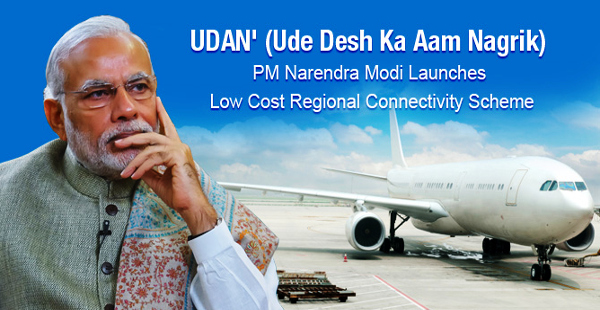
In a major push to strengthen India’s regional aviation network, the Union Cabinet, chaired by Prime Minister Narendra Modi, has approved the launch of the Regional Connectivity Scheme – Modified UDAN with a total outlay of Rs. 28,840 crore. The revamped scheme will run for ten years, from FY 2026-27 to FY 2035-36, with full budgetary support from the Government of India.
The decision marks a significant expansion of India’s efforts to make air travel affordable and accessible, especially for underserved and unserved regions. The modified scheme is expected to improve regional air connectivity, stimulate economic growth in Tier-2 and Tier-3 cities, support trade and tourism, and strengthen access to healthcare and emergency services in remote, hilly, and island areas. It also aligns with the broader vision of Atmanirbhar Bharat and the national goal of Viksit Bharat 2047.
A major component of the scheme is the development of airport infrastructure. Under Modified UDAN, the government plans to develop 100 airports from existing unserved airstrips, with an estimated capital expenditure of Rs. 12,159 crore over the next eight years. This expansion is aimed at building a more competitive aviation ecosystem and ensuring that more regions are brought into the country’s air connectivity network.
The scheme also addresses the challenge of sustaining smaller regional aerodromes. Since many Regional Connectivity Scheme-only airports have limited revenue streams but high recurring costs, the government has proposed operation and maintenance support for three years. This support will be capped at Rs. 3.06 crore annually per airport and Rs. 0.90 crore per year for each heliport or water aerodrome. The total estimated expenditure for this component is Rs. 2,577 crore, covering around 441 aerodromes.
To further improve last-mile connectivity in geographically difficult regions, the government will develop 200 modern helipads under the scheme. These helipads, particularly targeted at hilly, remote, island, and aspirational districts, will be built at an estimated cost of Rs. 15 crore each, taking the total outlay for this component to Rs. 3,661 crore over the next eight years. The move is expected to significantly improve both emergency response capabilities and connectivity in areas where traditional airport infrastructure may not be feasible.
Another key pillar of the scheme is Viability Gap Funding, or VGF, which provides financial support to airline operators flying awarded regional routes. Recognising that such routes often need more time to become commercially viable, the Cabinet has approved Rs. 10,043 crore in VGF support over the next ten years. This is expected to encourage more operators to serve remote sectors and help create a stable regional aviation market.
In line with the government’s Atmanirbhar Bharat initiative, the scheme also includes the acquisition of indigenous aircraft to address the shortage of suitable smaller aircraft and helicopters for difficult terrains. Under this provision, two HAL Dhruv helicopters will be procured for Pawan Hans, while Alliance Air will receive two HAL Dornier aircraft. The move is intended to support domestic aerospace manufacturing while improving connectivity in challenging regions.
The original UDAN scheme, launched in October 2016, was designed to make flying affordable for the common citizen and improve access to smaller cities. Over the past nine years, it has operationalised 663 routes across 95 airports, heliports, and water aerodromes as of 28 February 2026. During this period, more than 3.41 lakh flights have been operated, carrying 162.47 lakh passengers. The scheme has played a key role in linking remote, hilly, and island areas with the rest of the country, while also boosting tourism, healthcare access, and emergency services.
With the approval of Modified UDAN, the government is now looking to build on that foundation and expand India’s regional aviation footprint even further. The scheme is expected to create a more inclusive air transport network, deepen economic integration across regions, and bring affordable air travel within reach of more citizens over the next decade.
Source: PIB
You may also like
-
CG Power Strengthens India’s Semiconductor Manufacturing Ecosystem with ₹7,600 Crore Sanand Investment
-
Kargil Gets Its First Heat-Pump Dehydration and Cold Storage Facility to Boost Ladakh’s Agricultural Economy
-
India Explores 3,000 km Power Corridor to Supply 2,000 MW of Clean Electricity to Singapore
-
ONGC Explores Three Advanced Oilfield Technologies to Improve Mumbai High Well Operations
-
Kabra Extrusiontechnik’s GEON Commissions 20 MWh Battery Storage Project in Rajasthan
