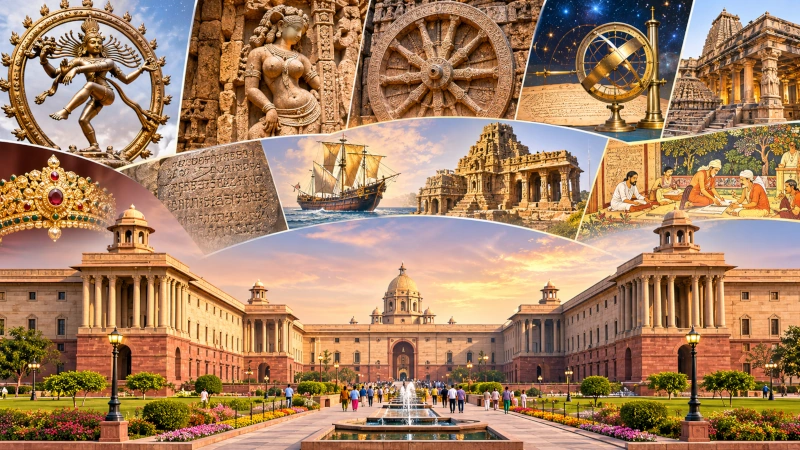
The Cabinet Committee on Economic Affairs (CCEA), chaired by Prime Minister Narendra Modi, has approved the development of the Yuge Yugeen Bharat Museum at the historic North and South Block Complex in New Delhi, with an estimated investment of ₹3,230 crore. The decision, announced on November 11, 2026, marks a significant step towards establishing a major national cultural institution dedicated to presenting the continuity, diversity and richness of India’s civilisational heritage.
The museum will be developed through the adaptive reuse of the iconic North and South Block buildings, transforming the former centres of government administration into public cultural spaces while preserving their architectural character and historical significance. The project will integrate traditional museum practices with immersive technologies, modern exhibition facilities and advanced conservation infrastructure.
A Civilisational Museum with the World’s Largest Display Area
The Yuge Yugeen Bharat Museum is envisioned as a comprehensive institution presenting India’s civilisational journey through its tangible and intangible cultural heritage. The museum will bring together archaeological discoveries, historical objects, artistic traditions, scientific knowledge systems, cultural practices and documentary evidence within an integrated exhibition framework.
Spread across a proposed built-up area of approximately 1,78,509 square metres, the museum is planned to have the world’s largest museum display area. According to the Ministry of Culture, the project has been benchmarked against major international museums and will incorporate contemporary exhibition design, immersive technologies and visitor-oriented interpretation facilities.
The museum complex will include thematic galleries, collection storage facilities, conservation laboratories, public amenities, landscaped spaces, intelligent building systems and supporting infrastructure. The development will follow international practices in museum planning, heritage conservation, exhibition design and sustainable cultural management, adapted to India’s historical and cultural context.
The project is intended to create a major centre for understanding India’s civilisational evolution through carefully curated exhibitions that connect different historical periods, geographical regions and cultural traditions.
Transforming North and South Blocks into Public Cultural Institutions
One of the defining features of the Yuge Yugeen Bharat Museum is the adaptive reuse of the historic North and South Block buildings, which have served as important centres of India’s government administration.
Constructed during the British colonial period, the buildings subsequently became central institutions of governance in independent India. Their architectural character and historical associations make them significant components of New Delhi’s built heritage.
The relocation of government offices to new administrative facilities has created an opportunity to assign the historic complex a new public purpose. Rather than replacing the existing structures, the museum project will retain their architectural and heritage character while adapting their interiors for exhibition galleries, conservation facilities and visitor services.
The transformation will preserve two of New Delhi’s most recognisable government buildings while opening them to the public as spaces dedicated to India’s historical and cultural heritage.
The establishment of the Yuge Yugeen Bharat Museum was originally announced by Prime Minister Narendra Modi on May 18, 2023. The project proposal was subsequently appraised by the Public Investment Board on July 27, 2026, and received the concurrence of the Ministry of Culture before securing approval from the Cabinet Committee on Economic Affairs.
Nearly 18 Lakh Heritage Objects Identified for the Museum
The Ministry of Culture has undertaken an extensive exercise to identify historical objects, collections and cultural materials for the proposed museum.
Approximately 1.8 million objects, equivalent to 18 lakh artefacts and collection items, have been identified for potential inclusion in the museum’s exhibitions and collections.
These objects have been identified from the National Museum, other museums administered by the Ministry of Culture, 52 site museums maintained by the Archaeological Survey of India, state museums and private collections.
The identification exercise forms part of the museum’s content development and collection analysis programme. The proposed displays will be developed through thematic curation, bringing together materials from different institutions to present India’s civilisational heritage across historical periods.
The museum will also incorporate dedicated conservation and storage facilities to support the preservation, management and interpretation of collections. These facilities are intended to provide appropriate conditions for the long-term care of historical objects while supporting research and educational activities.
Dedicated Galleries on Indian Mathematics, Astronomy, Architecture and Knowledge Systems
The museum’s exhibition programme will be organised around major themes representing different dimensions of India’s civilisational development.
The Ministry of Culture has identified themes including Architecture and Cityscapes, Mathematics and Astronomy, Languages and Scripts, Faith and Spirituality, and Bharat Connects – Trade and Ideas.
The Architecture and Cityscapes galleries are intended to explore India’s architectural traditions and the development of settlements and urban environments across different historical periods.
The Mathematics and Astronomy galleries will provide a platform for presenting India’s contributions to mathematical knowledge and astronomical inquiry. These subjects form an important part of the country’s intellectual heritage and its historical engagement with scientific observation and calculation.
The Languages and Scripts galleries will explore India’s linguistic traditions and writing systems, while Faith and Spirituality will address the religious and philosophical traditions that have shaped the country’s cultural history.
The Bharat Connects – Trade and Ideas galleries will examine India’s historical connections with other regions through commerce, cultural exchanges and the circulation of knowledge.
By organising exhibitions around civilisational themes rather than relying exclusively on chronological displays, the museum aims to present the interconnected development of India’s scientific, cultural, artistic and intellectual traditions.
First Gallery Expected to Open in 2027
The Yuge Yugeen Bharat Museum will be implemented in phases over five financial years, from FY 2026–27 to FY 2030–31.
According to the Ministry of Culture, the first inaugural gallery, dedicated to the theme of Adornment, is expected to open to the public in the North Block during the latter part of 2027.
The Adornment gallery will form the first phase of the museum’s public exhibition programme. A modular development approach is being formulated to enable additional galleries to be introduced progressively as the project advances.
The phased implementation strategy will involve coordinated project management, exhibition design, engineering works, technical supervision, quality assurance and periodic monitoring.
The government has emphasised that the museum’s development will combine heritage conservation requirements with modern infrastructure and exhibition technologies, allowing the historic buildings to accommodate their new public functions.
Museum Designed to Accommodate One Crore Visitors Annually
The Yuge Yugeen Bharat Museum is being equipped to accommodate an annual visitor flow of approximately one crore people, reflecting the scale of the proposed institution and its intended role as a major national cultural destination.
The museum will cater to students, researchers, scholars, cultural practitioners, domestic tourists, international visitors and the general public.
Its exhibition and educational facilities are intended to support historical learning, academic research, cultural engagement and public appreciation of India’s civilisational heritage.
The Ministry of Culture expects the museum to strengthen cultural tourism and international engagement by creating a prominent institution presenting India’s historical and cultural achievements to audiences from across the world.
Although the museum will be located in New Delhi, its collections and exhibitions are intended to represent the cultural diversity of all Indian states and Union Territories.
Employment Generation and Make in India Opportunities
The development and operation of the Yuge Yugeen Bharat Museum are expected to create direct and indirect employment opportunities across several sectors.
The construction and development phases will require professionals associated with architecture, engineering, exhibition design, conservation, research, museum management and technology integration.
The government also expects the project to generate opportunities for artisans, craftspeople, designers, researchers, museologists, performers and other professionals working in India’s cultural and creative industries.
The museum’s operations are expected to support employment in tourism, hospitality, visitor services, retail and related sectors.
Under the Make in India initiative, structured vendor development programmes are planned to encourage domestic manufacturing of museum materials, exhibition equipment and associated products. These programmes are intended to create opportunities for Indian manufacturers, artisans, conservation specialists and technology providers to participate in the development of advanced museum infrastructure.
The government also expects the project to encourage domestic capabilities in exhibition fabrication, museum technologies and heritage-related services.
Investment, Visitor Services and Revenue Generation
The approved project cost of ₹3,230 crore has been determined through architectural and exhibition design studies, engineering assessments, museum planning requirements and technical evaluations undertaken by the concerned agencies.
The investment will support the development of galleries, conservation facilities, collection storage systems, immersive exhibition technologies, visitor amenities, landscaping, intelligent building systems and associated infrastructure.
The museum is also expected to generate recurring revenue through ticket sales, food and beverage facilities, events, venue rentals, guided tours, digital experiences, retail outlets and other visitor services.
The proposed revenue-generating facilities form part of the museum’s long-term operational framework, although the Ministry of Culture has not announced specific revenue projections in its approval statement.
A New Institutional Home for India’s Civilisational Heritage
The approval of the Yuge Yugeen Bharat Museum represents a major development in India’s cultural infrastructure, combining the conservation of historic government buildings with the establishment of a large-scale national museum.
The project will bring together collections from institutions across the country and present India’s historical development through interconnected themes covering architecture, science, philosophy, languages, trade, artistic traditions and cultural practices.
Its proposed scale, contemporary exhibition infrastructure and conservation facilities are intended to support public education, research, heritage preservation and cultural tourism.
With an approved investment of ₹3,230 crore, a proposed built-up area of 1,78,509 square metres and nearly 18 lakh identified collection objects, the Yuge Yugeen Bharat Museum is being developed as a major institution dedicated to preserving and presenting India’s civilisational heritage for future generations.
You may also like
-
Kārttikeya and the War Against Tārakāsura: The Rise of the Divine Commander
-
Two Envoys, Two Missions: Comparing Hanumān’s and Aṅgada’s Diplomatic Strategies
-
Aṅgada and Rāvaṇa: The Art of Diplomatic Communication and the Weight of Words
-
Shiva versus Jalandhara: Siege Warfare, Strategic Deception and the Destruction of an Invincible Asura
-
Vīrabhadra Confronts the Gods: The Celestial Battle That Overwhelmed Dakṣa’s Defenders
