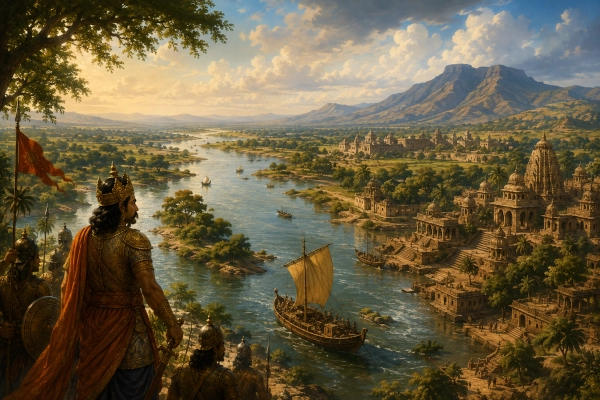
Ashmaka, also known in Prakrit and Buddhist traditions as Assaka, was an important ancient country of the Deccan associated with the Godavari valley in present-day Maharashtra and Telangana. The Mahabharata recognises the Ashmakas as a distinct people and political region, while later Buddhist literature remembers Assaka as one of the sixteen great Mahajanapadas of ancient India. Together, these traditions make Ashmaka one of the most significant ancient geographical names connected with the upper and middle Godavari basin.
The ancient territory should not be imagined as following the modern Maharashtra-Telangana boundary. Its extent changed over time, and the surviving literary sources belong to different historical periods. The safest geographical identification places the Ashmaka country somewhere along the Godavari corridor extending from parts of present-day Maharashtra into northern Telangana, with neighbouring Mulaka occupying another part of the same great river valley. The Maharashtra State Gazetteer places Ashmaka, together with Rishika, Mulaka and Dandaka, across the middle and upper Godavari region.
Ashmaka is particularly valuable it preserves a royal origin tradition for Ashmaka, associates the ruler with the foundation of Paudanya, includes the Ashmakas within the geographical catalogue of Bharat, and records Ashmaka warriors on the Pandava side during the Kurukshetra War.
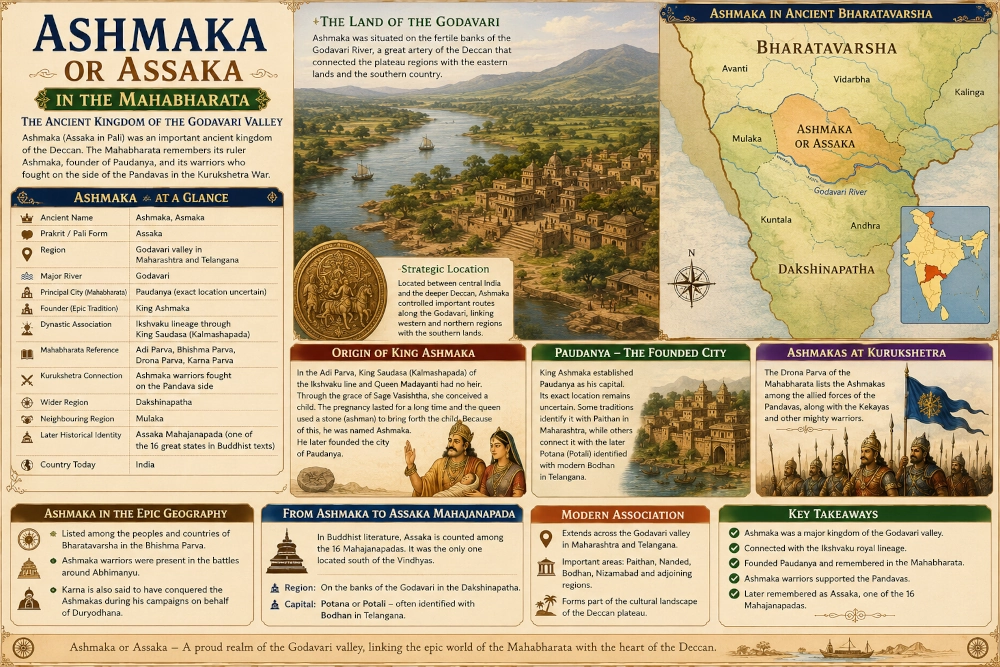
Ashmaka at a Glance
| Feature | Identification |
|---|---|
| Ancient Name | Ashmaka, Asmaka |
| Later Prakrit Form | Assaka |
| Political Character | Ancient Deccan kingdom; later remembered as a Mahajanapada |
| Approximate Modern Region | Godavari valley in Maharashtra and Telangana |
| Principal River | Godavari |
| Mahabharata City | Paudanya |
| Traditional Founder | King Ashmaka |
| Dynastic Association | Ikshvaku lineage through King Saudasa/Kalmashapada |
| Important Epic Connection | Ashmaka warriors fought on the Pandava side |
| Wider Geographical Zone | Dakshinapatha |
| Neighbouring Region | Mulaka |
| Possible Later Capital Tradition | Potana or Potali |
| Possible Modern Associations | Bodhan in Telangana; alternative traditions connect Paudanya with places in Maharashtra |
| Modern States | Maharashtra and Telangana |
| Country Today | India |
Where Was Ancient Ashmaka?
The strongest geographical clue for Ashmaka is the Godavari River. Ancient Buddhist geographical traditions place Assaka on the Godavari in the Dakshinapatha, while the Maharashtra State Gazetteer includes Ashmaka among the ancient regions occupying the middle and upper Godavari valley. This broadly places the country across parts of today’s Maharashtra and Telangana rather than within one modern state alone.
The exact boundaries remain uncertain. Ancient political territories changed repeatedly, and names such as Ashmaka and Mulaka may have covered different areas at different times. Some reconstructions place Ashmaka principally on one side of the Godavari and Mulaka on the other, while others suggest periods when the political influence of Ashmaka extended more widely.
For our map, the most responsible identification is therefore:
Ashmaka or Assaka → Godavari valley in Maharashtra and Telangana → India.
This should be shown as an approximate ancient region rather than a sharply bordered kingdom.
Ashmaka in the Mahabharata
The Mahabharata knows Ashmaka both as the name of a royal figure and as the name of a people or country. This dual use is important because the epic preserves a legendary explanation for the origin of the name while also treating the Ashmakas as an established regional community.
In the Adi Parva, the story appears within the lineage associated with King Saudasa, also known as Kalmashapada. After a complex series of events involving the sage Vasishtha, Saudasa’s queen Madayanti eventually conceived a child. According to the narrative, the pregnancy continued for an extraordinarily long period, and the queen finally used a stone in bringing forth the child. Because of this connection with a stone, or ashman, the child was named Ashmaka.
The Mahabharata then states that this royal sage Ashmaka became the founder of a city called Paudanya. This is one of the clearest direct epic associations between Ashmaka and an identifiable urban centre.
King Ashmaka and the Ikshvaku Line
The Ashmaka origin story connects the region with one of India’s most famous royal genealogies. King Saudasa belonged to the Ikshvaku or solar dynasty, the same great line within which many celebrated rulers of ancient Indian tradition were placed.
According to the Mahabharata narrative, Saudasa and Queen Madayanti had remained without an heir. Through the intervention of Vasishtha, Madayanti conceived the child who eventually became Ashmaka. The birth narrative explains his name through the use of a stone, and Ashmaka later established Paudanya.
Whether this story preserves a historical migration, a dynastic claim or an etiological legend explaining the name of the Ashmaka people cannot be established. Its importance lies instead in showing how the Mahabharata incorporated the Deccan kingdom into the wider genealogical geography of Bharat.
The Ashmaka country was therefore not represented as culturally disconnected from the northern kingdoms. Epic tradition linked its ruling line with the same prestigious dynastic networks that shaped the political imagination of northern India.
Paudanya: The City Founded by Ashmaka
The Mahabharata explicitly states that King Ashmaka founded Paudanya. This makes Paudanya one of the most important geographical markers in any attempt to reconstruct Ashmaka.
The precise modern identification of Paudanya remains debated. Some traditional geographical works have associated Paudanya with Paithan in Maharashtra, an important ancient city on the Godavari. Other scholarship connects the Potana or Potali of later Assaka traditions with Bodhan in present-day Telangana. The relationship between Paudanya, Potana and Potali has therefore generated several competing reconstructions.
This uncertainty should be clearly preserved rather than resolved artificially. The Mahabharata securely provides the name Paudanya, but it does not give us a modern coordinate. Later literary traditions concerning Assaka provide Potana or Potali as a capital, and many scholars favour Bodhan for that later centre.
Ashmaka and Assaka: Are They the Same?
Ashmaka is the Sanskrit form of the name, while Assaka is the form commonly found in Pali Buddhist literature. The two are generally regarded as referring to the same or closely related ancient people and region.
However, an important chronological distinction must be maintained. The Ashmaka appearing in the Mahabharata belongs to the epic’s geographical and dynastic tradition. The Assaka Mahajanapada described by Buddhist sources belongs to the early historic period, when the sixteen Mahajanapadas had emerged as major political units.
It would therefore be misleading to assume that every Mahabharata reference describes exactly the same political boundaries as the later Assaka Mahajanapada. What the different traditions demonstrate is the long survival of the Ashmaka-Assaka geographical name within the Deccan.
Later Buddhist sources place Assaka on the banks of the Godavari and identify it as the only one of the traditional sixteen Mahajanapadas situated south of the Vindhyas.
Ashmaka and the Dakshinapatha
Ancient literature places Ashmaka firmly within the Dakshinapatha, the great southern geographical and commercial world of India. The term could mean both the southern country and the major southern routes connecting northern and central India with the Deccan.
Ashmaka’s position on the Godavari made it especially important within this network. Travellers descending from the Narmada and central Indian regions could move towards the Godavari before continuing eastward or southward. The river itself created a natural corridor across the plateau.
Buddhist geographical tradition describes a Brahmana named Bavari settling on the Godavari in the Assaka territory of the Dakshinapatha. This later evidence reinforces the association between Ashmaka and the river valley and helps establish the region as one of the principal ancient states of the northern Deccan.
The Godavari and the Identity of Ashmaka
No geographical feature is more important to Ashmaka than the Godavari River. Rising near Trimbakeshwar in present-day Maharashtra, the Godavari travels eastward across the Deccan before entering Telangana and ultimately flowing towards the Bay of Bengal.
Ancient settlements developed along this corridor because the river provided water, agricultural land and a natural communication route. The region also sat between the great plateau routes connecting western India with central and southern Bharat.
The Maharashtra State Gazetteer describes Ashmaka, Mulaka and neighbouring ancient regions as forming major divisions of the upper and middle Godavari valley. This makes the river itself a safer geographical anchor than any attempt to draw rigid political frontiers.
Ashmaka and Mulaka
Ashmaka was closely connected with another ancient Deccan country called Mulaka. The two names frequently occur in historical discussions of the Godavari valley, but their exact relationship appears to have changed over time.
Several reconstructions place Mulaka around Pratishthana, modern Paithan, while Ashmaka lay farther along the Godavari towards the east or south-east. Other interpretations allow for larger Ashmaka territories that may at times have incorporated or overlapped with Mulaka.
The Maharashtra State Gazetteer treats Rishika, Ashmaka, Mulaka and Dandaka collectively as principal ancient regions of the middle and upper Godavari valley. This approach is useful because it avoids imposing artificial precision where the literary evidence does not provide it.
Ashmaka and Mulaka should therefore be shown as neighbouring Godavari regions with approximate and potentially shifting boundaries.
Ashmaka in the Geography of Bharatavarsha
The Bhishma Parva contains one of the Mahabharata’s great geographical catalogues of the peoples and countries of Bharatavarsha. Ashmaka appears within this wider regional geography, confirming that it was recognised as a distinct janapada.
The Ashmakas are listed among the peoples of the southern part of Bharat, placing them within the broad Deccan world known to the epic. Textual indexes of the Critical Edition identify the reference in the Bhishma Parva alongside other ancient regional names.
This is especially significant because it shows that Ashmaka was not merely the legendary name of a king descended from Saudasa. By the geographical sections of the Mahabharata, the name had become associated with an identifiable people and country.
Ashmaka and the Pandavas
The Ashmakas also appear directly within the political and military world of the Kurukshetra War. The Drona Parva names the Ashmakas among the forces aligned with the Pandavas, together with important allies such as the Kekayas and leading Panchala warriors.
The Sanskrit verse includes the Ashmakas in a list of powerful warriors and allied groups supporting the Pandava cause. This provides one of the clearest pieces of evidence for the political allegiance of at least one Ashmaka contingent during the great war.
This reference is important because the Mahabharata frequently shows that large geographical regions could contain several rulers or political factions. An alliance with the Pandavas therefore need not mean that every ruler associated with the wider Ashmaka country necessarily followed the same side.
Nevertheless, the textual evidence securely places Ashmaka warriors within the Pandava military coalition.
The Ashmaka Ruler and Abhimanyu
The Drona Parva also refers to an heir or ruler of Ashmaka during the fierce battles surrounding Abhimanyu. The episode shows that the name Ashmaka was attached to a recognised royal house participating in the conflict.
Textual indexes of the Mahabharata refer to the Ashmaka ruler and his heir, while the wider narrative places Ashmaka warriors within the Pandava coalition.
These passages strengthen the political character of Ashmaka within the epic. It was not simply a geographical designation for an undefined southern population but a country possessing kings, heirs and organised military forces.
Ashmaka and Karna’s Conquests
Another Mahabharata tradition associates the Ashmakas with the campaigns of Karna before Duryodhana’s Vaishnava sacrifice. Karna undertook extensive conquests on behalf of Duryodhana, forcing numerous rulers and peoples to acknowledge Kuru authority and provide tribute.
The Karna Parva later remembers the Ashmakas among peoples who had been defeated by Karna and made tributary. This does not necessarily conflict with Ashmaka forces later supporting the Pandavas. Political allegiance in the Mahabharata is frequently complex, and military defeat followed by tribute did not guarantee permanent loyalty.
The passage instead illustrates how Ashmaka formed part of the wider interstate system in which powerful northern kingdoms attempted to establish sovereignty over the Deccan.
Ashmaka Between North and South India
Ashmaka occupied a strategically important geographical position. To its north and north-west lay the approaches towards Avanti, the Narmada valley and central India. To the west lay the upper Godavari country of Maharashtra, while routes eastward followed the river towards Telangana and eventually the lower Deccan.
This made Ashmaka a natural intermediary between northern and southern Bharat. Armies, merchants, pilgrims and messengers travelling through the Deccan could use the Godavari valley as one of their principal corridors.
The later importance of Assaka as a Mahajanapada reinforces the likelihood that this geographical position encouraged the development of substantial settlements and political authority. The continued appearance of the name across Sanskrit, Pali and Puranic traditions suggests a region with considerable historical persistence.
The Later Assaka Mahajanapada
The best-known historical appearance of Assaka comes from Buddhist literature, where it is counted among the sixteen Mahajanapadas. This later political formation should be distinguished from the epic narrative while still being recognised as part of the long history of the same regional name.
Assaka was particularly unusual among the Mahajanapadas because it was located south of the Vindhyas, whereas most of the other sixteen major states were concentrated in northern India. Buddhist geographical sources place it on the Godavari in the Dakshinapatha.
Its capital is given as Potana or Potali. Many modern historians identify this settlement with Bodhan in the Nizamabad region of Telangana, although alternative identifications have also been proposed.
The Mahajanapada evidence is extremely useful for reconstructing ancient Deccan history, but it should be described as later corroborating evidence for the continuing Ashmaka-Assaka geographical tradition, rather than as proof that the Mahabharata kingdom possessed identical boundaries.
Paudanya, Potana and Bodhan
The relationship between the Mahabharata’s Paudanya and the later Assaka capital called Potana or Potali is one of the more difficult questions in reconstructing Ashmaka geography.
Some scholars regard these names as related and identify the ancient centre with modern Bodhan in Telangana. Bodhan lies within the wider Godavari-Manjira region and fits reasonably well with the broader placement of Assaka in the northern Deccan.
Other traditions have associated Paudanya with places farther west in Maharashtra, including Paithan.
Paudanya was the Mahabharata city founded by King Ashmaka. Later Assaka tradition names Potana or Potali as a capital, often identified with Bodhan in Telangana, although the precise relationship between these ancient place-names remains debated.
Ancient Ashmaka and Modern Geography
| Ancient Reference | Approximate Modern Association |
|---|---|
| Ashmaka / Asmaka | Godavari valley of Maharashtra and Telangana |
| Assaka | Pali form of Ashmaka |
| Principal geographical feature | Godavari River |
| Paudanya | Mahabharata city founded by King Ashmaka; precise location uncertain |
| Potana / Potali | Later Assaka capital |
| Common modern identification of Potana | Bodhan, Telangana |
| Alternative Paudanya tradition | Paithan or another upper Godavari location in Maharashtra |
| Mulaka | Neighbouring Godavari region, often associated with Paithan and central Maharashtra |
| Dakshinapatha | Wider southern region and route system |
| Modern States | Maharashtra and Telangana |
| Country Today | India |
These identifications should be treated as geographical approximations rather than fixed ancient borders. The association of Ashmaka with the Godavari valley is considerably stronger than any proposed reconstruction of its precise territorial limits.
Ashmaka’s Place in the Mahabharata World
Ashmaka is important because it demonstrates how deeply the Deccan was integrated into the geographical world of the Mahabharata. The epic links the country with an ancient royal genealogy, remembers the foundation of Paudanya, includes the Ashmakas among the recognised peoples of Bharat and places Ashmaka warriors in the military alliances of Kurukshetra.
The kingdom’s location along the Godavari also gives it exceptional geographical significance. Ashmaka lay on one of the principal natural corridors connecting central India with the Deccan. Rather than appearing as a distant southern frontier, it belonged to an interconnected political system that included Avanti, Vidarbha, Mulaka, Kuntala and numerous other kingdoms.
Later Buddhist evidence strengthens this picture. By the early historic period, Assaka had become important enough to be counted among the sixteen Mahajanapadas, showing that the Godavari valley continued to support powerful political centres long after the epic traditions had taken shape.
The Legacy of Ashmaka
The legacy of Ashmaka survives not through a modern state bearing its name, as in the case of Vidarbha, but through the ancient geography of the Godavari valley. The region formed a bridge between western Maharashtra, Telangana and the wider Deccan, and its importance is reflected in several independent textual traditions.
The Mahabharata remembers King Ashmaka and Paudanya, the geographical sections recognise the Ashmaka people, and the war narratives place Ashmaka warriors beside the Pandavas. Buddhist literature later preserves Assaka as one of the great Mahajanapadas and firmly associates it with the Godavari and Dakshinapatha.
Ashmaka or Assaka — Godavari valley in Maharashtra and Telangana — India.
Its precise borders remain uncertain, but its broad position is clear. Ancient Ashmaka belonged to the northern Deccan, grew around the great Godavari corridor and formed an important link between the kingdoms of central India and the wider political and cultural world of southern Bharat.
Sources and Textual Basis
The Adi Parva of the Mahabharata provides the most important dynastic reference by describing the birth of King Ashmaka and stating that he founded the city of Paudanya. The Bhishma and Drona Parvas recognise the Ashmakas as a distinct people and place Ashmaka forces within the Pandava alliance during the Kurukshetra War.
For geographical reconstruction, the Maharashtra State Gazetteer places Ashmaka among the major ancient divisions of the upper and middle Godavari valley. Early Buddhist geographical tradition independently places Assaka on the Godavari within Dakshinapatha and later remembers it among the sixteen Mahajanapadas. These sources together support the broad identification of Ashmaka with the Godavari valley of present-day Maharashtra and Telangana, while leaving its precise ancient boundaries open to interpretation.
You may also like
-
Yavana in the Mahabharata: Greek Connections, Pandava Campaigns and the Warriors of Kurukshetra
-
India and Sri Lanka Launch SAMHiTA Manuscript Digitisation Project to Preserve Ancient Buddhist Heritage
-
ASI Uses Ground-Penetrating Radar to Investigate Ancient Buddhist Stupa at Ujjain After Nearly 90 Years
-
Pahlava: The Parthian World Beyond India’s Northwestern Frontiers in the Mahabharata
-
Namami Gange in 2026: 368 Projects Completed, 4,339 MLD Sewage Treatment Capacity Created as Ganga Rejuvenation Advances
