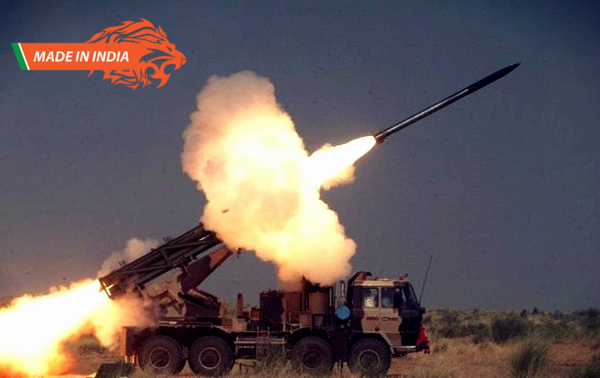
The Indian Army has expanded its Pinaka rocket artillery capability by operationalising its seventh regiment, strengthening its long-range strike capacity at a time of continued security pressure along both the western and northern borders. According to recent reporting, an eighth regiment has already received more than half its equipment and is expected to become operational before the end of 2026. Two more regiments are also likely to be raised next year, which would take the total number of Pinaka regiments in service to ten, while the Army’s longer-term objective remains a much larger fleet of 22 regiments.
Pinaka, developed by DRDO, has emerged as India’s flagship indigenous multi-barrel rocket launcher system. The earlier versions had a strike range of about 40 km, but the system has steadily evolved into a far more potent weapon. Newer variants such as the Guided Pinaka and the Pinaka Long Range Guided Rocket have pushed the reach up to 120 km, significantly improving the Army’s ability to conduct deeper precision strikes. A DRDO test in December 2025 successfully demonstrated the Pinaka Long Range Guided Rocket at its full 120-km range, with the rocket launched from an in-service Pinaka launcher, highlighting the platform’s expanding versatility.
The Army’s Pinaka expansion is tied closely to India’s broader push for defence self-reliance. In August 2020, the Ministry of Defence signed contracts worth about Rs 2,580 crore with Indian companies for six Pinaka regiments for the Regiment of Artillery. PIB said those six regiments comprised 114 launchers with Automated Gun Aiming and Positioning Systems, 45 command posts, and 330 vehicles, and were meant for deployment along the northern and eastern borders. The same release described the project as falling under the “Buy (Indian)” category with 70% indigenous content.
More recent information on PIB shows that the Pinaka ecosystem is continuing to deepen beyond launchers alone. The Ministry of Defence’s 2025 year-end review noted contracts for Area Denial Munition Type-1 for the Pinaka Multiple Launch Rocket System, High Explosive Pre-Fragmented Mk-1 enhanced rockets for Pinaka, and approval for long-range guided rocket ammunition for the Pinaka system. Taken together, these developments indicate that India is no longer just adding launcher regiments, but also broadening the ammunition family and operational flexibility of the weapon platform.
The latest induction also reflects a larger shift in Army artillery planning. Recent reports indicate that the Army currently fields about 15 rocket artillery regiments across three platforms, including seven Pinaka regiments, three Russian-origin Smerch regiments and five older BM-21 Grad units. Over time, the ageing Grad systems are expected to be replaced by additional Pinaka units, giving India a more standardised and increasingly indigenous rocket artillery arm.
Reference:
Times of India:
https://timesofindia.indiatimes.com/defence/news/amid-border-tension-army-adds-one-more-pinaka-regiment-to-its-arsenal-of-six-one-more-will-be-ready-by-year-end/articleshow/129668256.cms
PIB – MoD signs contracts worth Rs 2580 crore for six Pinaka regiments:
https://www.pib.gov.in/PressReleasePage.aspx?PRID=1650038
PIB – DRDO successfully conducts maiden flight test of Pinaka Long Range Guided Rocket:
https://www.pib.gov.in/PressReleseDetailm.aspx?PRID=2209588&lang=1®=3
PIB – Ministry of Defence Year End Review 2025:
https://www.pib.gov.in/PressReleasePage.aspx?PRID=2210154
You may also like
-
Solar Defence Expands Its Vision Towards Military Humanoid Robotics and Advanced Autonomous Defence Systems
-
AVTEC Strengthens India’s Indigenous Defence Manufacturing with Automatic Transmissions for Combat Vehicles
-
Jindal Defence–Taurus T9: Indian Army Showcases Made-in-India Submachine Gun
-
India–Australia Joint Military Exercise AUSTRAHIND 2026 Begins in Kerala with 240 Troops, New Zealand Joins as Observer
-
DRDO Advances Indigenous Compact Data Link Development for Small UAVs and Loitering Munitions
