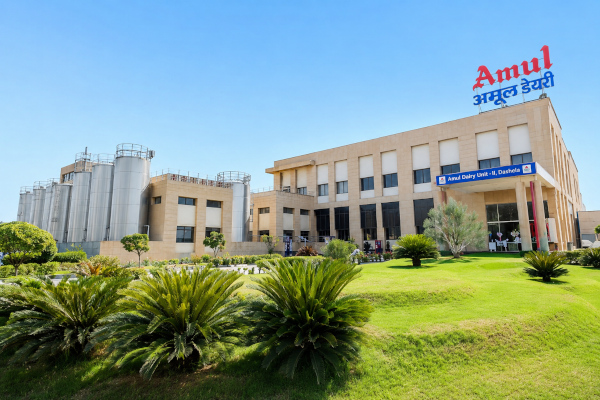
Union Home and Cooperation Minister Amit Shah inaugurated the new automated milk processing and packaging plant of Madhur Dairy Unit-2 at Dashela in Gandhinagar, Gujarat, on May 17, 2026. The facility has been presented as a major cooperative-sector investment aimed at strengthening farmer incomes, women-led dairy participation, and value-added milk processing under the broader “Sahkar Se Samriddhi” vision.
Built over 15 acres at an estimated cost of ₹128 crore, the modern plant currently has the capacity to process 2.5 lakh litres of milk per day. According to the official release, this capacity is expected to double to 5 lakh litres per day in the future, giving Madhur Dairy a stronger base for milk procurement, processing, packaging and distribution.
The inauguration was attended by Gujarat Chief Minister Bhupendrabhai Patel, Gujarat Minister Harsh Sanghavi and other dignitaries. Speaking at the event, Shah described the new facility not merely as an industrial project, but as an initiative linked directly to the economic empowerment of milk-producing families, especially rural women who form the backbone of Gujarat’s dairy cooperative movement.
Madhur Dairy’s own growth story reflects the scale of India’s cooperative dairy model. Established in 1971, the dairy began with milk collection of just 6,000 litres and a turnover of ₹7,000. It has since grown into an institution with an annual turnover of ₹628 crore, supported by a wider network of milk collection, processing and distribution.
The new plant also fits into the national push for “White Revolution 2.0,” which aims to significantly expand India’s milk production over the next decade. Shah said that Gujarat’s leading cooperative dairies, including Amul, Banas Dairy and Mehsana Dairy, have adopted advanced technologies to improve productivity and ensure that gains from the dairy value chain reach livestock farmers directly.
A major theme of the event was the role of women in the cooperative dairy economy. The PIB release states that nearly 36 lakh women are associated with milk production of around 3 crore litres per day, generating daily business worth approximately ₹200 crore through the cooperative network. This makes dairy not only an agricultural activity, but also a powerful rural income and women’s self-reliance platform.
The release also highlighted Amul’s AI Digital Assistant, “Sarlaben,” as a technology tool meant to support rural women and livestock farmers. The platform is expected to make digital assistance more accessible to ordinary dairy farmers by simplifying access to information and support services in the livestock economy.
Shah further said that the use of circular economy principles in the dairy sector could help increase dairy incomes by at least 20 percent in the coming years. This points to a wider shift in dairy policy from simple milk collection towards value addition, waste utilisation, technology integration and sustainability-led income growth.
The Madhur Dairy Unit-2 inauguration therefore represents more than the opening of another processing facility. It signals the next phase of India’s cooperative dairy model, where modern infrastructure, artificial intelligence, women-led rural enterprise, value-added nutrition products and circular economy practices are being brought together to strengthen farmer prosperity and rural development.
You may also like
-
HPCL Commissions India’s First Indigenous Blue Hydrogen Unit at Visakhapatnam Refinery
-
Bihar’s GI-Tagged Mithila Makhana Expands Global Reach as India Exports 7,265 Tonnes in FY26
-
NHPC Announces Commercial Operation of Fifth 250 MW Unit at Subansiri Lower Hydroelectric Project
-
India and New Zealand Strengthen Trade Ties with Electronic Origin Data Exchange Agreement Under FTA
-
India Hosts Agrivoltaics World Conference 2026, Unveils Plans for Major Solar Farming Expansion Under PM-KUSUM
