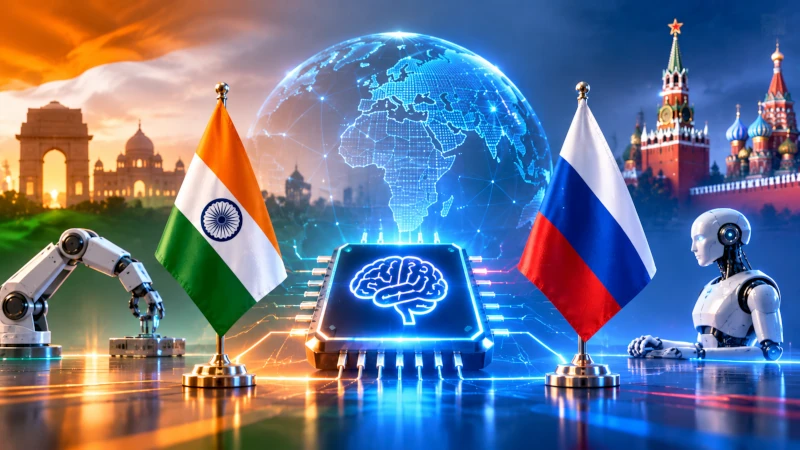
Indian artificial intelligence specialists joined researchers, technology developers and industry representatives from several countries at the AI Journey 2026 international conference in Moscow, Russia. Organised by Sberbank with the support of Russia’s Artificial Intelligence Alliance, the three-day conference ran from 26 to 28 November 2026, with its final day dedicated to fundamental scientific research, generative AI models and robotics. The participation of Indian specialists reflects India’s growing presence within the international artificial intelligence research and innovation ecosystem.
An International Platform for Artificial Intelligence Cooperation
AI Journey 2026 brought together more than 30 international AI speakers from countries including India, China, Brazil, Serbia, Kenya, Kazakhstan and Egypt. The conference provided a platform for researchers, entrepreneurs and technology enterprises to exchange knowledge, discuss emerging technological challenges and present developments in artificial intelligence. Its programme addressed both the scientific foundations of AI and the practical deployment of intelligent systems across various economic sectors.
The conference was organised around three principal themes covering society, business and science. This structure enabled participants to examine artificial intelligence from multiple perspectives, ranging from its influence on everyday life to its industrial applications and long-term scientific development. The programme combined online participation with in-person sessions at Sberbank’s headquarters in Moscow.
Indian Participation in the Global AI Innovation Ecosystem
Among the Indian participants featured in the conference programme was young technology entrepreneur Raul John Aju, who was invited to share his experience of developing a business using artificial intelligence. His participation highlighted the opportunities that increasingly accessible AI technologies are creating for young entrepreneurs and emerging technology enterprises. The engagement also provided an opportunity to showcase Indian entrepreneurial capabilities before an international technology audience.
India’s expanding artificial intelligence ecosystem encompasses startups, academic research institutions, software developers and enterprises working across healthcare, agriculture, financial services, manufacturing and education. Participation in international conferences enables Indian specialists to exchange perspectives with researchers and industry representatives working on similar technological challenges. These interactions can help identify opportunities for future research collaboration and knowledge exchange.
Scientific Research, Generative AI and Robotics
The concluding day of AI Journey 2026, held on 28 November, focused on scientific research and the next generation of artificial intelligence technologies. The scientific programme was inaugurated by Russian Deputy Prime Minister Dmitry Chernyshenko and Sberbank Senior Vice-President Andrey Belevtsev. Discussions centred on fundamental AI research, generative models, intelligent agents and robotics, with particular attention to the reliability and expanding capabilities of intelligent systems.
Researchers examined how artificial intelligence can contribute to scientific discovery and improve the ability of machines to interact with complex physical environments. Humanoid robotics and the application of intelligent machines in manufacturing, logistics and urban environments also featured in the programme. These discussions reflected the increasing convergence of artificial intelligence, advanced computing, engineering and physical automation.
BRICS+ Cooperation in Artificial Intelligence
The conference also hosted the BRICS+ AI Business Forum on 27 November 2026, bringing together representatives from participating economies to discuss industrial applications of artificial intelligence. The discussions examined the challenges involved in moving AI technologies from experimental projects to broader commercial and industrial deployment. Participants also explored areas where enterprises and research organisations from different countries could undertake collaborative technological development.
For India, engagement through such platforms provides opportunities to interact with emerging technology ecosystems beyond traditional international research networks. Collaboration across BRICS+ countries could facilitate knowledge exchange, industrial partnerships and discussions concerning the responsible development of artificial intelligence. The forum served as a platform for exploring these possibilities rather than announcing specific bilateral technology agreements.
Expanding India–Russia Technological Engagement
India and Russia have longstanding institutional relationships in science, engineering, space technology and advanced industrial development. Artificial intelligence represents an emerging area through which these established relationships could acquire additional dimensions. Both countries are developing domestic AI capabilities and exploring applications of intelligent technologies across public services, industrial production, healthcare and scientific research.
International conferences such as AI Journey provide opportunities for Indian and Russian specialists to exchange technical expertise and identify areas of complementary capability. Potential avenues of engagement include scientific computing, multilingual AI systems, industrial automation, robotics and specialised artificial intelligence applications. The realisation of such opportunities would depend on subsequent institutional engagement and the development of specific collaborative programmes.
Building International Partnerships for the Future of Artificial Intelligence
Indian participation in AI Journey 2026 demonstrates the importance of international engagement in the development of advanced technologies. As artificial intelligence increasingly influences scientific research, industrial productivity and economic development, exchanges between researchers and enterprises can contribute to a broader understanding of emerging opportunities and technological challenges. Such engagement also enables countries to strengthen domestic innovation capabilities through exposure to international research and industrial experience.
The Moscow conference provided an important platform for connecting Indian technology specialists with the wider international AI community. Continued participation in scientific and industrial forums could support India’s efforts to develop indigenous technological capabilities while establishing constructive international research partnerships. These exchanges can contribute towards building an artificial intelligence ecosystem that is innovative, reliable and responsive to diverse developmental requirements.
You may also like
-
L&T Secures Order to Develop 900 MWh Battery Energy Storage Project in Gujarat
-
Alpex Solar Commences Commercial Production at 2.2 GW TOPCon Solar Cell Facility
-
SEBI Explores Indigenous AI Model for India’s Securities Market
-
Indian Railways Completes Excavation of All 14 Tunnels in Sivok–Rangpo Railway Project
-
Ramnathapuram Mundu Chilli: Tamil Nadu’s Distinctive Round Chilli and Its Geographical Indication Heritage
