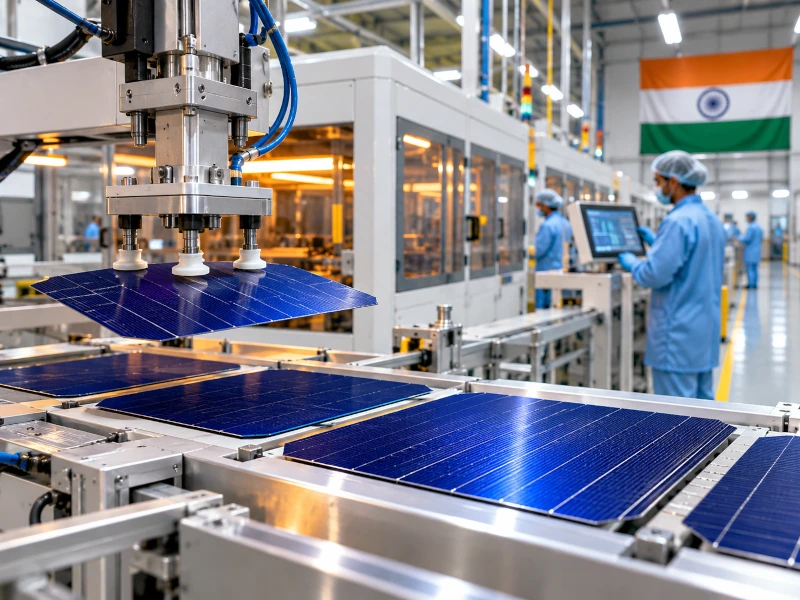
Alpex Solar Limited has commenced commercial production of G12R third-generation Tunnel Oxide Passivated Contact (TOPCon) solar cells at its manufacturing facility in Kosi-Kotwan, Mathura, Uttar Pradesh, with effect from 28 November 2026. The facility, with an installed manufacturing capacity of 2.2 gigawatts (GW), represents a significant milestone in the company’s transition towards integrated photovoltaic manufacturing. The development strengthens India’s domestic solar cell manufacturing capabilities while supporting the country’s efforts to build a more self-reliant renewable energy supply chain.
Advancing Domestic Solar Cell Manufacturing
The Kosi-Kotwan manufacturing facility, inaugurated in September 2026, has progressed through equipment installation, commissioning and trial production to commercial operations. The facility spans approximately 900,000 square feet and incorporates advanced automation, automated guided vehicles and precision laser processing systems. According to the company’s November 2026 investor presentation, the manufacturing technology supports solar cell conversion efficiencies of up to 26.5 per cent.
The commencement of commercial production enables Alpex Solar to manufacture a critical component of photovoltaic modules within its own industrial ecosystem. By integrating solar cell production with its existing module manufacturing operations, the company expects to improve supply reliability, product consistency and manufacturing quality. This backward integration could also reduce its dependence on externally sourced solar cells.
Third-Generation TOPCon Technology
TOPCon technology represents an advancement in crystalline silicon photovoltaic cell architecture, incorporating an ultrathin tunnel oxide layer and a passivated contact structure to reduce electrical losses. These technological improvements enable more efficient conversion of sunlight into electricity compared with conventional solar cell architectures. The technology has emerged as an important component of the global solar industry’s transition towards higher-efficiency photovoltaic products.
The G12R rectangular solar cell format provides manufacturers with additional flexibility in module design and dimensional optimisation. Combined with TOPCon technology, this architecture supports the development of high-performance photovoltaic modules for utility-scale solar installations, industrial applications and distributed renewable energy systems. Domestic manufacturing of such cells allows Indian companies to participate in increasingly sophisticated segments of the global photovoltaic value chain.
Advanced Automation and Technical Skill Development
Alpex Solar has equipped its manufacturing facility with automated production systems designed to support precision processing and consistent manufacturing standards. The facility incorporates Laser Enhanced Contact Optimisation (LECO) technology, which helps improve electrical contact formation during solar cell manufacturing. Automated material handling systems further support production efficiency and process consistency.
The company’s core engineering personnel have undergone specialised training in advanced solar cell manufacturing in Taiwan and China. The initiative supports the development of domestic technical expertise in photovoltaic processing, equipment operation and manufacturing yield optimisation. Building these capabilities within India is important for sustaining long-term competitiveness as solar manufacturing technologies continue to evolve.
Expanding Towards Wafer and Ingot Manufacturing
Following the commencement of commercial solar cell production, Alpex Solar has indicated that its next strategic focus will be the first phase of its silicon wafer and ingot manufacturing project. These upstream components form the foundation of crystalline silicon photovoltaic manufacturing, making their domestic production an important step towards deeper industrial integration. Establishing these capabilities would extend the company’s manufacturing operations beyond cells and modules into earlier stages of the photovoltaic supply chain.
According to its November 2026 investor presentation, the company is targeting June 2028 for the commencement of its first phase of wafer and ingot production. The project remains a future development and has not yet entered commercial operations. Its successful implementation would further strengthen the company’s ability to offer integrated photovoltaic manufacturing solutions.
ALMM List-II Approval Remains Pending
Alpex Solar has stated that an inspection for the inclusion of its solar cells under the Approved List of Models and Manufacturers (ALMM) List-II is expected during the week following its regulatory announcement. The framework is administered by the Ministry of New and Renewable Energy and identifies approved solar cell models and manufacturers for applicable domestic solar projects. Inclusion would support the company’s participation in projects subject to the relevant ALMM requirements.
While commercial production has officially commenced, ALMM List-II approval remains pending as of 28 November 2026. The regulatory process constitutes a separate milestone from the operational commencement of the manufacturing facility. Its completion would strengthen the company’s access to eligible segments of India’s expanding solar energy market.
Strengthening India’s Renewable Energy Manufacturing Ecosystem
India’s renewable energy expansion requires a manufacturing ecosystem capable of supplying advanced photovoltaic components at scale. Domestic solar cell production is particularly important because it enables Indian manufacturers to move beyond module assembly and develop capabilities in higher-value manufacturing processes. Facilities such as Alpex Solar’s Kosi-Kotwan plant contribute towards greater diversification and resilience within the country’s renewable energy supply chain.
The commencement of commercial production at the 2.2 GW facility demonstrates the growing participation of Indian private-sector enterprises in advanced photovoltaic manufacturing. Combined with investments in automation, technical skill development and upstream manufacturing, such initiatives can strengthen India’s industrial capabilities while supporting its clean energy transition. The continued expansion of integrated solar manufacturing will provide a stronger foundation for India’s long-term energy security, technological self-reliance and global renewable energy competitiveness.
You may also like
-
SEBI Explores Indigenous AI Model for India’s Securities Market
-
India Advances ₹26,968 Crore Space-Based Surveillance Programme with 52-Satellite Constellation
-
Indian Railways Completes Excavation of All 14 Tunnels in Sivok–Rangpo Railway Project
-
Ramnathapuram Mundu Chilli: Tamil Nadu’s Distinctive Round Chilli and Its Geographical Indication Heritage
-
Raise Financial Services Launches Indigenous AI-Powered TradingCharts Platform
