Chapter 4 — Jñāna Karma Sannyāsa Yoga
Ślokas 4–5
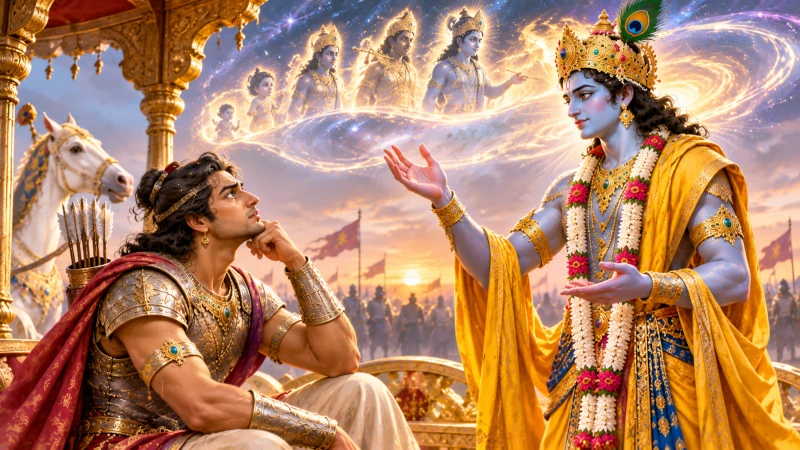
The Bhagavad Gita presents a profound dialogue concerning the nature of existence, consciousness, memory and divine knowledge when Arjuna questions Krishna about the ancient origins of Yoga. Having heard Krishna declare that he originally imparted this eternal wisdom to Vivasvan, the Sun god, Arjuna finds himself confronted with an apparent contradiction. Krishna’s response reveals the distinction between ordinary human consciousness and divine awareness, opening a philosophical discussion that transcends the conventional understanding of birth, death and time.
Arjuna’s Question: Understanding the Apparent Contradiction
Krishna had explained that the knowledge of Yoga was originally imparted to Vivasvan and subsequently transmitted to Manu and Ikshvaku. Arjuna, however, knew Krishna as his contemporary, companion and charioteer on the battlefield of Kurukshetra. He therefore questioned how someone born in his own era could have instructed a divine being associated with the earliest periods of creation.
Arjuna’s question reflects the natural limitations of human reasoning when confronted with realities extending beyond ordinary experience. Rather than accepting Krishna’s statement without examination, he seeks clarification through sincere inquiry. His approach illustrates the importance of questioning as a means of deepening philosophical understanding.
Bhagavad Gita — Chapter 4, Śloka 4
Sanskrit
अर्जुन उवाच ।
अपरं भवतो जन्म परं जन्म विवस्वतः ।
कथमेतद्विजानीयां त्वमादौ प्रोक्तवानिति ॥ ४ ॥
Transliteration
arjuna uvāca
aparaṁ bhavato janma
paraṁ janma vivasvataḥ
katham etad vijānīyāṁ
tvam ādau proktavān iti
English Translation
Arjuna said: Your birth occurred much later, while the birth of Vivasvan was in ancient times. How am I to understand that You imparted this teaching to him in the beginning?
Krishna’s Revelation: The Mystery of Many Births
Krishna responds by revealing that both he and Arjuna have passed through numerous births. The essential distinction, however, is that Krishna remembers them all, whereas Arjuna does not possess such awareness. This revelation introduces a fundamental difference between divine consciousness and the limited recollection associated with embodied human existence.
Within the philosophical framework of the Bhagavad Gita, the absence of memory does not necessarily establish the absence of previous existence. Krishna invites Arjuna to recognise that reality may extend beyond the boundaries of his personal experience. The dialogue consequently challenges the assumption that everything capable of being known must fall within the limits of ordinary human perception.
Bhagavad Gita — Chapter 4, Śloka 5
Sanskrit
श्रीभगवानुवाच ।
बहूनि मे व्यतीतानि जन्मानि तव चार्जुन ।
तान्यहं वेद सर्वाणि न त्वं वेत्थ परन्तप ॥ ५ ॥
Transliteration
śrī-bhagavān uvāca
bahūni me vyatītāni
janmāni tava cārjuna
tāny ahaṁ veda sarvāṇi
na tvaṁ vettha parantapa
English Translation
The Supreme Lord said: Many births have passed for both you and Me, O Arjuna. I know them all, but you do not know them, O subduer of enemies.
The Distinction Between Human and Divine Consciousness
Human awareness is shaped by experience, memory, sensory perception and the circumstances of embodied existence. An individual ordinarily remembers only a limited portion of their present life, while countless experiences gradually disappear from conscious recollection. Krishna’s revelation introduces a form of divine awareness that, according to the Gita, is not subject to these limitations.
The distinction is developed further in the subsequent verses, where Krishna describes his divine manifestation through his own spiritual power. His statement concerning previous births should therefore not be interpreted as suggesting that Krishna and Arjuna undergo identical forms of birth under identical circumstances. The Gita distinguishes the conditioned existence of embodied beings from the conscious manifestation of the Divine.
Memory Is Not the Measure of Reality
Arjuna’s uncertainty arises because he attempts to understand Krishna’s statement through the chronological boundaries of his own experience. From his perspective, Krishna’s present birth appears incompatible with the claim of having instructed Vivasvan in ancient times. Krishna’s response demonstrates that the limitations of an individual’s awareness do not necessarily define the limits of existence itself.
This philosophical insight encourages intellectual humility. Human beings frequently interpret unfamiliar circumstances according to their existing knowledge, personal experiences and assumptions, even when these provide only a partial understanding of reality. Recognising these limitations creates space for deeper inquiry, reflection and the acquisition of wisdom.
The Importance of Sincere Questioning
One of the most significant aspects of this dialogue is Krishna’s willingness to answer Arjuna’s question rather than dismiss his uncertainty. Arjuna expresses his difficulty openly, demonstrating that genuine spiritual inquiry need not be incompatible with devotion. His desire to understand becomes the foundation for receiving a more profound explanation of divine existence.
The Bhagavad Gita repeatedly presents knowledge as something that develops through dialogue, reflection and disciplined inquiry. Arjuna’s questions allow Krishna to elaborate upon concepts that might otherwise remain unexplored. The relationship between teacher and student is consequently strengthened through sincere engagement rather than unquestioning acceptance.
The Moral and Philosophical Significance
Human perception reveals only a fragment of a much larger reality. The limitations of our knowledge should encourage humility and inquiry rather than the assumption that everything beyond our understanding is impossible. Krishna’s response reminds Arjuna that individual memory and immediate experience do not necessarily encompass the entirety of existence.
The teaching also highlights the importance of recognising the difference between what is known, what remains unknown and what is assumed. Such awareness can encourage a more thoughtful approach to philosophical questions and the uncertainties encountered throughout life. Within the spiritual framework of the Bhagavad Gita, this openness becomes an important foundation for the pursuit of higher knowledge.
Relevance to Contemporary Life
In everyday life, individuals frequently make judgments based on incomplete information, limited experience and established assumptions. Personal disagreements, intellectual disputes and misunderstandings can arise when people regard their own perspective as the complete representation of reality. Arjuna’s inquiry offers an example of approaching uncertainty through respectful questioning rather than premature conclusions.
The lesson encourages individuals to remain receptive to knowledge that challenges their existing understanding. It does not require abandoning critical reasoning but recognising that reasoning itself benefits from additional information, experience and reflection. Intellectual humility can consequently contribute to better judgment, meaningful dialogue and continuous personal development.
Conclusion: Wisdom Begins with Recognising the Limits of Knowledge
The dialogue between Arjuna and Krishna in the fourth chapter of the Bhagavad Gita explores the relationship between human perception, divine consciousness and the nature of existence. Arjuna’s sincere question provides the opportunity for Krishna to reveal a dimension of reality that extends beyond ordinary memory and chronological understanding. The exchange establishes the philosophical foundation for Krishna’s subsequent teachings concerning divine manifestation.
The enduring message of these verses is that wisdom begins when individuals recognise the limitations of their own understanding and remain willing to explore deeper truths. Through sincere questioning, intellectual humility and spiritual reflection, human beings can progress beyond rigid assumptions towards a more comprehensive understanding of existence. The Bhagavad Gita thus presents the pursuit of knowledge as an enduring journey rather than a completed achievement.
Scriptural References
Śrīmad Bhagavad Gita — Chapter 4, Śloka 1: Krishna reveals that he originally imparted the eternal knowledge of Yoga to Vivasvan.
Chapter 4, Śloka 4: Arjuna questions how Krishna could have instructed Vivasvan in ancient times.
Chapter 4, Śloka 5: Krishna reveals the existence of numerous previous births and the distinction between his awareness and Arjuna’s recollection.
Chapter 4, Śloka 6: Krishna explains the divine nature of his manifestation despite being unborn and imperishable.
You may also like
-
Krishna Reveals the Ancient Lineage of the Gita: When Wisdom Is Lost Across Generations
-
King Janaka: The Ruler Who Reached Perfection Through Action
-
The Self Cannot Be Killed: Krishna’s First Great Teaching to Arjuna
-
Aranmula Parthasarathy Temple: The Krishna Shrine Where Mahabharata, Pamba and Kerala’s Temple Culture Meet
-
Procrastination and the Bhagavad Gita: Why We Delay the Life We Are Meant to Live
