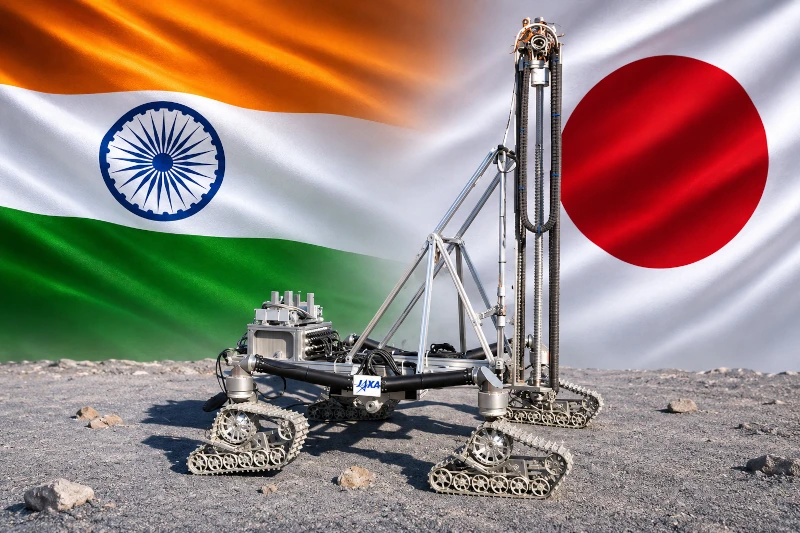
The Japan Aerospace Exploration Agency (JAXA) has unveiled a ground-test prototype of the lunar rover being developed for Chandrayaan-5, the joint India–Japan Lunar Polar Exploration (LUPEX) mission. Demonstrated on 25 November 2026 at JAXA’s Chofu Aerospace Centre in Tokyo, the rover represents an important engineering milestone in the collaborative lunar exploration programme. The mission is designed to investigate water resources and other volatile substances near the Moon’s south pole, advancing scientific understanding of the lunar environment and its potential resources for future space exploration.
JAXA Demonstrates Lunar Rover Mobility
JAXA showcased the mobility capabilities of the ground-test rover through a driving demonstration conducted on terrain designed to represent challenging lunar surface conditions. The demonstration involved navigating uneven surfaces, rocky obstacles and simulated depressions, providing engineers with opportunities to evaluate the vehicle’s mobility characteristics. Such terrestrial testing forms an important part of preparing robotic exploration systems for the demanding conditions of the lunar surface.
The prototype is an engineering test model rather than the final flight-qualified rover. Further development and qualification will be required to ensure that the operational vehicle can withstand launch conditions, extreme lunar temperatures, abrasive surface dust and the environmental challenges associated with exploration near the Moon’s south pole.
India and Japan Combine Their Space Exploration Capabilities
Chandrayaan-5 represents the first joint lunar surface exploration mission undertaken by the Indian Space Research Organisation (ISRO) and JAXA. Under the collaborative arrangement, ISRO is responsible for developing the lunar lander, while JAXA is developing the rover and providing the launch vehicle. Both space agencies are also contributing scientific instruments and engineering expertise to the mission.
The partnership brings together India’s experience in autonomous lunar landing and Japan’s capabilities in robotic mobility, spacecraft engineering and scientific instrumentation. The complementary responsibilities establish a framework for integrating technologies developed independently by the two countries into a coordinated lunar exploration system.
Investigating Water Resources at the Lunar South Pole
The principal scientific objective of LUPEX is to investigate the presence, quantity, distribution and physical characteristics of water resources in the Moon’s southern polar region. The mission will examine areas near permanently shadowed regions, where extremely low temperatures may allow water ice and other volatile materials to remain preserved over extended periods. Understanding these deposits is important for reconstructing the Moon’s geological and environmental history.
Unlike earlier missions that relied predominantly on remote observations, Chandrayaan-5 is intended to conduct direct investigations of lunar surface and subsurface materials. The rover will carry scientific instruments capable of examining the composition of the lunar environment and analysing samples for evidence of water and other volatile substances.
Scientific Instruments for Advanced Lunar Exploration
The LUPEX rover will carry a multidisciplinary suite of scientific instruments contributed by participating space agencies. These include equipment for analysing lunar samples, investigating subsurface structures, measuring hydrogen-related signatures and studying the physical properties of lunar soil. Together, these instruments are intended to provide complementary scientific observations of the polar environment.
India’s contributions include the ISRO Sample Analysis Package (ISAP), the Mid-Infrared Imaging Spectrometer (MIR) and the Permittivity and Thermophysical Investigation for Moon’s Aquatic Scout (PRATHIMA). The mission also incorporates international scientific participation, including a neutron spectrometer contributed by the United States’ National Aeronautics and Space Administration (NASA).
Building Upon India’s Chandrayaan Programme
Chandrayaan-5 represents the next stage in India’s sustained programme of lunar scientific exploration. Chandrayaan-1, launched in 2008, contributed important evidence of water-related molecules on the lunar surface, while Chandrayaan-2 expanded India’s capabilities in orbital lunar observations. Chandrayaan-3 subsequently demonstrated successful soft landing and robotic exploration near the Moon’s southern polar region in August 2023.
India is also developing Chandrayaan-4 as a lunar sample return mission, extending its technological capabilities into sample collection and return to Earth. Chandrayaan-5 complements these programmes by focusing on direct investigation of lunar polar resources through a collaborative robotic exploration platform. Together, these missions reflect the progressive expansion of India’s lunar science and exploration capabilities.
Why Lunar Water Matters for Future Space Exploration
Water resources on the Moon are of scientific interest because they may contain information about the origin, transportation and preservation of volatile substances throughout the Solar System. Investigating their distribution and composition could contribute to a better understanding of the Moon’s evolution and its interactions with the wider space environment.
Lunar water could also have potential applications in future human space exploration, including astronaut support and the production of oxygen and hydrogen. However, the feasibility of extracting and utilising these resources on an operational scale remains to be established. LUPEX is intended to contribute scientific evidence that can inform future assessments of lunar resource utilisation.
Strengthening India–Japan Space Cooperation
The Chandrayaan-5 programme represents a significant expansion of scientific and technological cooperation between India and Japan. Regular technical interface meetings between ISRO and JAXA have supported the coordination of spacecraft design, scientific instrumentation, engineering requirements and mission planning. The rover demonstration provides a visible indication of progress in the hardware development phase of this partnership.
International collaboration in space exploration enables participating countries to share specialised expertise, infrastructure and scientific resources. The LUPEX programme provides an opportunity for Indian and Japanese researchers to develop complementary capabilities while contributing to international scientific understanding of the Moon.
Chandrayaan-5 Targets a 2028 Launch
The mission is currently targeting a launch in 2028 aboard Japan’s H3 launch vehicle from the Tanegashima Space Centre. Before launch, the Indian lander, Japanese rover and associated scientific instruments will require further development, integration and comprehensive qualification. The mission schedule remains dependent on the successful completion of these engineering and operational preparations.
The unveiling of the ground-test rover should therefore be understood as an important developmental achievement rather than confirmation of mission readiness. Continued cooperation between ISRO and JAXA will be essential as the programme advances towards integrated spacecraft testing and eventual launch preparations.
Advancing Scientific Exploration of the Moon
JAXA’s demonstration of the Chandrayaan-5 rover prototype marks another important milestone in the joint India–Japan lunar exploration programme. By combining India’s lunar landing expertise with Japan’s robotic exploration technologies and international scientific instrumentation, LUPEX seeks to expand humanity’s understanding of the Moon’s polar environment. As development progresses towards the planned launch, the mission provides an opportunity to strengthen international scientific cooperation while establishing valuable knowledge for future generations of lunar exploration.
References
- Japan Aerospace Exploration Agency — LUPEX Rover Driving Test Media Materials and Press Briefing, 25 November 2026.
- Indian Space Research Organisation — ISRO and JAXA Gear Up for Joint Chandrayaan-5/LUPEX Mission in the Technical Interface Meet.
- Japan Aerospace Exploration Agency — Lunar Polar Exploration Mission, Official Mission Overview.
- Japan Aerospace Exploration Agency — JAXA–NASA Collaboration on LUPEX and Neutron Spectrometer Participation.
- The Japan Times — JAXA Unveils Test Model of Rover for Mission with India to Find Water on Moon, 26 November 2026.
- The Indian Express — Japan Space Agency Unveils Chandrayaan-5 Rover Prototype Ahead of 2028 Lunar Mission, 27 November 2026.
You may also like
-
New Technology Developed for Stable, Tunable and Scalable White LEDs
-
Indian Scientists Pioneer Solar Particle Detection from Both Polar Regions
-
IIT Kanpur and Rolls-Royce Partner to Advance Aircraft Cabin Noise Reduction Technologies
-
First North-East India-Specific Antivenom Developed Against Neglected Pit Vipers Species
-
ISRO Advances Preparations for First Uncrewed Gaganyaan Mission
