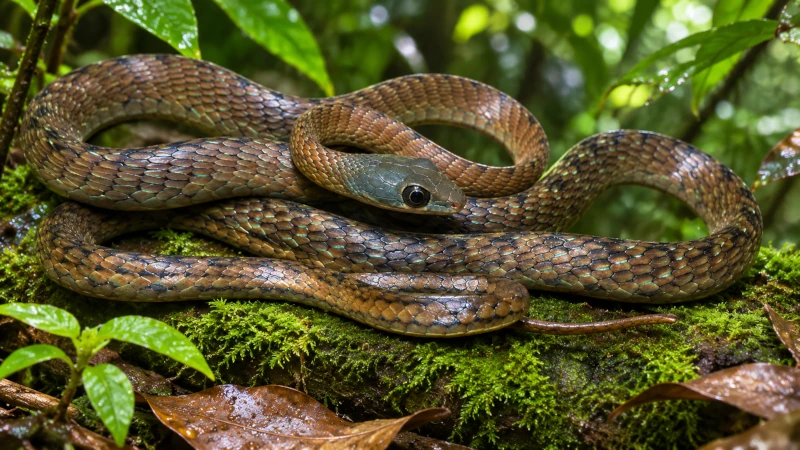
Researchers have formally described a new species of non-venomous tree snake from India’s Western Ghats, naming it Dendrelaphis beddomei, or Beddome’s bronzeback. The scientific description, published on 12 November 2026 in the international journal Taprobanica, resolves longstanding confusion surrounding the closely related large-eyed bronzeback (Dendrelaphis grandoculis). The discovery highlights the remarkable reptilian diversity of the Western Ghats and the importance of combining traditional taxonomic research with contemporary citizen-science observations.
Resolving a Longstanding Taxonomic Mystery
The research was undertaken by S.R. Ganesh, S.N. Poornaprajna, Ashok Kumar Mallik and Gernot Vogel, representing scientific institutions in India and Germany. Their investigation involved comparisons of preserved specimens, historical zoological collections and photographic records of living snakes. The researchers established that specimens previously assigned to the large-eyed bronzeback represented two distinct species.
The study also provides a revised scientific description of Dendrelaphis grandoculis and an updated identification key for southern Indian members of the genus Dendrelaphis. This revision will assist researchers in distinguishing closely related species and improve the accuracy of future biodiversity documentation.
Discovery in the Foothills of Karnataka’s Western Ghats
The formal description of Beddome’s bronzeback was based on two specimens recovered as roadkill in January 2012 from Sullia in Karnataka’s Dakshina Kannada district. These specimens provided the physical material necessary for detailed morphological examination and comparison with previously documented species. Additional records of living individuals helped researchers assess variations in external appearance.
The newly recognised species predominantly inhabits the lower, rain-facing slopes of the Western Ghats. These landscapes contain diverse vegetation and climatic conditions that support numerous specialised reptiles, amphibians and other organisms. The discovery reinforces the scientific importance of foothill ecosystems, which can harbour distinctive biodiversity alongside the better-known high-elevation forests of the mountain range.
Distinctive Physical Characteristics of Beddome’s Bronzeback
Beddome’s bronzeback possesses several morphological characteristics that distinguish it from the large-eyed bronzeback. These include a greater number of scales beneath the tail, differences in the arrangement of scales around the eyes and a comparatively elongated loreal scale. Its red or pink tongue provides another distinguishing characteristic when compared with the darker tongue of its close relative.
Many individuals also exhibit pale markings along their lower flanks, while some possess prominent dark patches across the upper body. The combination of these features enabled researchers to establish a reliable scientific distinction between the two species. Such detailed morphological comparisons remain fundamental to reptile taxonomy, particularly when closely related species share similar external appearances.
Honouring Richard Henry Beddome
The species has been named in honour of Colonel Richard Henry Beddome (1830–1911), a naturalist whose research contributed extensively to the documentation of southern India’s biodiversity. His work encompassed botany, reptiles and amphibians, with particular attention to the biological wealth of the Western Ghats. The proposed common name, Beddome’s bronzeback, commemorates his contributions to the region’s natural history.
The naming also establishes a connection between historical natural history investigations and contemporary biodiversity research. Historical collections and scientific descriptions continue to provide valuable comparative material for researchers investigating species identities, geographical distributions and evolutionary relationships.
Citizen Science Contributes to Biodiversity Research
An important aspect of the discovery was the contribution of photographic observations submitted through citizen-science platforms. These records supplemented preserved specimens by providing information about the appearance and variation of snakes encountered in their natural habitats. The integration of public observations with formal scientific examination helped researchers develop a more comprehensive understanding of the newly described species.
Citizen science has become an increasingly valuable component of biodiversity documentation, particularly in geographically extensive and ecologically diverse regions such as the Western Ghats. Responsible wildlife photography and accurate recording of observations can provide researchers with information that might otherwise remain undocumented. Scientific validation of these records ensures that public participation contributes meaningfully to formal biodiversity research.
The Ecological Importance of Bronzeback Tree Snakes
Bronzeback snakes belong to the genus Dendrelaphis, a group of predominantly arboreal reptiles within the family Colubridae. Their slender bodies and agility enable them to navigate trees, shrubs and other vegetation, where they form part of forest and woodland food webs. As predators of small animals, bronzebacks contribute to the ecological interactions that sustain functioning terrestrial ecosystems.
The recognition of additional species within this genus improves scientific understanding of reptile diversity and geographical distribution. Accurate species identification is particularly important for ecological assessments because closely related animals may occupy different habitats or face different environmental pressures. Continued research into Beddome’s bronzeback will help establish a clearer understanding of its ecology and conservation requirements.
Western Ghats Continue to Reveal Undocumented Biodiversity
The Western Ghats constitute one of the world’s recognised biodiversity hotspots, supporting numerous endemic species of plants, reptiles, amphibians, birds and mammals. Despite centuries of scientific exploration, the region continues to reveal previously undocumented species and taxonomic relationships. Discoveries such as Beddome’s bronzeback demonstrate that even animals encountered in relatively accessible landscapes may remain scientifically misunderstood for considerable periods.
The identification of new species also reinforces the importance of conserving habitats beyond formally protected forest areas. Foothill landscapes, agricultural mosaics, riverine vegetation and forest corridors can contribute to maintaining regional biodiversity. Comprehensive conservation approaches therefore require an understanding of ecological connectivity across both protected and human-modified landscapes.
Conservation Significance of the Discovery
The recovery of the specimens used in the scientific description as roadkill illustrates one of the ways reptiles encounter human infrastructure. Roads passing through wildlife habitats can expose arboreal and terrestrial species to vehicle collisions while fragmenting their natural environments. However, the population status and specific conservation requirements of Beddome’s bronzeback require further investigation.
Formal recognition of the species provides a foundation for future studies of its distribution, habitat preferences, abundance and ecological relationships. Establishing reliable baseline information will enable researchers to assess potential threats and determine whether targeted conservation measures are necessary. Continued field surveys and responsible citizen-science documentation can contribute to this process.
Expanding India’s Scientific Understanding of Its Natural Heritage
The formal description of Beddome’s bronzeback adds another distinctive species to the documented reptilian diversity of India’s Western Ghats. By combining historical specimens, detailed morphological research and citizen-science observations, the researchers have resolved a longstanding taxonomic uncertainty while creating opportunities for further ecological investigation. Continued investment in biodiversity research, scientific collections and habitat conservation will help India better understand and preserve the extraordinary natural heritage of the Western Ghats for future generations.
References
- Ganesh, S.R., Poornaprajna, S.N., Mallik, A.K. and Vogel, G. (2026). A New Species of Dendrelaphis (Serpentes: Colubridae) from the Western Ghats, Related to D. grandoculis, with a Revised Identification Key to Southern Indian Species. Taprobanica, Volume 15, Number 2, pp. 388–399.
- DOI: 10.47605/tapro.v15i2.436.
- Down To Earth — New Species of Tree Snake Identified in Western Ghats, November 2026.
You may also like
-
Indian Scientists Discover New Bioluminescent Cardinalfish Species in Bay of Bengal
-
Scientists Discover New Grasshopper Species in Nagaland
-
Three Uncommon Bird Sightings Highlight Tripura’s Sukhsagar Wetland Biodiversity
-
Wild Asian Elephants Reestablish Resident Population in Madhya Pradesh’s Bandhavgarh Forest Landscape
-
Indian Researchers Discover Two New Cave-Dwelling Gecko Species in Meghalaya
