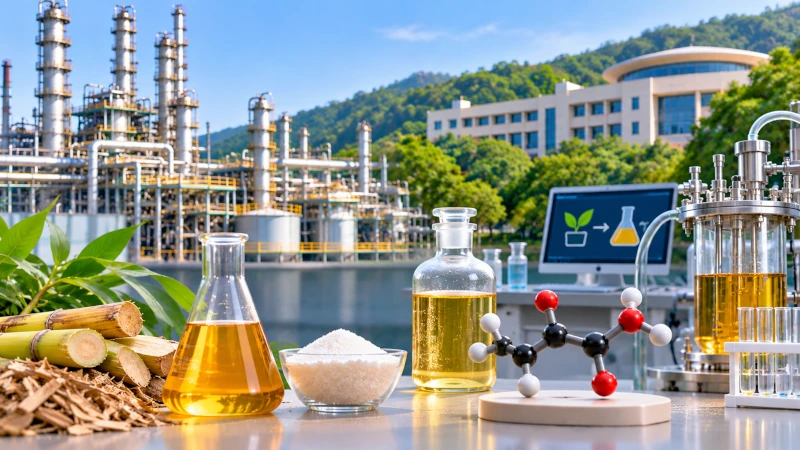
Numaligarh Refinery Limited (NRL) and the Indian Institute of Technology Guwahati (IIT Guwahati) have signed a Memorandum of Agreement (MoA) to jointly develop an indigenous process for producing levulinic acid using glucose feedstock supplied by NRL. Signed on 27 November 2026 at the NRL Centre in Guwahati, the agreement brings together industrial resources and academic research expertise to advance domestic capabilities in bio-based specialty chemicals. The collaboration represents an important research initiative supporting India’s bioeconomy, sustainable chemical manufacturing and technological self-reliance.
Developing Indigenous Bio-Based Chemical Technology
The agreement establishes a framework for developing a domestic production process for levulinic acid, a versatile chemical derived from carbohydrate-rich feedstocks. NRL will contribute its glucose feedstock resources, while IIT Guwahati will provide research and chemical engineering expertise. The collaboration seeks to develop an indigenous technological pathway that could support future industrial applications, subject to successful research, process validation and commercial evaluation.
Developing domestic production technologies for specialty chemicals can help Indian industries reduce dependence on externally developed processes and imported chemical intermediates. Such initiatives also provide opportunities to create indigenous intellectual property and strengthen collaboration between publicly funded research institutions and industrial enterprises.
Levulinic Acid: A Versatile Bio-Based Platform Chemical
Levulinic acid is an organic compound that can be produced from biomass-derived carbohydrates, including glucose. Its molecular structure makes it a valuable platform chemical from which several other industrial compounds can be developed. Its potential applications extend across pharmaceuticals, polymers, solvents, fuel additives, plasticisers and specialty chemical formulations.
The significance of levulinic acid lies in its ability to serve as an intermediate between renewable biological resources and industrial chemical manufacturing. Conventional chemical production frequently depends on petroleum-derived feedstocks, whereas bio-based production pathways offer opportunities to diversify raw material sources. The economic and environmental advantages of such processes depend on feedstock availability, production efficiency and the overall lifecycle impact of manufacturing.
Supporting India’s Emerging Biorefinery Ecosystem
The collaboration aligns with the broader concept of biorefineries, which seek to convert renewable biological resources into fuels, chemicals, materials and other value-added products. Unlike conventional petroleum refineries, biorefineries utilise biological feedstocks to produce multiple industrial outputs. Integrating specialty chemical production into such facilities can improve resource utilisation and diversify industrial revenue streams.
For Numaligarh Refinery, research into glucose-based chemical production represents an opportunity to expand its technological capabilities beyond conventional petroleum refining. The development of value-added biochemical processes could complement its wider engagement with renewable feedstocks and sustainable industrial technologies. Successful commercialisation would, however, require further technical and economic assessment.
IIT Guwahati’s Expertise in Biomass Conversion
IIT Guwahati has established research capabilities in chemical engineering, biomass conversion, sustainable materials and biorefinery technologies. The institute’s published research activities include investigations into carbohydrate conversion for levulinic acid and formic acid production, as well as the development of economical processes for extracting value from waste biomass. These existing capabilities provide a relevant scientific foundation for the new collaboration.
Industry-academia partnerships enable researchers to address practical manufacturing requirements while giving industrial enterprises access to specialised scientific expertise. Such cooperation can help bridge the gap between laboratory discoveries and potential industrial applications through process optimisation, experimental validation and subsequent scale-up assessments.
Building on an Established Industry-Academia Partnership
The latest agreement builds upon an established relationship between Numaligarh Refinery and IIT Guwahati in sustainable industrial technology development. In 2019, the two institutions collaborated to establish the NRL Centre of Excellence for Sustainable Materials at IIT Guwahati. The initiative focused on developing useful materials from waste and by-products generated by petroleum industries, biorefineries and agricultural enterprises.
The institutions also entered into an agreement in 2023 to develop technology for producing green activated carbon from bamboo dust. These earlier collaborations demonstrate a continuing interest in biomass utilisation, industrial waste valorisation and sustainable material development. The levulinic acid initiative extends this research relationship into the field of bio-based specialty chemicals.
Strengthening Northeast India’s Industrial Research Ecosystem
Northeast India possesses substantial biological resources, agricultural diversity and opportunities for developing biomass-based industries. Research into converting renewable feedstocks into commercially valuable chemicals could contribute to the region’s industrial diversification while encouraging greater utilisation of locally available resources. Such opportunities are particularly relevant to Assam’s evolving energy, petrochemical and biochemical manufacturing ecosystem.
The participation of a major public sector refinery and a leading technical institution creates a framework for connecting industrial requirements with regional scientific expertise. Over time, successful research collaborations could support specialised employment, technological entrepreneurship and the development of associated manufacturing enterprises in Northeast India.
Potential Applications in Pharmaceuticals and Advanced Materials
Levulinic acid and its derivatives have potential applications in pharmaceutical intermediates, speciality solvents, polymer manufacturing and renewable chemical products. Derivatives such as gamma-valerolactone and levulinate esters are also being investigated for applications in industrial solvents, fuel-related products and sustainable chemical synthesis. The versatility of these compounds makes levulinic acid an important subject of contemporary biochemical research.
Developing competitive indigenous production processes could provide Indian chemical manufacturers with additional sources of industrial raw materials. However, the commercial viability of these applications will depend on achievable production costs, product purity, manufacturing scalability and market demand. The agreement between NRL and IIT Guwahati represents an initial technological development initiative rather than confirmation of an established commercial supply chain.
Supporting India’s BioE3 and Atmanirbhar Bharat Objectives
The collaboration is consistent with the broader objectives of India’s BioE3 Policy, which promotes biotechnology for the economy, environment and employment through high-performance biomanufacturing. The development of bio-based chemicals represents an important area within the country’s wider transition towards sustainable industrial technologies. Indigenous process development can complement these objectives by strengthening domestic research, manufacturing expertise and intellectual property creation.
Partnerships between public sector enterprises and academic institutions also contribute to the technological self-reliance envisioned under Atmanirbhar Bharat. By connecting industrial feedstock resources with scientific research capabilities, such initiatives can establish pathways for developing technologies suited to India’s manufacturing requirements and resource availability.
Advancing Towards Indigenous Sustainable Chemical Manufacturing
The agreement between Numaligarh Refinery and IIT Guwahati represents another step towards developing India’s domestic capabilities in bio-based specialty chemicals. By combining industrial resources with academic research expertise, the collaboration provides a foundation for investigating economically viable and sustainable production pathways for levulinic acid. As the technology progresses through research, validation and potential industrial scale-up, it could contribute to India’s expanding bioeconomy, strengthen Northeast India’s industrial ecosystem and support the development of indigenous chemical manufacturing technologies.
References
- PSU Connect — NRL, IIT Guwahati Sign MoA for Indigenous Levulinic Acid Technology, 27 November 2026.
- Indian Masterminds — NRL and IIT Guwahati Join Hands to Develop Indigenous Levulinic Acid Production Technology, 27 November 2026.
- IIT Guwahati, Department of Chemical Engineering — Research Projects on Carbohydrate Conversion and Levulinic Acid Production.
- Numaligarh Refinery Limited — Research and Development Policy.
- IIT Guwahati — NRL Centre of Excellence for Sustainable Materials.
You may also like
-
Raise Financial Services Launches Indigenous AI-Powered TradingCharts Platform
-
UPI to Remain Free for Consumers as India Strengthens Digital Payment Infrastructure
-
Hindustan Mag and Prozeal Green Energy Plan 600-Tonne Rare-Earth Magnet Facility in Gujarat
-
Indian Traditional Artisans Record ₹2.07 Crore in Sales at India International Trade Fair
-
Omnitech Engineering Secures Development Order from BrahMos Aerospace
