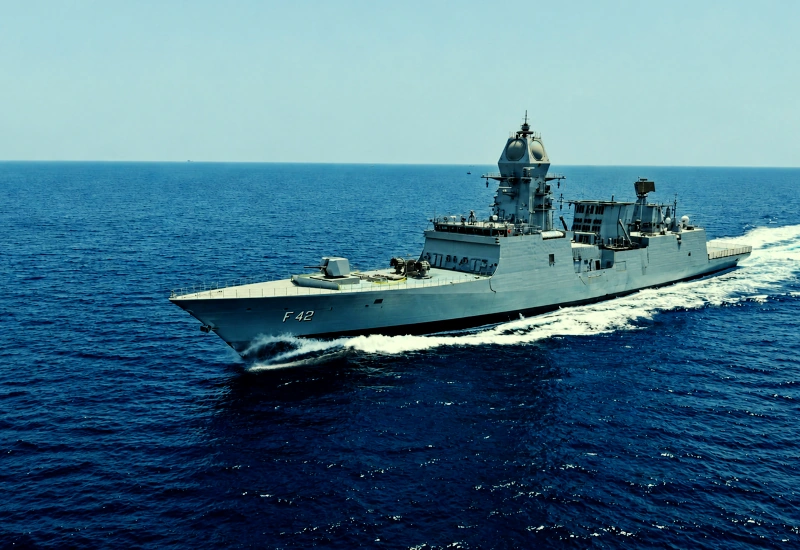
India achieved a significant milestone in indigenous naval shipbuilding on 27 November 2026 with the delivery of Vindhyagiri (Yard 3024), the seventh and final advanced stealth frigate of the Nilgiri-class Project 17A, to the Indian Navy. Constructed by Garden Reach Shipbuilders and Engineers Limited (GRSE), the warship was handed over at the company’s shipyard in Kolkata. The delivery marks the successful culmination of Project 17A ship deliveries, demonstrating India’s growing capabilities in indigenous warship design, advanced naval engineering and complex defence manufacturing.
Completion of Project 17A
The delivery of Vindhyagiri completes one of India’s major indigenous surface combatant construction programmes. All seven Project 17A frigates have now been delivered to the Indian Navy within approximately 23 months of the delivery of the first-of-class warship, Nilgiri, on 20 December 2024. Vindhyagiri is also the third frigate of the class constructed by GRSE, highlighting the shipyard’s contribution to India’s naval modernisation and indigenous defence manufacturing capabilities.
Project 17A represents a technological advancement over the preceding Project 17 Shivalik-class frigates, incorporating improvements in stealth, automation, survivability and combat capabilities. Conceived as versatile multi-mission platforms, these warships are designed to address evolving maritime security challenges across multiple operational domains. Their delivery strengthens the material foundation of the Indian Navy’s fleet modernisation programme.
Indigenous Design and Advanced Naval Engineering
The Project 17A frigates were designed by the Indian Navy’s Warship Design Bureau, with the construction of Vindhyagiri overseen by the Warship Overseeing Team in Kolkata. The programme demonstrates the institutional capabilities developed within the Indian Navy and domestic shipbuilding industry to design and construct sophisticated surface combatants. The integration of advanced engineering systems, weapons, sensors and platform management technologies represents a significant progression in India’s indigenous naval design capabilities.
Vindhyagiri incorporates a Combined Diesel or Gas (CODOG) propulsion configuration, featuring diesel engines and gas turbines driving controllable-pitch propellers on each shaft. The propulsion architecture provides operational flexibility to meet varying mission requirements. The frigate also incorporates an advanced Integrated Platform Management System (IPMS), supporting automated monitoring and management of essential onboard systems.
Enhanced Multi-Dimensional Warfare Capabilities
The Nilgiri-class frigates feature an advanced suite of weapons and sensors designed to support anti-surface, anti-air and anti-submarine warfare operations. Compared with the earlier Shivalik-class frigates, Project 17A incorporates technological improvements intended to enhance combat effectiveness and survivability in increasingly complex maritime environments. The combination of advanced sensors, integrated systems and improved stealth characteristics enables the frigates to undertake a broad range of naval missions.
These capabilities are particularly relevant to India’s expanding maritime responsibilities across the Indian Ocean Region. The multi-mission architecture provides the Indian Navy with greater flexibility in undertaking fleet protection, maritime security and other operational assignments. Following their respective commissioning and operational integration, the frigates will contribute to the progressive strengthening of India’s surface combatant fleet.
Significant Reduction in Warship Construction Time
One of the notable achievements of Project 17A has been the progressive reduction in warship construction timelines. Vindhyagiri was completed within a build period of 68 months, compared with the 84 months required for the first-of-class Nilgiri. This represents a reduction of 16 months, reflecting the institutional experience accumulated during the construction of the preceding six frigates.
The improvement demonstrates the benefits of continuity in indigenous warship construction programmes, where accumulated engineering knowledge, production experience and systems integration expertise can contribute to greater manufacturing efficiency. The completion of all seven ship deliveries within a relatively compressed period also underscores the coordination between the Indian Navy, domestic shipyards and their industrial partners. These capabilities provide a valuable foundation for future indigenous naval construction programmes.
75 Per Cent Indigenisation and Strengthening of India’s Defence Industrial Ecosystem
Project 17A has achieved an indigenous content of 75 per cent, reflecting the expanding participation of Indian industry in advanced naval platform construction. More than 200 micro, small and medium enterprises (MSMEs) have participated in the programme, contributing to the development of a wider domestic industrial ecosystem supporting warship manufacturing. Their involvement demonstrates the importance of integrating specialised manufacturing enterprises into major national defence projects.
According to the Ministry of Defence, the programme has generated direct employment for approximately 4,000 personnel and indirect employment for more than 10,000 individuals. Beyond employment generation, the project has contributed to the development of specialised engineering expertise, manufacturing capabilities and industrial experience within the domestic supply chain. Such industrial participation strengthens India’s long-term ability to support indigenous naval construction and sustain complex maritime platforms.
Continuing the Legacy of INS Vindhyagiri
Named after the Vindhyagiri mountain range in Karnataka, the new frigate carries forward the legacy of the erstwhile INS Vindhyagiri, a Leander-class frigate that served the Indian Navy from 8 July 1981 to 11 June 2012. The earlier warship rendered nearly 31 years of service to the nation, forming part of an earlier generation of India’s naval surface combatants. The new Vindhyagiri continues this naval heritage through a platform incorporating contemporary indigenous design and advanced maritime technologies.
The transition from the earlier Leander-class frigate to the technologically advanced Project 17A platform also illustrates the evolution of India’s naval engineering capabilities over successive decades. While preserving the historical identity associated with the warship’s name, the new frigate embodies the Indian Navy’s continuing emphasis on technological modernisation and self-reliance.
Advancing India’s Aatmanirbharta in Naval Shipbuilding
The delivery of Vindhyagiri represents more than the completion of a seven-warship construction programme. It demonstrates India’s ability to combine indigenous naval design, advanced engineering, industrial participation and progressively improved manufacturing timelines within a major defence acquisition initiative. The experience gained through Project 17A will provide an important foundation for subsequent generations of domestically designed and constructed naval platforms.
With all seven Nilgiri-class frigates delivered, Project 17A stands as a significant achievement in India’s pursuit of Aatmanirbharta in defence manufacturing. Its combination of technological advancement, industrial development, employment generation and maritime capability enhancement illustrates the broader national value of indigenous warship construction. The programme reinforces India’s ability to build a modern naval force supported by an increasingly capable domestic defence industrial ecosystem.
Source: Ministry of Defence, Press Information Bureau, Government of India — Delivery of Vindhyagiri (Y3024), Project 17A Indigenous Advanced Stealth Frigate, published on 27 November 2026 at 6:04 PM.
You may also like
-
ISRO Successfully Tests Indigenous Gas Generator for Next-Generation Methane Rocket Engine
-
Chariot AI Launches Indigenous Foundation Models Under IndiaAI Mission
-
Walchandnagar Industries Secures ₹18.46 Crore Universal Vertical Launcher Order
-
BPCL Inaugurates New Lubricant Blending Plant and Base Oil Terminal at Rasayani
-
India Optel Commences Production of Indigenous CM-3 MR Sight at Dehradun
