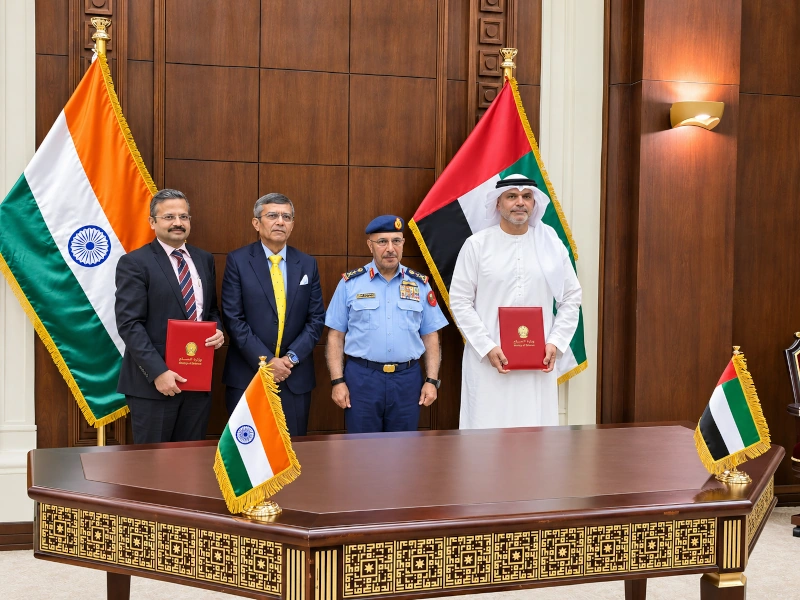
India and the United Arab Emirates (UAE) have agreed to accelerate the co-development and co-production of next-generation defence equipment, marking a further expansion of their strategic defence partnership. The decision was taken during the 14th meeting of the India-UAE Joint Defence Cooperation Committee (JDCC), held in Abu Dhabi on 26 November 2026. Both countries also agreed to strengthen cooperation in defence manufacturing, advanced technologies, artificial intelligence, cybersecurity, military training and maritime safety.
Advancing the India-UAE Strategic Defence Partnership
The meeting was co-chaired by Indian Defence Secretary Rajesh Kumar Singh and Lieutenant General Ibrahim Nasser M. Al Alawi, Under Secretary of the UAE Ministry of Defence. The discussions provided strategic direction to the initiatives outlined in the India-UAE Strategic Defence Partnership Framework, signed in May 2026 during the Indian Prime Minister’s visit to the UAE. The framework provides an institutional foundation for expanding bilateral defence engagement across industrial, technological and operational domains.
Both sides agreed to accelerate partnerships focused on the joint development and manufacturing of next-generation defence equipment. The initiative reflects an emphasis on expanding bilateral defence relations beyond conventional military engagement towards industrial collaboration and technological development. The official announcement, however, did not identify specific defence platforms, manufacturing projects, investment commitments or implementation timelines.
Artificial Intelligence and Advanced Defence Technologies
India and the UAE identified defence innovation, advanced technologies, artificial intelligence and cybersecurity as important areas for expanding bilateral cooperation. The inclusion of these domains reflects the growing importance of emerging technologies in contemporary defence modernisation. Cooperation in these areas could create opportunities for research institutions, defence technology companies and industrial partners from both countries.
Military training and maritime safety were also identified as priority areas for bilateral engagement. These areas complement the broader strategic partnership between India and the UAE, particularly given their geographical proximity to important maritime trade routes connecting the Arabian Sea and the Gulf region. The co-chairs agreed to periodically review the progress of bilateral defence initiatives before the next JDCC meeting.
Strengthening Defence Industrial Partnerships
A delegation representing the Indian defence industry accompanied the official Indian delegation to Abu Dhabi to facilitate business-to-business partnerships. Representatives of defence companies from both countries participated in a dedicated interaction organised on the sidelines of the JDCC meeting. The engagement provided a platform for exploring potential industrial partnerships and identifying areas of mutual technological and manufacturing interest.
The Indian defence industry delegation also visited Tawazun Industrial Park and held discussions with the UAE’s Tawazun Economic Council. These engagements were intended to identify potential areas of cooperation between Indian and Emirati defence enterprises. While no individual commercial agreements were announced, the interactions represent an institutional effort to connect the defence industrial ecosystems of both countries and facilitate future collaboration.
Strategic Consultations on Gulf and West Asian Security
The Indian delegation, led by Defence Secretary Rajesh Kumar Singh, also called on UAE Minister of State for Defence Affairs Mohamed bin Mubarak Fadhel Al Mazrouei. The two dignitaries exchanged views on the emerging geopolitical situation in the Gulf and West Asia and reaffirmed their commitment to strengthening the India-UAE Strategic Defence Partnership. The Indian Defence Secretary also conveyed greetings from Defence Minister Rajnath Singh.
The Indian delegation included representatives from the Department of Defence, the Indian Armed Forces, the National Security Council Secretariat and the Ministry of External Affairs. Earlier, the Defence Secretary paid solemn tributes at Wahat Al Karama in Abu Dhabi, a memorial dedicated to those who sacrificed their lives in the service of the UAE. The visit combined strategic consultations, institutional engagement and defence industrial outreach.
Opportunities for India’s Defence Manufacturing Ecosystem
The proposed expansion of joint development and production partnerships holds significance for India’s growing indigenous defence manufacturing ecosystem. Collaboration with Emirati industrial partners could provide Indian enterprises with opportunities to participate in joint research, technology development, manufacturing and international defence supply chains. Such partnerships would complement India’s broader efforts to strengthen domestic defence industrial capabilities and expand its international defence manufacturing relationships.
The emphasis on business-to-business engagement also creates potential opportunities for established defence manufacturers, specialised engineering enterprises and emerging defence technology companies. The commercial and technological outcomes of these engagements will depend on subsequent agreements, project identification and implementation by the participating organisations. The periodic review mechanism agreed upon during the JDCC meeting is intended to maintain institutional continuity and assess progress across the identified areas of cooperation.
Building an Enduring Strategic Defence Partnership
India and the UAE share centuries-old historical relationships rooted in maritime trade, cultural exchanges and strong people-to-people connections. The evolution of these ties into a strategic partnership, encompassing defence and security cooperation, reflects the widening scope of bilateral engagement. The decisions taken at the 14th JDCC meeting further strengthen the institutional foundations established under the Strategic Defence Partnership Framework.
By prioritising joint manufacturing, defence innovation, advanced technologies and sustained institutional engagement, India and the UAE are laying the groundwork for a more comprehensive defence relationship. The translation of these commitments into concrete industrial and technological projects could contribute to the development of mutually beneficial capabilities, stronger defence manufacturing ecosystems and enduring strategic cooperation between the two nations.
Source: Press Information Bureau, Ministry of Defence, Government of India — 26 November 2026, 8:00 PM.
You may also like
-
Colombo Security Conclave Adopts 2026–2027 Roadmap to Strengthen Indian Ocean Security
-
Kadet Defence Systems’ Indigenous JX3-30 Jet UAV Completes 50 Flights
-
Speed4 Defence Systems to Establish ₹50-Crore Defence Manufacturing Facility in Assam
-
IAF Expected to Receive First Made-in-India C-295 by December 2026
-
India Reaffirms Commitment to Indian Ocean Security at Eighth Colombo Security Conclave
