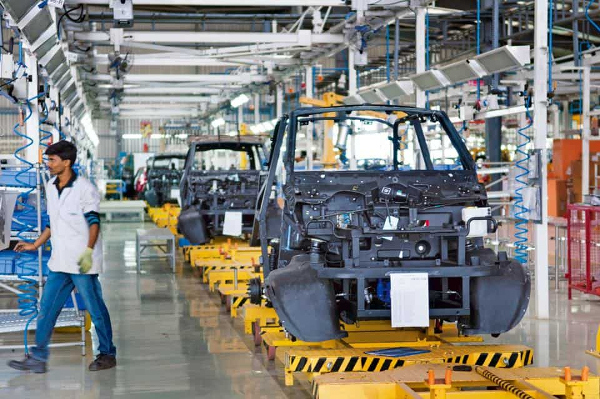
India’s Production Linked Incentive (PLI) Scheme for the Automobile and Auto Component Industry has attracted cumulative investments of ₹52,806 crore as of 30 September 2026, exceeding its original investment target of ₹42,500 crore. According to the Ministry of Heavy Industries’ announcement on 25 November 2026, the programme has also supported additional sales of ₹82,993 crore and created 77,755 employment opportunities. These developments highlight the expansion of India’s automotive manufacturing ecosystem and its increasing focus on advanced automotive technologies.
Investment Surpasses Original Target
Approved by the Government of India on 23 September 2021, the PLI-Auto Scheme carries a budgetary allocation of ₹25,938 crore. The programme encourages manufacturers to invest in advanced automotive products, including electric vehicles and specialised components, while strengthening indigenous manufacturing capabilities. It also permits qualifying research and development expenditure to count towards investment requirements, encouraging participating enterprises to integrate advanced technologies into their manufacturing operations.
Cumulative investment increased from ₹44,326 crore in March 2026 to ₹45,477 crore in June 2026 before reaching ₹52,806 crore in September 2026. This represents an increase of ₹10,306 crore over the scheme’s original investment objective. The progression indicates continued capital deployment across participating automotive and component manufacturing enterprises.
Incentive Disbursement Accelerates in FY2026–27
Union Minister for Heavy Industries and Steel H. D. Kumaraswamy reviewed the implementation of the programme on 25 November 2026. Incentive payments during the current financial year reached ₹4,385.28 crore, taking total disbursements since the programme’s introduction to ₹6,771.64 crore. These payments represent financial incentives provided under the scheme and are distinct from the capital investments reported by participating companies.
The production-linked framework connects financial assistance with eligible manufacturing performance. By supporting companies that satisfy prescribed production and localisation requirements, the programme encourages the development of domestic manufacturing capabilities alongside commercial expansion. This approach is particularly relevant to advanced automotive technologies that require substantial investment in engineering, product development and manufacturing infrastructure.
Incremental Sales and Employment Generation
The Ministry of Heavy Industries reported additional sales of ₹82,993 crore against the FY2019–20 baseline, alongside the creation of 77,755 employment opportunities. Earlier official figures had recorded incremental sales of ₹52,414 crore and employment generation of 67,820 as of March 2026. The subsequent increase illustrates the continued expansion of manufacturing activity among participating enterprises.
Automotive manufacturing also supports a wider network of businesses engaged in precision engineering, electronics, electrical systems, industrial automation and logistics. Expansion within this ecosystem can create additional opportunities for component suppliers, engineering professionals and specialised manufacturing enterprises. Sustained investment in technical training will remain important as the industry adopts increasingly sophisticated production technologies.
Strengthening Domestic Value Addition
A central feature of the PLI-Auto Scheme is its requirement that qualifying products achieve at least 50 per cent domestic value addition. By 25 November 2026, nine original equipment manufacturers had received domestic value addition certificates covering 139 products and variants. Another ten component manufacturers had obtained certification for 53 products and variants.
The localisation requirement encourages manufacturers to develop domestic sourcing networks rather than depend exclusively on imported components. It can also support collaboration between vehicle manufacturers, component suppliers and technology developers. Building indigenous capabilities across these interconnected industries is important for strengthening the resilience and competitiveness of India’s automotive supply chains.
Advancing Electric Mobility and Automotive Technologies
The automotive industry’s transition towards electric mobility is creating new manufacturing requirements across power electronics, electric propulsion, vehicle control systems and specialised components. The PLI-Auto Scheme supports the development of advanced automotive technology products within India, providing participating enterprises with opportunities to strengthen their technological capabilities.
Developing domestic expertise in these areas requires sustained research, engineering validation, specialised manufacturing infrastructure and skilled technical personnel. The scheme’s recognition of research and development expenditure as eligible investment supports this broader technological transition. Continued collaboration between manufacturers, research institutions and component suppliers can help translate indigenous engineering capabilities into commercially competitive automotive products.
Positioning India as a Global Automotive Manufacturing Hub
The expansion of India’s automotive manufacturing ecosystem has implications extending beyond domestic vehicle production. Stronger component manufacturing capabilities can enable Indian enterprises to participate more extensively in international automotive supply chains. Greater domestic value addition could also help reduce exposure to external supply disruptions while retaining a larger share of manufacturing-related economic activity within the country.
With cumulative investments exceeding the original target, the PLI-Auto Scheme has established a measurable foundation for further industrial development. Sustaining this progress will require continued technological innovation, manufacturing efficiency, workforce development and adherence to international quality standards. By integrating domestic production with advanced engineering capabilities, India can strengthen its position in the global automotive industry while advancing the objectives of Make in India and Atmanirbhar Bharat.
References
- Press Information Bureau, Ministry of Heavy Industries — PLI-Auto Scheme incentive disbursement and implementation review, 25 November 2026. Release ID: 2341207.
- Press Information Bureau, Ministry of Heavy Industries — Production Linked Incentive Scheme for Automobile and Auto Component Industry in India, 28 July 2026. Release ID: 2290691.
- Press Information Bureau, Ministry of Heavy Industries — PLI Scheme for Automobile and Auto Components, 21 July 2026. Release ID: 2287124.
- Press Information Bureau — Production Linked Incentive Schemes performance assessment, November 2026.
You may also like
-
Hindustan Zinc and IIT Madras Develop Indigenous Zinc-Air Battery Technology for Electric Mobility
-
MECL Strengthens Deep Coal Exploration Capabilities with Advanced KRAT-1500 Drill Rig
-
Unimech Aerospace Announces ₹45 Crore Surface Engineering Expansion
-
Harmal Chilli: Goa’s Distinctive Fiery Spice and Its Geographical Indication Heritage
-
NSE Becomes World’s Third-Largest Listed Exchange Operator
