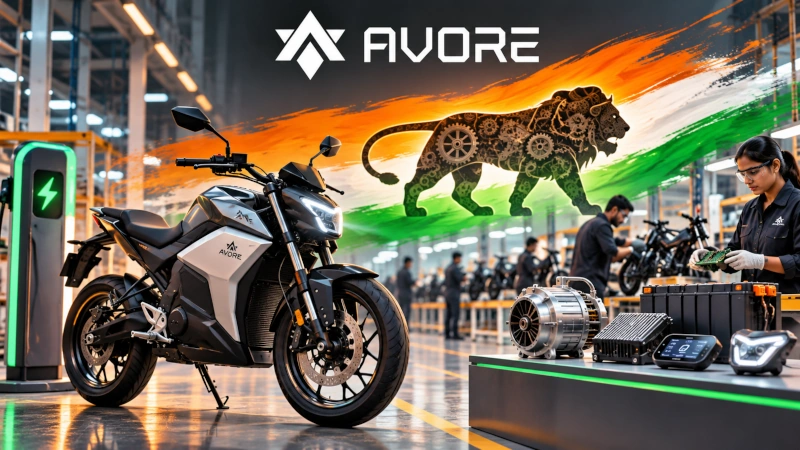
Indian electric motorcycle manufacturer Avore Electric, a brand of Gujarat-based Samarth E-Mobility, has reported that it sources 90 per cent of its components from within India. Announced on 25 November 2026, the development reflects the company’s emphasis on indigenous manufacturing, technological self-reliance and domestic supplier development. The localisation strategy combines in-house engineering capabilities with partnerships involving Indian component manufacturers and micro, small and medium enterprises.
Developing Indigenous Electric Vehicle Technologies
Avore Electric has focused on developing proprietary technologies across several essential electric motorcycle systems. Its internally manufactured components include motor controllers, digital instrument clusters, battery packs and rare-earth-free electric motors. The company has also developed its own vehicle lighting systems, extending its manufacturing capabilities beyond the principal electric powertrain components.
This approach enables the manufacturer to exercise greater control over vehicle engineering, component integration and product quality. Developing critical technologies domestically can also reduce dependence on imported assemblies and external technology providers. Such capabilities are particularly relevant to India’s electric mobility industry as manufacturers seek to establish greater control over intellectual property and supply chains.
Strengthening Gujarat’s Automotive Manufacturing Ecosystem
The company’s manufacturing operations at Chhatral in Gujarat are supported by a growing network of domestic industrial suppliers. Approximately half of Avore Electric’s suppliers are located within Gujarat, while half of its bulky components are sourced from manufacturers operating within a 100-kilometre radius of its production facility. These include chassis components, fabricated metal parts and polymer body panels.
Geographical proximity between manufacturers and suppliers can facilitate closer engineering collaboration, reduce transportation requirements and improve inventory management. It also enables smaller component manufacturers to participate more directly in emerging electric vehicle supply chains. The company’s localisation programme consequently extends beyond its own production facilities into the wider regional industrial ecosystem.
Integrating Indian MSMEs into Electric Vehicle Supply Chains
Avore Electric has been working with domestic MSMEs to strengthen manufacturing capabilities and align component production with automotive quality requirements. Its engineering and quality management teams have collaborated directly with suppliers to improve production consistency, manufacturing precision and process controls. The initiative recognises that developing a reliable domestic supply chain requires sustained technical engagement alongside commercial procurement arrangements.
The company has introduced established automotive quality methodologies, including Advanced Product Quality Planning (APQP) and the Production Part Approval Process (PPAP), within its supplier development programme. These methodologies provide structured mechanisms for evaluating component designs, validating manufacturing processes and maintaining consistent product quality. Their implementation can help domestic enterprises develop capabilities applicable to wider automotive manufacturing opportunities.
Reducing Dependence on Rare-Earth Materials
Among Avore Electric’s indigenous technological developments is its rare-earth-free electric motor. Developing alternatives to motors dependent on rare-earth permanent magnets is an important area of research within the global electric mobility industry. Such technologies can potentially reduce exposure to concentrated international supply chains and fluctuations in critical material availability.
Domestic development of motors and associated electronic controllers also creates opportunities for Indian manufacturers to acquire expertise in integrated electric propulsion systems. The ability to refine these technologies for local operating conditions can support product development suited to India’s diverse transportation requirements. Their long-term competitiveness will depend on demonstrated performance, reliability and manufacturing economics.
Balancing Localisation with Product Quality
The company acknowledged that its emphasis on domestic supplier development and stringent quality requirements has contributed to delays in motorcycle deliveries. Establishing reliable manufacturing processes across newly developed supplier networks requires technical validation and continuous improvement before production can be expanded. Avore Electric has indicated that it is prioritising component quality and manufacturing consistency over accelerated deliveries.
The reported 90 per cent domestic sourcing figure represents the company’s stated procurement localisation level. It should not be interpreted as independently certified domestic value addition or confirmation that every raw material and constituent part originates in India. Nevertheless, the company’s efforts to develop critical systems internally demonstrate a broader commitment to indigenous electric vehicle engineering.
Strengthening India’s Electric Mobility Manufacturing Capabilities
Avore Electric’s localisation strategy reflects the expanding technological ambitions of India’s private-sector electric vehicle manufacturers. By combining proprietary engineering, domestic component manufacturing and technical collaboration with MSMEs, the company seeks to develop an integrated electric mobility manufacturing ecosystem. Continued investment in research, supplier development and rigorous quality assurance can help strengthen domestic industrial capabilities, reduce import dependence and support India’s transition towards a competitive and self-reliant electric mobility economy.
References
- Samarth E-Mobility — Official corporate communications on indigenous electric vehicle technology development.
- EV Story — Avore Electric component localisation and supplier development report, 25 November 2026.
- Auto EV Times — Avore Electric domestic sourcing and in-house component manufacturing, 25 November 2026.
- News Bharat Daily — Avore Electric’s local sourcing ecosystem in Gujarat, 25 November 2026.
You may also like
-
India Tracks ₹38.11 Lakh Crore Infrastructure Investment Pipeline
-
Suzlon Energy Lays Foundation Stone for 1 GW AI-Enabled Wind Turbine Blade Factory in Tamil Nadu
-
Indian Nuclear Startup SUK-M Secures Funding to Develop Indigenous Thorium Microreactor
-
Jupiter Wagons Partners South Korea’s Woojin to Manufacture Metro Trains and Propulsion Systems in India
-
Gujarat’s Kalpasar Project: India’s Ambitious Freshwater Reservoir and Dutch Engineering Cooperation
