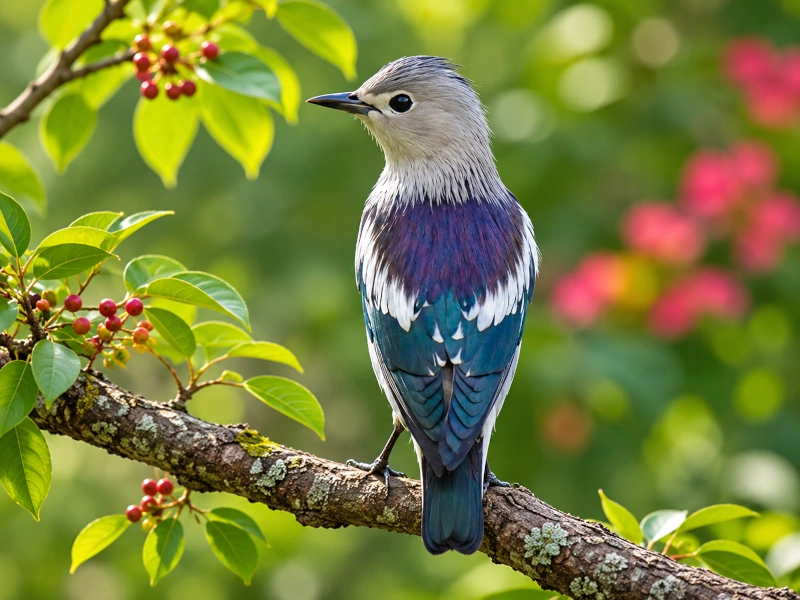
The Daurian Starling (Agropsar sturninus), an uncommon migratory visitor to southern India, has been recorded at the Punchakkari wetlands near Vellayani Lake in Thiruvananthapuram, Kerala. The bird was photographed by wildlife photographer Kannan Saveri on 22 November 2026, with the sighting reported on 24 November. The development has attracted the attention of birdwatchers and conservation enthusiasts, highlighting the ecological significance of Kerala’s wetlands in supporting migratory bird diversity.
Also known as the Purple-backed Starling and locally called Chenneelikkali in Malayalam, the species belongs to the starling family, Sturnidae. Its occurrence in Kerala is particularly noteworthy because the southern Indian peninsula lies outside its principal breeding and wintering range.
A Rare Migratory Visitor to Kerala
The Daurian Starling was scientifically documented at the Vellayani wetlands following a sighting on 14 November 2015. The observation was subsequently published in the ornithological journal Indian BIRDS on 16 May 2016, establishing an important early record of the species in Kerala.
Subsequent sightings have also been reported from the Kole wetlands in Thrissur and the Changaram bird habitat in Alappuzha. The latest photographic record at Punchakkari adds to the limited documented occurrences of the species in Kerala and reinforces the importance of sustained bird monitoring across the state’s wetland ecosystems.
The species is considered a vagrant in Kerala, meaning that its occurrence falls outside its usual geographical distribution or migration range. Although such observations provide valuable information about avian movements, an isolated sighting cannot establish a permanent change in migratory behaviour.
Geographical Distribution and Migration
The Daurian Starling breeds across parts of eastern Mongolia, southeastern Russia, China and the Korean Peninsula. During the northern winter, populations migrate towards warmer regions of southern China and Southeast Asia, including parts of Thailand, Malaysia, Singapore and Indonesia.
The species generally occupies open woodland, agricultural landscapes and areas containing scattered trees. It feeds primarily on insects and other small invertebrates, supplemented by fruits and nectar. During migration, Daurian Starlings may associate with other starling species, making careful observation and photographic documentation particularly valuable for identification.
Physical Characteristics and Identification
Measuring approximately 17–19 centimetres in length, the Daurian Starling is a relatively small member of the starling family. Adult males exhibit distinctive dark upperparts with a purple or bluish sheen, contrasting with lighter plumage around the head and underparts. Females and immature birds generally display more subdued brownish colouration.
The species exhibits variations in plumage according to age, sex and season, which can complicate identification under field conditions. Its resemblance to certain other members of the starling family further emphasises the importance of detailed photographic records and expert verification.
Punchakkari: An Important Habitat for Migratory Birds
Located near Vellayani Lake, Punchakkari contains a diverse landscape of agricultural fields, freshwater wetlands, shallow water bodies and surrounding vegetation. These interconnected habitats provide feeding, resting and shelter opportunities for numerous resident and migratory bird species.
The ecological diversity of the region makes it particularly attractive to birdwatchers and ornithologists. Punchakkari has previously yielded significant ornithological records, including the documented occurrence of the White-shouldered Starling in October 2022. Such observations demonstrate the scientific value of regular monitoring even within landscapes that lie close to major urban centres.
The continued occurrence of uncommon migratory species highlights the importance of preserving the interconnected character of these habitats. Wetlands, agricultural fields and surrounding vegetation collectively support ecological functions that cannot necessarily be maintained through the protection of isolated water bodies alone.
Conservation Status and Ecological Significance
The International Union for Conservation of Nature (IUCN) classifies the Daurian Starling as a species of Least Concern. Its global conservation status should therefore be distinguished from its rarity within Kerala, where it remains an infrequently encountered visitor rather than an established resident species.
Nevertheless, the protection of habitats used by uncommon migratory birds remains an important conservation priority. Wetland reclamation, habitat fragmentation, pollution and changes in traditional agricultural practices can reduce the availability of feeding and resting areas for numerous bird species. Preserving these ecosystems contributes to biodiversity conservation while supporting wider environmental functions such as water retention and ecological connectivity.
Citizen Science and Wildlife Documentation
The photographic documentation of the Daurian Starling demonstrates the contribution of individual birdwatchers and wildlife photographers to ornithological research. Regular field observations can generate valuable records of species distribution, seasonal movements and unusual occurrences that might otherwise remain undocumented.
When supported by accurate dates, reliable species identification and appropriate geographical information, citizen science observations can complement institutional biodiversity research. Long-term monitoring can also help researchers distinguish occasional vagrancy from more sustained changes in geographical distribution and migration patterns.
Strengthening Kerala’s Wetland Conservation
The latest Daurian Starling sighting at Punchakkari adds another noteworthy record to Kerala’s rich ornithological heritage. Although the species remains an uncommon visitor to the region, its documented presence highlights the value of maintaining diverse and interconnected habitats capable of supporting birds arriving from distant geographical regions.
Continued scientific monitoring, responsible birdwatching and community participation in wetland conservation can help safeguard these ecologically significant landscapes. Protecting Punchakkari and other wetland ecosystems across Kerala will not only benefit migratory birds but also preserve the wider biodiversity and environmental services upon which local communities depend.
References
- Manorama Online Environment — Daurian Starling sighting at Punchakkari wetlands, 24 November 2026.
- Indian BIRDS, Volume 11, Number 4 — Sighting of Purple-backed Starling (Agropsar sturninus) in Vellayani, Kerala, 16 May 2016.
- Indian BIRDS, Volume 18, Number 4 — Documentation of the White-shouldered Starling at Punchakkari, Kerala.
- Hong Kong Bird Watching Society — Daurian Starling species account.
- Malaysia Biodiversity Information System — Agropsar sturninus: Distribution and conservation status.
You may also like
-
Indian Scientists Identify Seven Potential Humpback Whale Hotspots
-
Pathanamthitta Biodiversity Survey Records Barn Swallow and 130 Bird Species
-
Captive-Bred Indian Vulture Travels 10,767 Km, Makes First Recorded Appearance in Latur
-
The Sacred Groves of India: Traditional Protection and Modern Biodiversity Conservation
-
New Micro-Moth Species Discovered in Assam After Nearly a Century
