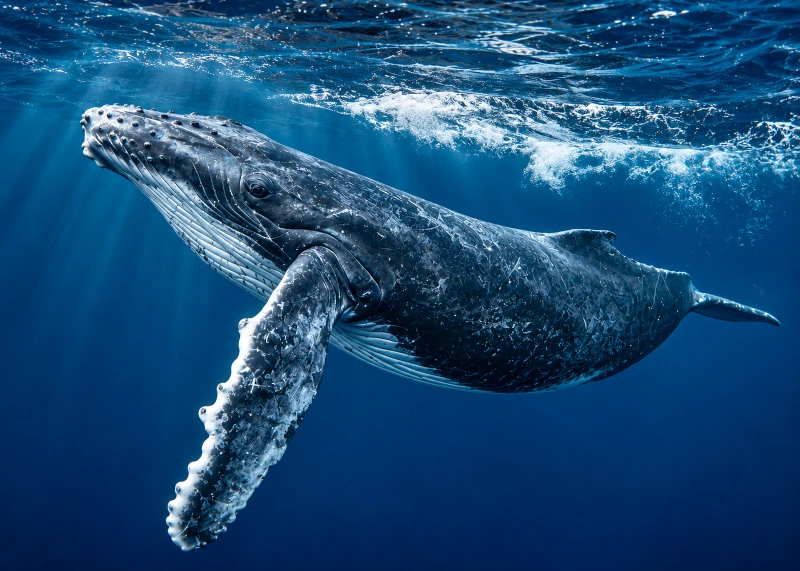
Researchers from the Wildlife Institute of India (WII) have identified seven potential sighting hotspots for Arabian Sea humpback whales in Indian waters through a scientific assessment conducted between 2022 and 2025. The findings were released on 23 November 2026 during the 92nd meeting of the Standing Committee of the National Board for Wildlife in New Delhi, according to information attributed to the Ministry of Environment, Forest and Climate Change. The assessment provides an important foundation for strengthening marine mammal conservation and understanding the distribution of this distinctive whale population.
Understanding the Arabian Sea Humpback Whale
The Arabian Sea humpback whale (Megaptera novaeangliae) belongs to a geographically distinct population that inhabits the northern Indian Ocean. Unlike most humpback whale populations, which undertake extensive seasonal migrations between tropical breeding grounds and higher-latitude feeding areas, Arabian Sea humpback whales remain within tropical and subtropical waters throughout the year.
Their geographical isolation and distinctive ecological characteristics make this population particularly important for marine biodiversity research. The Arabian Sea population is classified as Endangered on the IUCN Red List, highlighting the importance of understanding its distribution, habitat requirements and interactions with human activities.
Identifying Seven Potential Whale Hotspots
The Wildlife Institute of India’s assessment, covering the period from 2022 to 2025, identified seven potential sighting hotspots for Arabian Sea humpback whales in Indian waters. These findings provide researchers and conservation authorities with a scientific basis for identifying marine areas that may require more intensive monitoring and conservation attention.
Understanding the geographical distribution of marine mammals is essential for developing effective conservation strategies. The identification of potential hotspots can help guide future population assessments, habitat studies and investigations into the environmental conditions influencing whale distribution along India’s coastline.
Addressing Entanglement in Fishing Equipment
Entanglement in fishing equipment represents a significant conservation concern for large marine mammals. Whales can become trapped in fishing nets and associated equipment, potentially restricting their movement, affecting their ability to feed and causing serious injuries.
The findings of the Wildlife Institute of India’s assessment are expected to inform future conservation measures addressing such interactions. Collaboration between marine scientists, fisheries authorities, coastal communities and fishing enterprises can contribute to developing practical approaches that protect marine mammals while supporting sustainable fishing livelihoods.
Strengthening India’s Marine Mammal Research
India’s extensive coastline encompasses diverse marine ecosystems that support whales, dolphins, dugongs, marine turtles and numerous other species. Scientific assessments of marine mammal distribution contribute to a broader understanding of the ecological characteristics and conservation requirements of these habitats.
The Wildlife Institute of India’s research provides an opportunity to strengthen systematic marine biodiversity monitoring and develop evidence-based conservation strategies. Continued scientific investigations could help researchers better understand population distribution, habitat utilisation and seasonal patterns of marine mammal activity.
Supporting Marine Biodiversity Conservation
The identification of seven potential Arabian Sea humpback whale hotspots represents an important contribution to India’s marine conservation research. The findings can support future field investigations, conservation planning and engagement with coastal communities, particularly in areas where marine mammals interact with fisheries.
By combining scientific research with sustainable marine resource management, India can strengthen its capacity to conserve vulnerable marine species. Continued monitoring and cooperation between research institutions, conservation authorities and coastal communities offer a promising foundation for protecting Arabian Sea humpback whales and preserving the rich biodiversity of India’s marine ecosystems.
References
- Ministry of Environment, Forest and Climate Change, Government of India — 92nd Meeting of the Standing Committee of the National Board for Wildlife, 23 November 2026. PIB Release ID: 2340255.https://www.pib.gov.in/PressReleseDetailm.aspx?PRID=2340255&lang=1®=3
- Wildlife Institute of India — Arabian Sea Humpback Whale Assessment, research period 2022–2025.
- International Union for Conservation of Nature (IUCN) — Red List Assessment of the Arabian Sea Humpback Whale Population.
You may also like
-
Pathanamthitta Biodiversity Survey Records Barn Swallow and 130 Bird Species
-
Captive-Bred Indian Vulture Travels 10,767 Km, Makes First Recorded Appearance in Latur
-
The Sacred Groves of India: Traditional Protection and Modern Biodiversity Conservation
-
New Micro-Moth Species Discovered in Assam After Nearly a Century
-
Botswana-Born Cheetah Gives Birth to Four Cubs in Wild, India’s Cheetah Population Reaches 62
