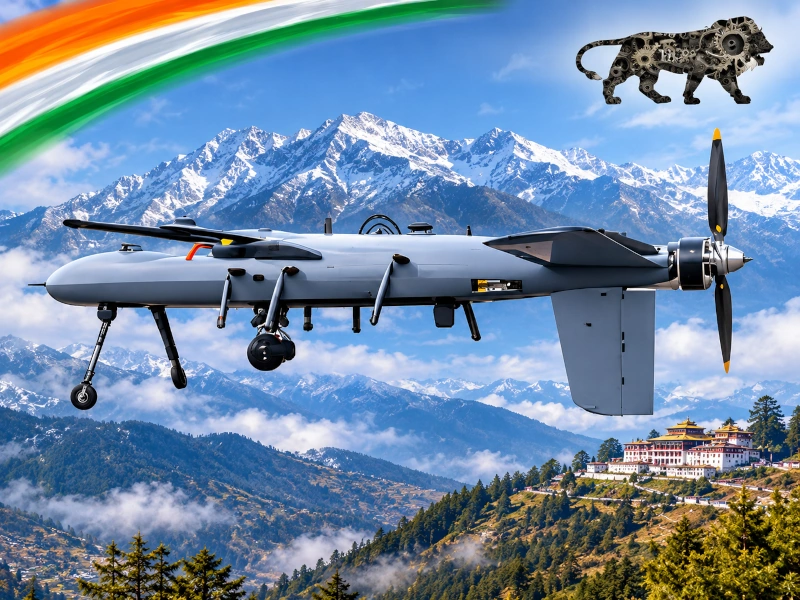
Karnataka-based aerospace technology company Sarus Aerospace Private Limited has highlighted the high-altitude capabilities of its indigenously developed Shaurya fixed-wing Vertical Take-Off and Landing (VTOL) unmanned aerial vehicle following a demonstration at Tawang in Arunachal Pradesh. According to the company, the aircraft demonstrated its capabilities at an altitude of approximately 5,000 metres, an operating environment that presents considerable challenges for conventional unmanned aerial systems.
The demonstration represents an important development in India’s expanding indigenous drone manufacturing ecosystem, particularly in the field of unmanned aircraft designed for mountainous terrain and demanding environmental conditions. Sarus Aerospace has developed the Shaurya platform to combine the vertical take-off capabilities of multirotor drones with the greater aerodynamic efficiency and endurance of fixed-wing aircraft.
The aircraft is intended for a range of applications, including intelligence gathering, surveillance, reconnaissance, mapping, infrastructure inspection and specialised delivery operations. Its hybrid propulsion architecture allows it to operate without conventional runways while undertaking missions that require greater aerial coverage than many standard multirotor platforms.
The company has also emphasised the aircraft’s high indigenous component content, modular design and integration of advanced navigation and communication technologies. These features reflect the growing technical capabilities of Indian private-sector aerospace companies engaged in developing sophisticated unmanned aerial platforms.
High-Altitude Demonstration in Arunachal Pradesh
The reported demonstration at Tawang is particularly significant because high-altitude operations impose demanding aerodynamic, mechanical and electronic requirements on unmanned aircraft. At higher elevations, reduced atmospheric density affects the performance of propellers and the amount of aerodynamic lift generated by the wings. Aircraft operating in such environments must compensate for these limitations through appropriate propulsion, aerodynamic design and flight-control systems.
Sarus Aerospace reported that its Shaurya platform demonstrated operational capabilities at approximately 5,000 metres above sea level. The company’s published technical specifications also identify 5,000 metres above mean sea level as the operational ceiling of its Shourya Mk4 aircraft, making the reported demonstration relevant to the platform’s intended performance envelope.
The mountainous terrain surrounding Tawang provides a demanding environment for unmanned aviation. Significant variations in elevation, strong local winds, restricted landing areas and rapidly changing weather conditions can complicate flight planning and aircraft operations. Communication links may also be affected by surrounding terrain, requiring careful consideration of navigation and control arrangements.
For hybrid VTOL aircraft, high-altitude testing is especially important because the vertical-lift motors must generate sufficient thrust during take-off and landing despite reduced air density. The aircraft must also maintain stable flight while transitioning between vertical-lift and conventional forward-flight modes.
The company’s communication confirms the high-altitude demonstration but does not provide a comprehensive technical flight-test report detailing the payload carried, flight duration, environmental conditions or take-off elevation. The development therefore demonstrates reported progress in high-altitude flight testing rather than establishing the completion of all operational qualification requirements.
Hybrid VTOL Design Combines Two Aircraft Technologies
Shaurya incorporates a hybrid VTOL configuration designed to combine the principal advantages of multirotor and fixed-wing unmanned aircraft. This arrangement allows the aircraft to take off and land vertically while using its wings to generate lift during forward flight, thereby reducing the continuous power requirement associated with conventional multirotor operations.
The Shourya Mk4 configuration uses four electrically powered vertical-lift motors together with a separate propulsion system for forward flight. During take-off, the vertical-lift motors raise the aircraft from the ground without requiring a runway. Once the aircraft reaches an appropriate altitude and flight condition, it transitions into forward flight, where aerodynamic lift is generated primarily by the wings.
The rear-mounted propulsion system provides the thrust required for sustained forward movement. This arrangement allows the aircraft to operate more efficiently over longer distances than a comparable multirotor system that must continuously use its propellers to generate vertical lift.
The ability to take off and land vertically is particularly valuable in mountainous environments, where flat operating areas may be limited and the construction or maintenance of conventional runways may be impractical. A hybrid aircraft can potentially operate from relatively small launch locations while retaining the range and endurance advantages associated with wing-supported flight.
However, hybrid VTOL designs also introduce engineering challenges because the aircraft must coordinate different propulsion systems and maintain stable flight throughout the transition between vertical and horizontal operating modes. Reliable flight-control software, appropriate propulsion management and accurate sensor feedback are essential for maintaining aircraft stability during these transitions.
The Shaurya programme reflects Sarus Aerospace’s efforts to address these challenges through indigenous aircraft design, propulsion integration and onboard control technologies.
Technical Specifications of the Shourya Mk4
According to technical information published by Sarus Aerospace, the Shourya Mk4 has a wingspan of approximately three metres and a maximum take-off weight of around 22 kilograms when configured with its stated five-kilogram payload. The aircraft has been designed to carry mission-specific equipment while maintaining the aerodynamic characteristics required for efficient fixed-wing flight.
The manufacturer reports a flight endurance of up to 90 minutes with a five-kilogram payload and a maximum speed of approximately 110 kilometres per hour. Its specified operational ceiling is 5,000 metres above mean sea level, although actual flight performance depends on atmospheric conditions, payload weight, battery configuration and mission requirements.
The aircraft’s structural design incorporates lightweight materials, including carbon-fibre composites, Kevlar and aerospace-grade aluminium. These materials offer a combination of low weight, mechanical strength and structural rigidity, making them suitable for unmanned aircraft where weight management has a direct influence on endurance and payload capacity.
The use of composite materials is particularly important because the aircraft must carry propulsion systems, batteries, communication equipment, navigation sensors and mission payloads within a limited overall weight. Reducing structural weight can provide additional flexibility in balancing flight endurance against payload requirements.
Sarus Aerospace has also developed the platform with field deployment in mind. According to the company, the Shourya Mk4 can be transported in a compact container and assembled without specialised tools in approximately ten minutes by a single operator.
This design approach is intended to simplify transportation and preparation for flight, particularly in environments where operating personnel may have limited space, equipment or logistical support.
These specifications represent the manufacturer’s stated design and performance characteristics. They should not be interpreted as independently verified results from the Tawang demonstration unless corresponding flight-test data are made available.
Indigenous Components and Domestic Aerospace Manufacturing
A notable feature of the Shaurya programme is Sarus Aerospace’s emphasis on indigenous engineering and manufacturing. The company states that approximately 97% of the components incorporated into the Shourya Mk4 are sourced or developed domestically, reflecting its efforts to create an Indian manufacturing ecosystem for advanced unmanned aircraft.
The development of an indigenous drone involves several interconnected engineering disciplines. The airframe must be designed to provide sufficient strength while minimising weight, the propulsion systems must be matched to the aircraft’s aerodynamic requirements, and the flight-control architecture must coordinate navigation, stability and mission execution.
Sarus Aerospace undertakes activities involving aircraft design, composite manufacturing, electronics, mechanical engineering and systems integration. By developing these capabilities within India, the company seeks to maintain greater control over product development, modifications, testing and production processes.
Indigenous manufacturing can also provide advantages in maintaining and adapting unmanned aircraft for specific customer requirements. When critical components and engineering expertise are available domestically, manufacturers may be better positioned to implement design changes, develop new configurations and provide technical support.
The development of locally engineered unmanned systems is particularly relevant to India’s aerospace industry because advanced drone technologies depend on specialised materials, electronics, propulsion systems, communication equipment and software.
By investing in these capabilities, companies such as Sarus Aerospace are contributing to the expansion of India’s private-sector aerospace engineering base and strengthening the domestic industrial foundations required for future unmanned aviation programmes.
Intelligence, Surveillance and Reconnaissance Applications
Shaurya has been developed to support intelligence, surveillance and reconnaissance applications through the integration of mission-specific observation equipment. Its modular architecture allows different payloads to be incorporated according to the requirements of individual operations.
The aircraft can accommodate electro-optical and infrared observation systems within its stated payload capacity. Electro-optical sensors provide visible-spectrum imaging, while infrared equipment can support observation under low-light conditions and in environments where thermal differences assist in identifying objects.
For security and defence applications, unmanned aircraft equipped with suitable sensors can provide aerial observation of terrain, infrastructure and areas that may be difficult to access from the ground. Such platforms can support situational awareness by collecting visual information and transmitting it to operators for assessment.
In mountainous environments, aerial surveillance can be particularly useful because steep terrain, restricted roads and significant elevation differences complicate conventional ground observation. Fixed-wing VTOL aircraft can potentially operate from smaller launch locations while covering larger areas than many conventional multirotor systems.
The Shourya Mk4’s reported endurance of up to 90 minutes provides an indication of the aircraft’s intended suitability for missions requiring sustained aerial observation. Actual mission duration will depend on the equipment installed, atmospheric conditions and operating profile.
Although the platform has potential military applications, the latest company announcement does not establish that Shaurya has received a confirmed production order from the Indian Armed Forces or completed formal military acceptance trials.
The Tawang demonstration should therefore be understood as a company-reported capability demonstration rather than confirmation of military induction.
Advanced Navigation and Communication Technologies
Reliable navigation and communication systems are essential for unmanned aircraft operating in challenging environments. This requirement becomes particularly important in mountainous regions, where terrain features can interfere with direct communication links and satellite navigation signals.
Sarus Aerospace has reported the integration of frequency-hopping communication technology into the Shourya Mk4 platform. Frequency-hopping systems operate by changing communication frequencies according to established patterns, helping improve communication resilience under certain interference conditions.
The company has also identified navigation capabilities designed to support operations when conventional satellite navigation signals are degraded or unavailable. These features are relevant to unmanned aircraft intended for demanding operational environments where dependence on a single navigation source may introduce vulnerabilities.
Developing such capabilities requires the integration of navigation sensors, onboard processors, communication equipment and flight-control software. The reliability of these systems depends not only on individual components but also on their ability to function together under realistic operating conditions.
Mountainous terrain can create additional challenges by obstructing communication paths and introducing variations in satellite signal availability. Aircraft operating in such environments may require carefully designed mission profiles and reliable procedures for responding to interruptions in communication.
The manufacturer’s published technical material identifies these technologies within the platform’s capabilities, although some features may depend on the selected aircraft configuration.
The Tawang announcement does not provide detailed results of specific communication-resilience or satellite-navigation-denial tests. These capabilities should therefore be presented as manufacturer-stated features rather than independently demonstrated outcomes from the reported high-altitude flight.
Importance of VTOL Drones for Mountainous Operations
The development of hybrid VTOL unmanned aircraft is particularly relevant to countries with extensive mountainous terrain and geographically dispersed infrastructure. Such regions frequently lack suitable runways, while conventional ground transportation may be constrained by terrain and weather conditions.
A VTOL aircraft can operate from relatively confined spaces without requiring the launch and recovery infrastructure associated with many conventional fixed-wing unmanned systems. Once airborne, it can transition into efficient forward flight and travel across valleys, ridgelines and other geographical obstacles.
For reconnaissance applications, this combination can provide useful operational flexibility. Aircraft can be launched from suitable locations near the area of interest and directed towards observation zones that may be difficult to reach by road.
Mountain environments nevertheless impose significant technical limitations. Reduced atmospheric density can lower available propeller thrust, while cold temperatures can influence battery performance and electronic equipment. Strong winds and rapidly changing weather may also affect aircraft stability and mission planning.
These conditions make field demonstrations and environmental testing important stages in aircraft development. Performance observed under ordinary operating conditions cannot automatically be assumed to remain unchanged at high elevations.
Sarus Aerospace’s reported demonstration at Tawang contributes to its experience in evaluating the Shaurya platform under conditions relevant to high-altitude operations.
Continued testing across different environmental conditions will remain important in establishing the aircraft’s operational capabilities and identifying opportunities for further technical refinement.
Applications in Mapping and Infrastructure Inspection
Beyond defence and security applications, Shaurya’s hybrid VTOL configuration offers potential utility in surveying, mapping and infrastructure inspection.
Unmanned aircraft equipped with suitable imaging systems can collect aerial photographs and other information used to create maps, examine terrain features and monitor physical infrastructure. Such capabilities are relevant to engineering, infrastructure planning, environmental observation and geographical surveying.
In mountainous regions, aerial mapping can provide information about terrain that may be difficult to examine through conventional ground-based methods. The ability to launch an aircraft without a runway can simplify operations in locations where suitable flat ground is limited.
Infrastructure inspection represents another potential application. Unmanned aircraft can support observation of roads, bridges, power infrastructure and other facilities, depending on the sensors installed and the applicable operating permissions.
Sarus Aerospace also identifies specialised delivery operations among the possible uses of its unmanned platforms. A VTOL aircraft with an appropriate payload configuration could potentially transport selected lightweight materials between suitable operating locations.
The practical suitability of such applications depends on payload requirements, range, environmental conditions, safety arrangements and regulatory approvals.
These potential civilian applications demonstrate the broader industrial significance of hybrid VTOL technology and the opportunities available to Indian companies developing unmanned systems for multiple sectors.
Sarus Aerospace and Belagavi’s Emerging Drone Industry
Sarus Aerospace Private Limited was established in 2023 and operates from Belagavi in Karnataka. The company is associated with the Visvesvaraya Technological University ecosystem and has focused on developing indigenous unmanned aircraft and associated aerospace technologies.
Its activities include aircraft design, composite manufacturing, electronics development, propulsion integration and flight testing. These capabilities support the development of unmanned systems intended for specialised applications in defence, surveying, surveillance and other sectors.
The company’s emergence reflects the expansion of India’s aerospace startup ecosystem beyond established industrial centres such as Bengaluru and Hyderabad.
Belagavi possesses an engineering and industrial base that can support activities involving precision manufacturing, materials processing, mechanical engineering and technical research.
Companies developing advanced unmanned aircraft can contribute to this ecosystem by creating demand for specialised components, engineering services, electronic equipment and technical skills.
The development of indigenous aerospace startups also provides opportunities for collaboration between academic institutions, engineering companies and specialised manufacturers.
Sarus Aerospace’s work on the Shaurya platform illustrates how smaller Indian technology companies are increasingly participating in sophisticated aircraft development rather than limiting their activities to the assembly of imported drone systems.
Significance for India’s Indigenous UAV Ecosystem
India’s unmanned aviation sector has expanded considerably as domestic companies develop platforms for defence, commercial, industrial and public-sector applications.
The growth of this ecosystem has encouraged investment in aircraft design, propulsion systems, navigation technologies, composite materials and specialised mission equipment.
Hybrid VTOL aircraft represent an important segment of this industry because they combine features of conventional fixed-wing platforms and multirotor drones within a single aircraft configuration.
Developing such systems requires considerable engineering expertise, particularly in the areas of flight-control integration, aerodynamics, power management and autonomous operations.
For Indian manufacturers, establishing these capabilities domestically creates opportunities to develop products suited to the country’s geographical and operational requirements.
High-altitude applications are particularly relevant because India possesses extensive mountainous regions where conventional aviation infrastructure may be limited and environmental conditions can challenge unmanned aircraft.
The Shaurya programme contributes to this developing technology base through indigenous aircraft engineering and continued capability demonstrations.
Its future commercial and operational development will depend on further testing, product refinement, certification requirements and customer adoption.
Strengthening India’s High-Altitude Unmanned Aviation Capabilities
Sarus Aerospace’s reported high-altitude demonstration of the indigenous Shaurya VTOL drone at Tawang represents an encouraging development in India’s expanding unmanned aviation industry.
The aircraft combines vertical take-off and landing capabilities with efficient fixed-wing flight, offering a platform intended for surveillance, reconnaissance, mapping and specialised aerial operations. Its modular payload architecture, lightweight composite construction and emphasis on indigenous components reflect the increasing technical sophistication of Indian aerospace startups.
The reported demonstration at approximately 5,000 metres highlights the company’s efforts to develop aircraft capable of operating in demanding mountainous environments. Continued testing will help establish the platform’s performance across different payload configurations, atmospheric conditions and operational requirements.
The programme also demonstrates the growing importance of domestic expertise in aircraft design, propulsion integration, navigation technologies, electronics and composite manufacturing.
As Indian companies continue developing specialised unmanned platforms, projects such as Shaurya can contribute to the country’s technological capabilities while creating new opportunities for indigenous aerospace manufacturing, engineering innovation and advanced unmanned aviation applications.
You may also like
-
Coal India Receives Government Letter of Intent for 1,200-Tonne Rare Earth Magnet Manufacturing Facility
-
Prime Industries Partners with Wahi Sons to Expand Precision Engineering and Defence Manufacturing Capabilities
-
DRDO and Japan’s ATLA to Advance Joint Research in Advanced Missile and Defence Technologies
-
Bhairav Robotics Begins Rajasthan Desert Trials of Indigenous Vrishabh Combat UGV, Plans Unmanned Combat Testing
-
India and Japan Sign Letter of Intent to Enable Japanese Military Live-Fire Training in India
