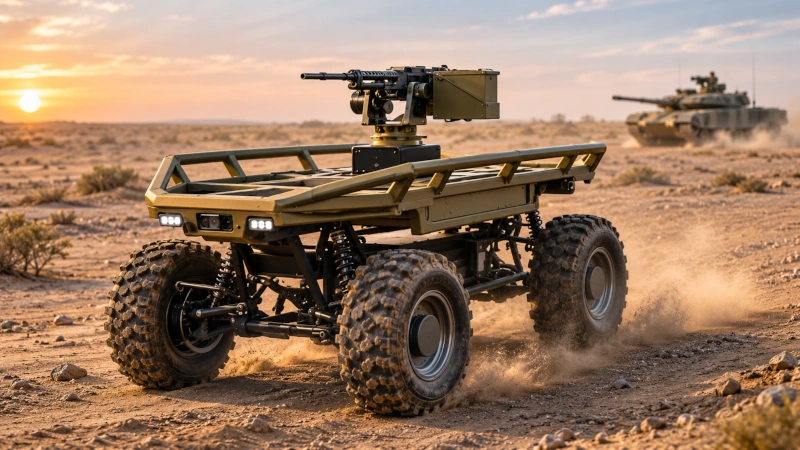
Indian defence technology company Bhairav Robotics has commenced desert trials of its indigenously developed Vrishabh Combat Unmanned Ground Vehicle (UGV) in Rajasthan, marking an important development in India’s efforts to establish advanced robotic platforms for military operations. The trials are evaluating the vehicle’s mobility, stability and performance across challenging desert terrain, while also examining its ability to operate alongside conventional armoured platforms.
The development, reported on November 18, 2026, represents another stage in the company’s ongoing programme to develop a modular unmanned ground system capable of undertaking surveillance, reconnaissance, logistics and combat-support missions. Bhairav Robotics has confirmed that Vrishabh is being tested across sand dunes, loose sand, gravel, hard soil and uneven surfaces to assess its performance under demanding environmental conditions.
An important feature of the testing programme involves operating Vrishabh alongside a tank, allowing the company to explore coordination between crewed armoured vehicles and unmanned ground platforms. According to Bhairav Robotics, the desert trials are progressing satisfactorily, with unmanned combat testing identified as the next stage of development.
The programme highlights the increasing participation of Indian private-sector defence companies in developing advanced ground robotics and autonomous military technologies, particularly systems designed to support military personnel in hazardous operational environments.
Rajasthan Desert Trials Evaluate Mobility and Operational Performance
Rajasthan’s desert terrain presents considerable challenges for military vehicles, particularly unmanned wheeled platforms that must maintain traction, stability and reliable movement without an onboard driver. Loose sand, shifting dunes, gravel surfaces and uneven ground can affect vehicle handling, suspension performance and the effectiveness of propulsion systems. These conditions make desert testing an important stage in evaluating the suitability of robotic vehicles for military applications.
Bhairav Robotics is using the current trials to examine Vrishabh’s performance across different surfaces and terrain conditions. The testing involves movement through sandy stretches, navigation across irregular ground and operation over surfaces where wheel traction and vehicle stability become critical. Such evaluations allow engineers to assess the practical performance of the vehicle’s mechanical architecture and identify areas requiring further development.
The company has indicated that Vrishabh is performing satisfactorily during the ongoing evaluations. However, detailed technical results, including measured mobility performance, endurance under desert conditions and the extent of autonomous navigation achieved, have not been publicly disclosed. The present trials therefore represent a continuing development programme rather than the completion of military qualification testing.
Field evaluations of this nature are particularly important because military robotic platforms must eventually operate in environments that are considerably more demanding than laboratory or demonstration conditions. The information obtained during these trials can support improvements in suspension design, propulsion efficiency, vehicle stability, control systems and overall reliability.
Vrishabh Operates Alongside a Tank During Desert Testing
One of the most significant aspects of the Rajasthan trials is the operation of Vrishabh alongside a conventional tank. Bhairav Robotics has confirmed that this activity forms part of its efforts to examine coordination between crewed and unmanned military platforms, an approach that is receiving increasing attention in the development of modern military technologies.
The concept of crewed-uncrewed teaming involves employing remotely operated or autonomous systems alongside vehicles operated by military personnel. In such arrangements, unmanned platforms can potentially undertake reconnaissance, transport equipment, observe hazardous areas or perform specialised support functions while conventional military vehicles continue their principal operational roles.
For armoured formations, smaller unmanned ground vehicles could provide additional capabilities without requiring personnel to physically occupy every platform operating in potentially dangerous areas. A robotic vehicle equipped with observation equipment, for example, could examine terrain or provide additional situational awareness while operating under the supervision of a human operator.
Testing Vrishabh alongside a tank provides an opportunity to study practical challenges involving vehicle movement, coordination, communication and operation across common terrain. However, the company has not disclosed the precise technical arrangements involved or demonstrated that the vehicles operated as part of a fully integrated autonomous combat formation. The current activity is best understood as an exploratory evaluation of cooperation between crewed and unmanned platforms.
Indigenous Vrishabh Developed as a Modular Military Platform
Vrishabh is a four-wheeled unmanned ground vehicle developed by Bhairav Robotics, an Indian defence technology company based in Kakinada, Andhra Pradesh. The platform has been designed around a modular architecture that allows different equipment and mission-specific payloads to be integrated according to operational requirements. This approach enables a common vehicle platform to be adapted for different military applications rather than requiring separate vehicle designs for every task.
According to technical information released by the developer and documented in defence industry reporting, Vrishabh incorporates a 4×4 mobility configuration and an electric propulsion system supported by a 16 kWh battery. The vehicle has a stated maximum speed of approximately 50 kilometres per hour, an operational range of up to 100 kilometres and a payload capacity of approximately 150 kilograms. These specifications represent the platform’s reported design capabilities rather than independently verified results from the latest Rajasthan trials.
The vehicle’s modular configuration is intended to accommodate equipment for reconnaissance, surveillance, logistics, casualty evacuation and combat-related operations. Its architecture also supports the integration of sensors and specialised mission systems, allowing the platform to be configured for different operational environments.
The development of a multi-role platform can offer practical advantages by allowing manufacturers to standardise mechanical components, electrical systems and maintenance arrangements across different vehicle configurations. For military users, such an approach could eventually simplify training, equipment support and the integration of new technologies as operational requirements evolve.
Autonomous and Remotely Controlled Capabilities
Vrishabh has been designed to support manual, semi-autonomous and autonomous operating modes, reflecting the growing importance of flexible control systems in modern military robotics. Remotely controlled operation allows personnel to direct a vehicle from a separate location, while semi-autonomous functions can assist with selected navigation and mobility tasks under human supervision.
More advanced autonomous capabilities may enable a vehicle to undertake designated movements or respond to certain environmental conditions with reduced continuous operator input. Developing these functions requires the integration of navigation technologies, onboard sensors, control software and dependable communication systems capable of operating under difficult field conditions.
For unmanned ground vehicles, autonomous navigation presents challenges that differ considerably from those encountered by aerial platforms. Ground vehicles must negotiate rocks, slopes, loose soil, trenches and other physical obstacles while maintaining stability and avoiding situations in which the vehicle could become immobilised.
Desert environments introduce additional difficulties because sand can affect traction, obscure surface features and interfere with the performance of mechanical components. Dust and extreme environmental conditions may also influence the reliability of sensors and electronic equipment.
The Rajasthan trials provide an opportunity to evaluate the platform in such conditions and gather information required for further engineering improvements. Bhairav Robotics has not released detailed results establishing the extent of autonomous performance achieved during the current testing programme, making continued field validation an important part of the vehicle’s development.
Vrishabh Designed to Accommodate Remote Weapon Systems
An important aspect of Vrishabh’s intended military capability is its ability to accommodate remotely operated weapon systems. The vehicle has been developed with a modular architecture that permits the integration of weapon stations and other specialised equipment, allowing it to be configured for combat-support applications.
Bhairav Robotics has developed the Rakshak remote-controlled weapon station as part of its defence technology portfolio. According to earlier technical information provided to defence industry publication Janes, Vrishabh has been designed to support weapon options including light and medium machine guns, the AGS-30 automatic grenade launcher and the NSV 12.7 mm heavy machine gun.
Remote weapon stations generally combine mechanical weapon mounts with observation equipment, stabilisation systems and electronic controls. These technologies allow personnel to operate supported weapons from locations separate from the weapon platform, potentially reducing direct exposure to danger during designated operations.
Integrating such equipment into an unmanned ground vehicle requires careful consideration of mechanical stability, electrical power requirements, communication reliability and the interaction between the weapon system and the vehicle’s control architecture. The overall performance of the platform must also be evaluated with its intended operational payload installed.
Although Vrishabh has been designed to accommodate combat-related equipment, the company’s November 2026 announcement does not establish that the latest desert trials included completed live-fire qualification testing. The distinction between weapon integration capability and successful combat-system validation remains important when assessing the platform’s present development status.
Unmanned Combat Trials Planned as Next Development Stage
Bhairav Robotics has identified unmanned combat testing as the next phase of Vrishabh’s development following the ongoing desert mobility trials. The proposed testing will represent a progression from evaluating the vehicle’s basic movement and terrain-handling characteristics towards examining its suitability for more demanding military applications.
Combat-oriented testing of unmanned ground systems can involve assessing the interaction between mission payloads, vehicle movement, operator controls and onboard electronic equipment. Such evaluations are important because a vehicle carrying additional equipment may behave differently from one operating without a mission-specific payload.
The integration of specialised systems can affect weight distribution, power consumption, vehicle stability and overall endurance. Developers must therefore examine how the complete platform performs under conditions representative of its intended operational role rather than relying exclusively on the performance of individual components.
For remotely operated combat platforms, reliable communication and operator supervision are also essential elements of system development. Maintaining dependable control becomes particularly important when vehicles operate in difficult terrain or environments where communication conditions may vary.
The company has not announced a confirmed date or detailed schedule for the proposed unmanned combat trials. Nevertheless, the planned progression demonstrates its intention to advance Vrishabh through successive stages of engineering evaluation and operational testing.
Potential Applications in Reconnaissance and Battlefield Surveillance
Beyond its combat-related applications, Vrishabh’s modular architecture offers potential utility in reconnaissance and surveillance missions. Unmanned ground vehicles equipped with suitable observation systems can support the collection of information from terrain where direct movement by military personnel may involve operational risks.
A robotic platform carrying electro-optical equipment could potentially examine roads, approach routes, obstacles and other areas of interest while transmitting information to personnel operating from protected positions. Such capabilities may be particularly useful when ground-level observation is required and the deployment of a conventional vehicle would be impractical.
Unlike aerial systems, ground-based robotic platforms can remain stationary for observation and operate close to the surface, although their effectiveness depends on terrain conditions, communication arrangements and the capabilities of their installed sensors.
The use of unmanned ground systems for reconnaissance also creates opportunities for cooperation with conventional armoured vehicles. A smaller robotic platform could potentially investigate selected areas ahead of a larger formation or provide supplementary observation capabilities during designated operations.
These applications illustrate the broader military relevance of the Vrishabh programme. However, the successful employment of such capabilities would require further testing, suitable sensor integration and operational validation before the platform could be considered ready for military deployment.
Logistics and Casualty Evacuation Applications
Vrishabh’s reported payload capacity also creates opportunities for adapting the platform to military logistics and support functions. Ground robots designed to carry equipment can potentially assist personnel by transporting supplies, tools and other essential materials over short distances in operational environments.
Military logistics frequently involves repeated movement of equipment between positions, sometimes across terrain that is difficult or potentially hazardous. Unmanned vehicles may eventually complement conventional transport methods by undertaking selected tasks without requiring personnel to remain onboard the transport platform.
The platform’s modular design could also support specialised configurations for casualty evacuation, provided suitable equipment and safety arrangements are developed and validated. Such applications require careful engineering because the transportation of injured personnel places additional demands on vehicle stability, suspension performance and operational reliability.
These potential roles demonstrate why unmanned ground vehicles are increasingly being developed as multi-purpose military systems rather than exclusively as robotic weapon platforms.
For Vrishabh, the ability to adapt a common mobility platform to different requirements could become an important advantage as its technology matures. The current trials, however, should not be interpreted as confirmation that every proposed logistics or casualty evacuation configuration has completed operational testing.
Bhairav Robotics and India’s Emerging Defence Robotics Ecosystem
Bhairav Robotics is an Indian defence technology company focused on developing robotic systems for military and security applications. Based in Kakinada, Andhra Pradesh, the company has been working on unmanned platforms intended to support operations in demanding terrain and environments.
Established in 2023, Bhairav Robotics represents part of India’s expanding ecosystem of specialised private-sector companies working on autonomous systems, military electronics and advanced robotic technologies. Its development activities include unmanned ground platforms and associated mission equipment intended to meet emerging defence requirements.
Vrishabh was publicly introduced in December 2025 as a modular ground vehicle designed for multiple military applications. The platform’s subsequent development and testing activities reflect the company’s efforts to progress from product demonstration towards practical field evaluation.
Developing such systems requires expertise across mechanical engineering, electric propulsion, electronics, software, sensors and systems integration. Companies operating in this sector must combine these disciplines to produce platforms capable of functioning reliably in environments where terrain, weather and operating conditions can change significantly.
The Rajasthan desert trials provide Bhairav Robotics with an opportunity to demonstrate its engineering capabilities while gathering practical data for continued platform development. The programme also reflects the increasing sophistication of indigenous defence technology projects being undertaken by smaller Indian companies.
Zen Technologies’ Strategic Association with Bhairav Robotics
Bhairav Robotics has a strategic industrial association with Hyderabad-based Zen Technologies Limited, an Indian defence technology company specialising in military training systems, simulation equipment and counter-drone technologies.
Zen Technologies announced an investment in Bhairav Robotics in February 2025 as part of its efforts to expand into emerging military robotics and unmanned ground systems. The investment established a substantial minority shareholding and created opportunities for cooperation between an established defence technology company and a specialised robotics developer.
Zen Technologies has developed a portfolio of products supporting military training, simulation and specialised defence applications. Its association with Bhairav Robotics represents an expansion into the growing field of robotic ground platforms.
Such investments can be important for smaller technology companies because advanced defence products frequently require sustained engineering work, extensive testing and multiple development cycles before they become suitable for military procurement.
Access to technical expertise, industrial experience and financial resources can support the progression of promising technologies from early-stage development towards more mature systems.
The relationship between Zen Technologies and Bhairav Robotics illustrates how established Indian defence companies are increasingly participating in emerging technology areas through investment and collaboration with specialised domestic developers.
Significance for India’s Western Desert Operations
The decision to evaluate Vrishabh in Rajasthan is particularly relevant because desert terrain forms an important part of India’s western military operating environment. Ground systems intended for such conditions must maintain mobility across loose sand, uneven surfaces and extensive open terrain.
Conventional military vehicles are designed with specific mobility and suspension characteristics to address these challenges. Smaller unmanned wheeled platforms must demonstrate comparable reliability within the limitations of their size, weight and intended mission roles.
Desert conditions also create additional challenges for electronic equipment, sensors and communication systems. Dust exposure, changing temperatures and uneven terrain can influence the performance of components that function reliably under controlled conditions.
By conducting trials in Rajasthan, Bhairav Robotics can evaluate the interaction between Vrishabh’s mechanical design, propulsion system and control architecture in an environment relevant to potential military applications.
The testing alongside a tank adds another dimension by allowing the company to examine the practical requirements of operating an unmanned platform in proximity to a larger armoured vehicle.
Although these evaluations have clear military relevance, there has been no confirmed announcement establishing that Vrishabh has received an Indian Army production order or completed formal military acceptance trials. Its present status remains that of a domestically developed platform undergoing field testing and further validation.
Growing Importance of Unmanned Ground Vehicles in Modern Warfare
Military organisations around the world are examining the potential of unmanned ground systems to complement conventional vehicles and personnel in a variety of operational roles. Their development reflects wider technological advances in robotics, sensors, electric propulsion, communications and automated control systems.
Ground robotic platforms can potentially undertake selected reconnaissance, logistics, engineering and support functions while reducing the need for personnel to enter hazardous areas. Their effectiveness, however, depends on reliable mobility, dependable communications and the ability to perform assigned tasks under realistic operating conditions.
Unlike unmanned aerial vehicles, which generally operate above physical ground obstacles, robotic ground platforms must continuously negotiate changing surfaces and terrain features. This creates substantial engineering requirements for navigation, stability, obstacle detection and vehicle recovery.
The development of military UGVs therefore involves more than the integration of remote controls into a conventional vehicle. It requires the creation of dependable systems capable of combining mobility, sensing, communication and mission-specific equipment.
India’s growing interest in these technologies is creating opportunities for domestic companies to develop specialised platforms suited to the country’s varied operational environments. Programmes such as Vrishabh can contribute to this process by generating practical experience in the design, manufacture and testing of indigenous robotic systems.
Strengthening India’s Indigenous Military Robotics Capabilities
The commencement of Rajasthan desert trials marks an important stage in the development of Bhairav Robotics’ indigenous Vrishabh Combat Unmanned Ground Vehicle. By evaluating mobility across challenging terrain and examining operations alongside a tank, the company is progressing towards more demanding assessments of the platform’s intended military capabilities.
The planned transition to unmanned combat trials represents the next step in this development process, providing an opportunity to examine mission-specific systems and the integration of combat-related equipment. Continued engineering refinement, field testing and operational validation will remain essential before the platform can progress towards wider military adoption.
Vrishabh’s modular architecture, reported mobility characteristics and intended applications in surveillance, reconnaissance, logistics and combat support demonstrate the range of capabilities being pursued by India’s emerging defence robotics industry.
The programme also highlights the growing role of specialised Indian technology companies in developing complex military platforms through domestic engineering expertise and industrial collaboration.
As India’s defence manufacturing ecosystem continues to expand into autonomous and remotely operated systems, projects such as Vrishabh can contribute to the development of indigenous technical capabilities, specialised engineering skills and a stronger domestic foundation for next-generation military robotics.
You may also like
-
India and Japan Sign Letter of Intent to Enable Japanese Military Live-Fire Training in India
-
India’s Mounted PCB Parts Exports Surge to $2.1 Billion as Electronics Manufacturing Diversifies
-
India and Japan Expand Defence Manufacturing Partnership, Accelerate UNICORN Naval Stealth Technology Cooperation
-
CSIR Transfers Five Indigenous Technologies to Industry for Sustainable Infrastructure and Industrial Development
-
Sigma Advanced Systems and Spain’s Escribano Launch Joint Venture for Advanced Defence Manufacturing in India
