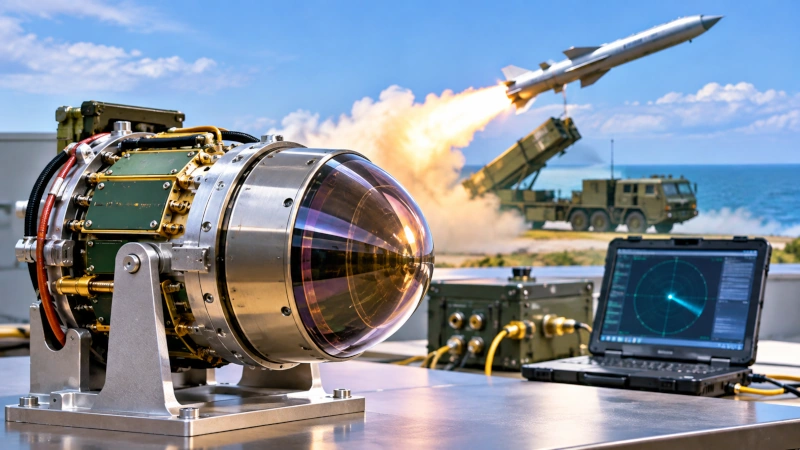
Chennai-based defence electronics company Data Patterns (India) Limited has confirmed that its indigenously developed seeker for the BrahMos supersonic cruise missile is undergoing qualification testing, marking an important stage in the company’s efforts to establish domestic capabilities in advanced missile guidance electronics. The development represents progress towards the potential production of a specialised subsystem used in precision-guided missile systems.
The latest status was disclosed by Data Patterns Chairman and Managing Director Srinivasagopalan Rangarajan during the company’s second-quarter FY2026–27 earnings conference call on November 9, 2026. The company confirmed that the seeker has been developed and that formal qualification activities are continuing before potential production orders can be considered.
The development highlights the growing contribution of India’s private defence industry to complex technologies associated with missile guidance, radar systems and advanced defence electronics.
Understanding the Role of a Missile Seeker
A seeker is a critical component of a guided missile’s targeting system. It enables the missile to acquire or track a designated target by processing signals received through sensors incorporated into its guidance architecture.
Modern missile seekers may use radar, infrared or other sensing technologies, depending on the missile’s intended operational requirements.
In radar-guided applications, the seeker processes electromagnetic signals to obtain information about a target’s position and movement. This information supports the missile’s guidance functions during the relevant stages of flight.
The development of such systems requires expertise in radio-frequency engineering, signal processing, electronic components, embedded computing and systems integration.
Missile seekers are technologically demanding because they must operate reliably within the physical and environmental constraints of a missile while processing information under rapidly changing conditions.
Their development involves extensive engineering, laboratory evaluation, integration testing and qualification before they can be considered for operational production.
The indigenous development of missile seekers is therefore relevant to India’s efforts to strengthen domestic capabilities in advanced defence electronics.
BrahMos and India’s Supersonic Cruise Missile Programme
BrahMos is a supersonic cruise missile developed through cooperation between India and Russia. The programme is undertaken by BrahMos Aerospace, the joint venture established between India’s Defence Research and Development Organisation and Russia’s NPO Mashinostroyenia.
The missile has been developed in different configurations for deployment from land-based systems, naval platforms and aircraft.
BrahMos is designed for high-speed precision engagement of designated targets, combining supersonic flight with guidance and navigation systems intended to support its operational requirements.
Its development has been an important component of India’s missile technology ecosystem, bringing together expertise in propulsion, aerodynamics, guidance electronics, manufacturing and systems integration.
The programme also involves an industrial supply chain consisting of public-sector organisations, research institutions and private companies supplying specialised components and subsystems.
The development of an indigenous seeker by Data Patterns represents another technological capability within this broader industrial ecosystem.
However, the company has not publicly disclosed the detailed configuration or performance characteristics of its BrahMos seeker, including its precise operating frequency, detection range or internal architecture.
Indigenous Seeker Completes Developmental Testing
Data Patterns has previously reported progress in the development and testing of its BrahMos seeker.
In its Q2 FY2026–27 investor presentation, the company listed the successful testing of a seeker for the BrahMos missile among its technological achievements during the 2021–2026 period.
This establishes that the company has already completed a reported testing milestone associated with the seeker development programme.
However, the November 9 earnings conference call clarified that formal qualification testing remains underway.
The distinction between developmental testing and qualification is important in defence equipment manufacturing. Developmental testing is generally undertaken to evaluate whether a system performs its intended functions during the engineering process.
Qualification testing is a further stage intended to establish compliance with specified technical, environmental, operational and reliability requirements.
A subsystem may demonstrate successful performance during developmental tests while still requiring additional evaluation before approval for production or operational integration.
The company’s latest disclosure therefore indicates progress towards qualification rather than completion of the entire acceptance process.
Qualification Testing Remains the Immediate Priority
During the November 9 conference call, Chairman and Managing Director Srinivasagopalan Rangarajan explained that the BrahMos seeker programme remains in the company’s business pipeline because qualification testing has not yet concluded.
Data Patterns expects that a production enquiry could follow successful completion of the qualification process.
The company indicated that it hopes to advance the programme over the coming months, although the actual timing will depend on the completion of qualification activities and subsequent decisions by the prospective customer.
This approach reflects the sequential nature of specialised defence equipment development, where successful engineering and testing must be followed by customer acceptance and commercial arrangements.
Qualification is particularly important for missile guidance electronics because the equipment must perform reliably within the demanding operating conditions associated with guided weapons.
The successful completion of this stage would represent an important technical milestone for Data Patterns and could provide a basis for subsequent production discussions.
Manufacturing Equipment Procured Ahead of Potential Orders
Data Patterns has already undertaken certain preparatory measures for manufacturing the indigenous BrahMos seeker.
According to company management, expensive equipment required for production activities has been purchased in anticipation of future manufacturing requirements.
However, the company has not yet invested in establishing the complete production assembly line or the associated stage-wise testing infrastructure.
Rangarajan explained that the company intends to avoid committing substantial capital to specialised production facilities before receiving greater certainty regarding customer orders and delivery schedules.
This reflects a measured investment strategy in a sector where manufacturing requirements are frequently linked to specific defence contracts and programme schedules.
The company expects to establish the necessary production infrastructure after qualification is completed and the customer provides greater clarity regarding manufacturing quantities and delivery requirements.
Data Patterns has indicated that its existing engineering capabilities should allow it to establish the production line without having to develop the underlying manufacturing expertise from the beginning.
In-House Design and Testing Capabilities
An important feature of the BrahMos seeker programme is the extent of the engineering capability developed within Data Patterns.
According to the company’s management, the seeker design and the associated testing technologies have been developed in-house.
The company possesses expertise in automated test equipment, customised testing systems and electronic systems engineering, which it considers relevant to establishing seeker production capabilities.
Automated test equipment plays an important role in defence electronics manufacturing because complex electronic assemblies require repeated verification during different stages of production.
Such equipment helps manufacturers evaluate whether individual components, circuit assemblies and integrated systems meet specified performance requirements.
For missile seekers, reliable testing infrastructure is particularly important because the finished subsystem must satisfy stringent technical requirements.
Data Patterns has stated that its existing design and testing knowledge would enable it to establish a dedicated manufacturing line relatively quickly once the necessary commercial arrangements are finalised.
The company’s confidence is based on its existing engineering capabilities, although the final production schedule has not yet been established.
Production Orders Depend on Successful Qualification
The November earnings call also provided clarity regarding the commercial status of the BrahMos seeker programme.
Data Patterns confirmed that it has not negotiated a production contract for the seeker.
The programme is currently regarded as a potential business opportunity rather than a confirmed production order.
Company management expects that successful qualification could lead to enquiries for manufacturing the subsystem, after which commercial discussions and production planning would follow.
The timing and scale of any future manufacturing contract will depend on the customer’s requirements and procurement decisions.
Data Patterns has also referred to the possibility of production associated with export requirements. However, no specific export order for the indigenous seeker has been confirmed.
The company has not disclosed a production quantity, contract value or firm delivery schedule for the seeker.
These developments make the qualification process the immediate technological priority before the programme can progress towards serial manufacturing.
Data Patterns’ Experience in BrahMos Electronics
Data Patterns has a long association with the development of specialised electronic systems for Indian defence programmes.
According to its corporate presentation, the company developed a fire-control system for BrahMos during an earlier phase of its technological development.
Its subsequent activities have included the design and manufacture of radar electronics, avionics equipment, electronic warfare systems, communication technologies and automated test systems.
The company has progressively expanded its capabilities from manufacturing individual electronic components and assemblies towards developing more complex integrated systems.
This experience provides the technological foundation for its work on advanced missile electronics.
The development of the BrahMos seeker represents an important extension of these capabilities into a specialised area of missile guidance technology.
It also illustrates how experience gained through radar engineering, microwave electronics and signal processing can support the development of additional defence applications.
Strengthening India’s Missile Electronics Supply Chain
The indigenous development of advanced missile subsystems is relevant to India’s efforts to strengthen domestic defence manufacturing and reduce dependence on imported technologies.
Modern precision-guided weapons incorporate several highly specialised components, including sensors, processors, navigation equipment, electronic control systems and guidance-related assemblies.
Developing such technologies domestically requires sustained investment in research, engineering, testing infrastructure and manufacturing capabilities.
India’s defence industrial ecosystem has increasingly involved private-sector companies in the development and production of these specialised subsystems.
Data Patterns is among the Indian companies building capabilities in radar technologies, electronic warfare, avionics and high-performance defence electronics.
The successful qualification of an indigenous BrahMos seeker could expand the range of domestically developed technologies available to the missile programme, subject to customer acceptance and subsequent procurement decisions.
Such developments are important because the technological capabilities created for one programme may also provide an engineering foundation for other advanced defence systems.
Opportunities in Future Missile Programmes
The experience gained through seeker development can be relevant to wider research and manufacturing activities involving guided weapons.
Missile guidance systems require specialised expertise that can be adapted and developed for different applications, although individual programmes may involve substantially different technical requirements.
Data Patterns has previously discussed its work on other seeker technologies, including higher-frequency seeker development activities.
The company has also highlighted its broader strategy of expanding into complex, high-value defence electronic systems using technologies developed through its existing programmes.
The BrahMos seeker project fits within this strategy by combining radio-frequency engineering, electronic systems design, testing technologies and potential manufacturing opportunities.
However, the commercial prospects of the programme remain dependent on successful technical qualification and formal customer orders.
Indigenous Development Advances Towards Manufacturing Readiness
The progress of Data Patterns’ BrahMos seeker programme represents a significant development in India’s private-sector defence electronics industry.
The company has completed the seeker development work associated with its reported testing milestone and is now pursuing formal qualification.
Its decision to acquire specialised equipment while postponing full production-line investment reflects an effort to prepare for manufacturing without treating potential orders as confirmed business.
The programme also demonstrates the importance of in-house engineering, automated testing and specialised electronic design capabilities in developing sophisticated defence technologies.
As qualification activities continue, Data Patterns is positioned to pursue the next stage of the programme once customer requirements and commercial arrangements are established.
The indigenous BrahMos seeker initiative highlights the growing technological depth of India’s defence manufacturing ecosystem and the contribution of Indian private enterprises to the development of advanced missile electronics.
You may also like
-
India’s Memory Chip Exports Surge 2,333% to $562.4 Million as Semiconductor Trade Expands
-
RRP Defense Partners with Israel’s McTech to Bring Advanced Counter-Drone Technologies to India
-
IndianOil’s Panipat Refinery Receives Approval for Commercial Sustainable Aviation Fuel Supply
-
Bengaluru Startup JohnAIC Targets Production of 100 AI Servers Monthly to Strengthen India’s Sovereign AI Infrastructure
-
Dynamatic Technologies Strengthens Global Aerospace Engagement with Canadian Defence Delegation and French Manufacturer Mecachrome
