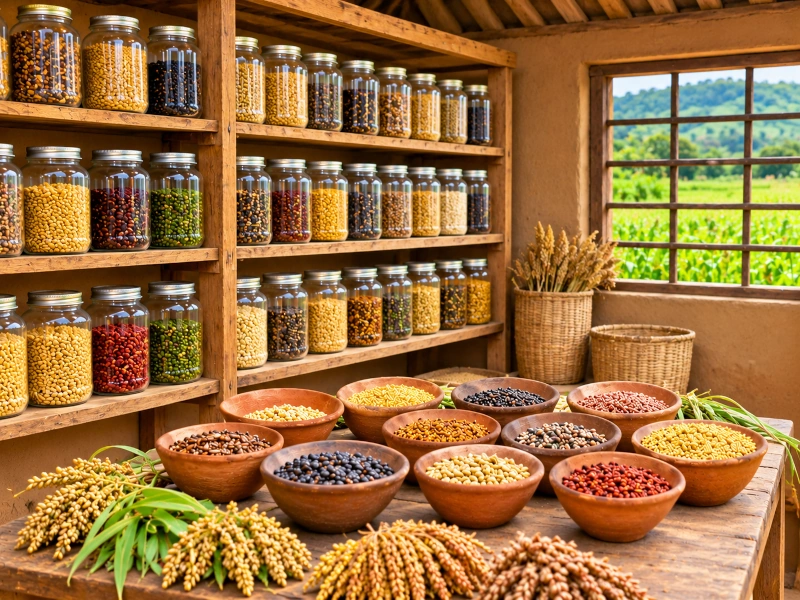
India has taken an important step towards strengthening community-based seed conservation and agricultural biodiversity, with the DIVERSIFARM-India project identifying at least 1,000 community seed banks across the country and mapping 652 of them through a new digital atlas. The initiative seeks to strengthen traditional seed systems, conserve indigenous crop varieties and improve the agricultural resilience and livelihoods of small and marginal farmers.
The findings were presented at the National Seminar for the Advancement of Community Seed Banks, held on November 17–18, 2026, at the National Agricultural Science Complex (NASC) in New Delhi. The two-day event brought together agricultural scientists, policymakers, researchers and representatives of institutions working on seed conservation and biodiversity management.
The project also released a capacity-building manual, policy recommendations for different categories of community seed banks and a roadmap for strengthening community seed conservation in Odisha. These initiatives are intended to provide institutional and technical support to community-led efforts to preserve agricultural genetic diversity.
Digital Atlas Maps India’s Community Seed Banks
One of the principal achievements of DIVERSIFARM-India is the development of a Geographic Information System (GIS)-based digital atlas documenting community seed banks operating across India. The atlas currently includes profiles of 652 institutions, providing a geographical overview of community-based seed conservation activities.
The survey conducted under the project indicates that India has at least 1,000 community seed banks, demonstrating the extent of local initiatives dedicated to preserving traditional crop varieties and maintaining access to seeds within farming communities.
The digital platform brings together information about community seed banks operating in different agricultural and ecological regions. By documenting these institutions and their activities, the atlas provides researchers, policymakers and agricultural organisations with a resource for understanding existing conservation networks and identifying opportunities for institutional support.
Community seed banks play an important role in maintaining locally adapted crop varieties that have been cultivated and preserved by farming communities over generations. Such varieties represent valuable agricultural genetic resources, particularly in regions where farmers depend on crops adapted to specific soil conditions, rainfall patterns and traditional cultivation practices.
India–Norway Collaboration Strengthens Community Seed Conservation
DIVERSIFARM-India is a collaborative research and development initiative led by the Fridtjof Nansen Institute (FNI) in Norway and the M S Swaminathan Research Foundation (MSSRF) in India. The project aims to strengthen community seed systems to improve food security, nutrition and livelihood opportunities among smallholder farmers.
The initiative represents an important component of agricultural research cooperation between India and Norway, bringing together expertise in biodiversity conservation, agricultural development, community institutions and policy research.
Addressing the national seminar, Norwegian Ambassador to India May-Elin Stener welcomed the extensive mapping and documentation of community seed banks undertaken through the project. She highlighted its importance within the broader partnership between India and Norway.
Dr Regine Andersen, Research Professor at the Fridtjof Nansen Institute, presented several outcomes of the three-year collaboration between FNI and MSSRF. She explained that the digital platform provides greater visibility to community seed banks operating across India while highlighting their collective efforts and contributions to agricultural biodiversity.
Dr R Rengalakshmi, Executive Director of MSSRF, emphasised that community seed banks function as more than physical facilities for storing seeds. They are living institutions supporting the conservation of agricultural biodiversity within farming communities and strengthening farmers’ capacity to respond to changing agricultural conditions.
Six Institutional Categories Identified for Targeted Policy Support
The DIVERSIFARM-India study identified six distinct typologies of community seed banks based on their management structures. This classification recognises that community seed banks operate through different organisational arrangements and require institutional support suited to their respective circumstances.
Community seed banks may differ in their administrative systems, local participation, conservation priorities and relationships with supporting organisations. Understanding these institutional differences is important for developing policies that address their operational requirements rather than treating all seed banks as identical institutions.
The policy brief developed under the project provides a framework for recognising these differences and designing more effective interventions. Such an approach can help policymakers and agricultural institutions identify appropriate mechanisms for technical assistance, institutional development and long-term sustainability.
The classification also provides a foundation for understanding how community seed banks can work alongside agricultural research institutions and government programmes while retaining their community-based character.
Odisha Roadmap Proposes Ten Measures to Strengthen Seed Banks
Odisha has emerged as a focal state for the DIVERSIFARM-India initiative, with the project developing a ten-point roadmap to strengthen community seed banks and improve the institutional environment in which they operate.
The roadmap recommends establishing a dedicated secretariat under Odisha’s Department of Agriculture and Farmers’ Empowerment. The proposed institutional arrangement would support coordination and the development of an enabling environment for community seed banks across the state.
The recommendations are intended to address the organisational, technical and policy requirements associated with sustaining community seed conservation initiatives. The roadmap provides a state-level framework that could inform similar efforts in other regions, subject to their agricultural and institutional circumstances.
Odisha’s role as the pilot state is particularly relevant because the project’s research and capacity-building activities have drawn upon detailed studies of community seed bank operations within the state.
Capacity-Building Manual Provides Practical Guidance
A major outcome of the national seminar was the release of a capacity-building manual designed to support the establishment, management and long-term sustainability of community seed banks across India.
Developed through detailed case studies conducted in Odisha, the manual combines technical guidance, organisational approaches and relevant policy considerations. It is intended to assist existing community seed banks while providing practical direction for communities and organisations seeking to establish new institutions.
The manual addresses the need to strengthen the operational capacities of community seed banks and develop institutional systems that support their continued functioning. By combining practical experience with research findings, it provides a resource for agricultural organisations, community institutions and development agencies involved in seed conservation.
Dr Trilochan Mohapatra, Chairperson of the Protection of Plant Varieties and Farmers’ Rights Authority (PPVFRA), released the manual at the National Agricultural Science Complex. In his inaugural address, he highlighted the Authority’s support for community seed banks and expressed confidence that increasing government support would help these institutions flourish.
Strengthening the Legal Framework for Community Seed Conservation
The DIVERSIFARM-India project also examined India’s legal and policy environment to identify opportunities and institutional challenges affecting community seed banks.
The study highlighted the relevance of the Protection of Plant Varieties and Farmers’ Rights Act, 2001, and India’s Biological Diversity Act, 2002, in supporting community-based agricultural biodiversity conservation.
The Protection of Plant Varieties and Farmers’ Rights Act provides a legal framework for protecting plant varieties while recognising specified rights of farmers, including provisions relating to the conservation and use of agricultural genetic resources. The Biological Diversity Act establishes mechanisms for biodiversity conservation, sustainable use and access and benefit-sharing.
These legal frameworks are particularly relevant to communities preserving traditional crop varieties and maintaining agricultural biodiversity through collective conservation efforts.
Dr P L Gautam, former Chairperson of the Protection of Plant Varieties and Farmers’ Rights Authority and the National Biodiversity Authority, highlighted the need for greater coordination between the two legal frameworks to improve their effectiveness for farming communities.
The discussions emphasised that stronger institutional coordination could help community seed banks benefit more effectively from existing legal protections and biodiversity conservation mechanisms.
Collaboration Between Community Seed Banks and National Gene Banks
The seminar also examined opportunities for closer cooperation between community seed banks and national institutions responsible for conserving plant genetic resources.
Dr Devendra Kumar Yadava, Director of the ICAR-National Bureau of Plant Genetic Resources and Deputy Director General (Crop Science) at the Indian Council of Agricultural Research, highlighted the importance of strengthening collaboration between community gene banks and national gene banks.
Community seed banks and national gene banks perform complementary functions within India’s agricultural biodiversity conservation system. Community institutions help maintain crop diversity through local cultivation, seed exchange and farmer participation, while national gene banks provide specialised facilities for the scientific conservation and documentation of plant genetic resources.
Greater cooperation between these institutions can support the identification, documentation and preservation of traditional crop varieties while improving the exchange of scientific knowledge and conservation practices.
Dr Gautam also emphasised that sustained financial commitments and capacity-building programmes are essential for strengthening community seed banks and ensuring their long-term institutional viability.
Community Seed Banks and Agricultural Resilience
Community seed banks are significant because they help farming communities maintain access to locally adapted planting material and preserve agricultural diversity that may otherwise decline as cultivation patterns change.
Traditional crop varieties often possess characteristics developed through generations of cultivation under local environmental conditions. Their conservation provides valuable genetic resources for agricultural research, crop improvement and efforts to respond to emerging environmental challenges.
Community seed banks can also help preserve farmers’ knowledge of seed selection, cultivation practices and crop characteristics. This knowledge forms an important part of India’s agricultural heritage and contributes to maintaining the relationship between farming communities and their local ecosystems.
The conservation of diverse seed varieties is increasingly relevant as agriculture faces challenges associated with irregular rainfall, rising temperatures, changing pest pressures and the need for sustainable production systems.
By improving access to locally suitable seeds and supporting community participation in conservation, these institutions can contribute to agricultural resilience, food security and the preservation of India’s rich crop diversity.
Building a Stronger Network for India’s Indigenous Seeds
The mapping of 652 community seed banks under DIVERSIFARM-India represents a significant advance in documenting India’s decentralised agricultural biodiversity conservation efforts. Alongside the national survey identifying at least 1,000 such institutions, the digital atlas provides a foundation for understanding the geographical spread and institutional diversity of community-led seed conservation.
The newly released capacity-building manual, six institutional typologies and Odisha’s ten-point roadmap add practical and policy dimensions to this effort. Together, these resources provide opportunities to strengthen existing seed banks, support the development of new community institutions and improve cooperation between farmers, researchers and government agencies.
The India–Norway collaboration also demonstrates how international research partnerships can contribute to nationally relevant agricultural development by combining scientific expertise with community knowledge and local conservation practices.
As India continues to strengthen its agricultural biodiversity conservation systems, community seed banks can serve as an important link between traditional farming knowledge and modern scientific institutions. By supporting these community-led initiatives through research, policy coordination and sustained capacity building, India can advance the conservation of indigenous crop varieties while strengthening the resilience and sustainability of its agricultural future.
You may also like
-
India’s Exports Surge 58% to ASEAN and 22% to South Asia as Trade Expands Across Global Markets
-
Tata Steel Plans India’s First Hydrogen Production Facility Using Steel Plant Off-Gases in Odisha
-
India’s Memory Chip Exports Surge 2,333% to $562.4 Million as Semiconductor Trade Expands
-
India–Kuwait Bilateral Trade Reaches $9.57 Billion as Nations Mark 65 Years of Diplomatic Relations
-
APEDA Facilitates First-Ever Biscuit Export from Varanasi to Madagascar, Expanding Uttar Pradesh’s Processed Food Trade
