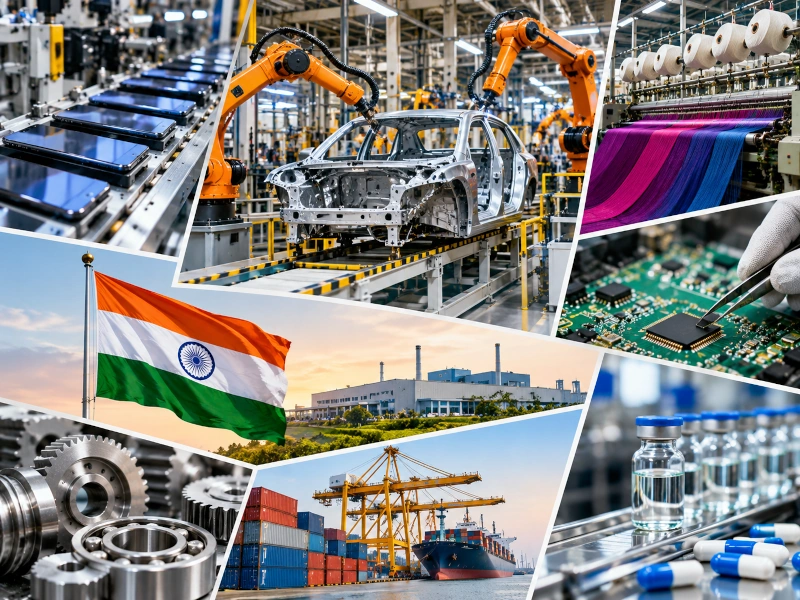
India’s Production-Linked Incentive (PLI) schemes have achieved 76% of their targeted investments and 64% of their production goals, according to an assessment by NITI Aayog. The progress reflects the expansion of domestic manufacturing capabilities, increasing industrial investments and the growing participation of Indian and international companies in the country’s manufacturing sector.
The PLI programme, implemented across 14 sectors, aims to strengthen domestic production, attract investments, encourage technological advancement and improve India’s competitiveness in global manufacturing. The schemes cover strategically important industries, including electronics and mobile phone manufacturing, automobiles and automotive components, textiles and other industrial sectors.
Investment and Production Targets Show Significant Progress
According to the NITI Aayog assessment, the PLI schemes have collectively achieved 76% of their investment targets, indicating substantial progress in attracting capital for manufacturing facilities, production infrastructure and industrial expansion.
The schemes have also achieved 64% of their targeted production levels, demonstrating the contribution of participating manufacturers towards expanding domestic industrial output.
The assessment indicates that investment commitments and production activities have progressed across the sectors covered by the programme, although the extent of implementation varies between individual industries.
With approximately 42% of the schemes’ combined implementation period remaining, the programme has scope for additional investments, increased production and further industrial expansion as participating manufacturing facilities advance towards their intended operational capacities.
Strengthening Electronics and Automobile Manufacturing
Electronics manufacturing, particularly mobile phone production, has emerged as an important component of India’s PLI framework. The programme has attracted participation from major international technology companies, including Apple and Samsung, alongside Indian manufacturers and suppliers.
The schemes have encouraged investments in manufacturing infrastructure and supported the development of domestic supply chains associated with electronics production.
In the automobile and automotive components sector, the PLI framework supports manufacturing expansion and the adoption of advanced technologies. The programme also covers textiles and other industrial sectors identified as important for strengthening India’s manufacturing capabilities.
By encouraging investments across multiple industries, the schemes seek to expand domestic production capacity while improving the competitiveness of Indian manufacturing in international markets.
Supporting Domestic Supply Chains and Export Opportunities
An important objective of the PLI initiative is to strengthen India’s manufacturing supply chains by encouraging companies to establish and expand production facilities within the country.
The programme provides production-linked incentives to eligible manufacturers, creating a framework that connects government support with manufacturing performance.
The expansion of domestic manufacturing capacity also supports opportunities for Indian companies to participate in international supply chains and increase their presence in export markets.
The involvement of major global manufacturers has contributed to the development of manufacturing ecosystems involving component suppliers, industrial service providers and supporting enterprises.
These developments form part of India’s broader efforts to increase domestic value addition, encourage industrial investment and strengthen its position in global manufacturing networks.
NITI Aayog Emphasises Continued Monitoring
NITI Aayog has highlighted the importance of monitoring the implementation of PLI schemes across the participating sectors to ensure that the programmes achieve their intended investment and production outcomes.
The assessment of investment and production targets provides a measure of progress while helping identify areas where implementation requires continued attention.
With a substantial portion of the combined implementation period remaining, further progress will depend on the expansion of manufacturing operations, the achievement of production milestones and the effective utilisation of investments already undertaken.
Continued monitoring is also important for assessing the contribution of individual sectors to the programme’s overall objectives.
Advancing India’s Manufacturing Ambitions
The progress recorded under the PLI schemes reflects India’s continuing efforts to establish a stronger and more competitive manufacturing ecosystem.
By attracting industrial investments, encouraging domestic and international manufacturers and supporting production across 14 sectors, the programme contributes to the development of manufacturing infrastructure, technological capabilities and industrial supply chains.
The achievement of 76% of the investment target and 64% of the production goal marks an important stage in the implementation of the PLI initiative.
As participating manufacturers expand their operations during the remaining implementation period, the programme provides opportunities for further growth in industrial production, employment generation, domestic value addition and exports, supporting India’s ambition to strengthen its position as a global manufacturing hub.
You may also like
-
Bharat Semi Raises $24 Million to Develop AI-Enabled Image Sensors for Drones, Robotics and Autonomous Systems
-
India’s Female Labour Force Participation Reaches 35%, Unemployment Declines to 4.9%
-
TDB-DST Approves ₹10 Crore Support for Neo Seekermetals to Develop Indigenous Critical Minerals Recycling Technology
-
Waigaon Turmeric – The Golden Heritage of Maharashtra’s Vidarbha Region
-
Mankind Pharma Signs Exclusive Licensing Agreement with Betta Pharmaceuticals for Lung Cancer Drug Ensartinib
