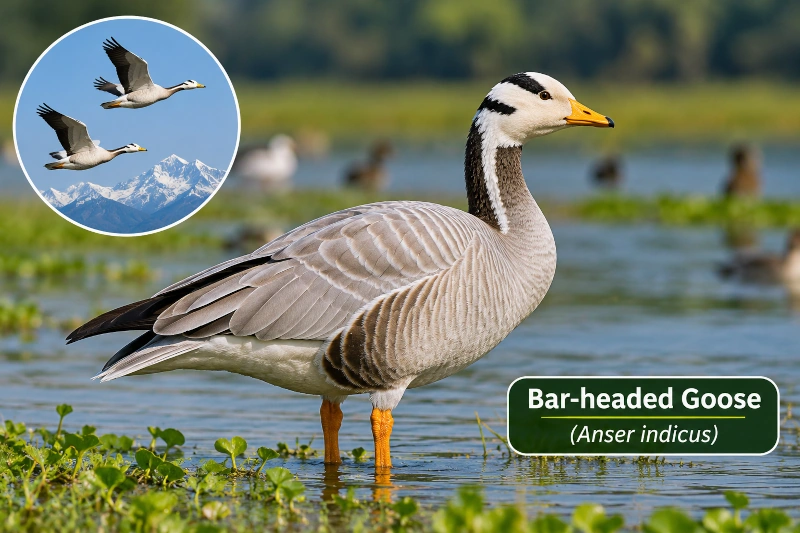
Bar-headed geese (Anser indicus), migratory waterbirds renowned for their remarkable ability to fly across the Himalayas, have been sighted at Nandur Madhmeshwar Wildlife Sanctuary in Maharashtra’s Nashik district. Their arrival during the winter migration season has attracted attention from forest officials, birdwatchers and wildlife enthusiasts, highlighting the sanctuary’s importance as a habitat for migratory birds.
The sighting was reported on November 15, with Nandur Madhmeshwar Wildlife Sanctuary Range Forest Officer Hiralal Chaudhary welcoming the arrival of the birds. Separate media reports described the sighting as particularly noteworthy because the species had reportedly not been observed at the sanctuary for nearly a decade.
The bar-headed goose is already included in the sanctuary’s official bird checklist available through the Ramsar Sites Information Service, confirming its historical association with the wetland.
A Remarkable Migratory Bird Returns to Nandur Madhmeshwar
The bar-headed goose is among the world’s most remarkable migratory waterbirds, distinguished by its ability to undertake long-distance journeys across mountainous terrain, including the Himalayan region.
The species is easily identified by its pale grey body, white head and two prominent black bars extending across the back of its head. Its yellow-orange bill and legs provide additional distinguishing characteristics.
Bar-headed geese breed primarily in high-altitude regions of Central Asia, including the Tibetan Plateau and Mongolia. During the colder months, many populations migrate southwards to wintering grounds in the Indian subcontinent.
These seasonal journeys take the birds across challenging geographical environments, including high mountain ranges and areas characterised by reduced atmospheric oxygen.
The recent arrival of bar-headed geese at Nandur Madhmeshwar forms part of the broader seasonal movement of migratory waterbirds into India’s wetlands.
Extraordinary Ability to Cross the Himalayas
Bar-headed geese are particularly well known for their physiological adaptations that enable them to fly at high altitudes.
Their respiratory and circulatory systems allow them to function under conditions where oxygen availability is considerably lower than at sea level.
Scientific studies have demonstrated that these birds possess specialised physiological characteristics, including efficient oxygen uptake and transport mechanisms that support sustained flight in low-oxygen environments.
Unlike many other migratory birds, bar-headed geese regularly cross Himalayan terrain during their seasonal movements between breeding and wintering areas.
Their migration has attracted considerable scientific interest because it provides opportunities to study high-altitude flight, respiratory physiology, energy expenditure and avian adaptation to demanding environmental conditions.
The bar-headed goose represents an important example of the remarkable physiological adaptations that enable migratory birds to travel across some of the world’s most challenging geographical landscapes.
Nandur Madhmeshwar: Maharashtra’s Important Wetland Habitat
Nandur Madhmeshwar Wildlife Sanctuary is situated near Niphad in Nashik district, at the confluence of the Godavari and Kadva rivers.
The wetland developed around the Nandur Madhmeshwar irrigation weir, where the accumulation of sediment over many decades created shallow water bodies, marshes, islands and other habitats suitable for aquatic birds.
The resulting wetland ecosystem supports a wide diversity of resident and migratory bird species.
Nandur Madhmeshwar was designated as a Wetland of International Importance under the Ramsar Convention on June 21, 2019, recognising its ecological significance.
According to information published by the Ministry of Environment, Forest and Climate Change, the Ramsar-designated wetland covers approximately 1,437 hectares and is managed by the Maharashtra Forest Department’s Wildlife Wing.
The sanctuary is also recognised for its importance to waterbirds and other wildlife associated with freshwater ecosystems.
A Sanctuary Supporting Hundreds of Bird Species
Nandur Madhmeshwar is popularly known as the Bharatpur of Maharashtra because of its diversity of wetland birds.
According to Maharashtra Tourism Department information, the sanctuary supports more than 265 bird species, including numerous migratory birds arriving from different parts of Asia and Europe.
Important bird species associated with the sanctuary include the Eurasian spoonbill, common pochard, northern pintail, painted stork, white stork, peregrine falcon and several species of ducks and other waterbirds.
The wetland also supports aquatic vegetation, fish and other organisms that contribute to its ecological productivity.
Its combination of shallow waters, mudflats, marshes and aquatic vegetation provides feeding and resting habitats for birds with different ecological requirements.
The presence of diverse wetland habitats makes Nandur Madhmeshwar an important seasonal destination for migratory waterbirds travelling across the Indian subcontinent.
Bar-headed Goose Already Documented in Official Bird Records
The bar-headed goose is included in the taxonomic list of birds associated with Nandur Madhmeshwar Wildlife Sanctuary available through the Ramsar Sites Information Service.
The checklist identifies the species by its scientific name, Anser indicus, and classifies it as a migratory waterbird.
Its inclusion establishes that the species has previously been documented at the sanctuary, although the checklist does not establish how frequently the birds have visited in recent years.
The latest sighting, reported in November 2026, therefore represents a renewed observation of an already documented migratory species rather than the discovery of a new species or the sanctuary’s first record.
Long-term records of bird occurrence are important because they provide information on the seasonal distribution of migratory species and their association with particular wetlands.
Wetland Conservation and Migratory Birds
Wetlands provide essential habitats for migratory birds by offering feeding areas, resting sites and protection during their seasonal movements.
For waterbirds such as bar-headed geese, suitable wetland conditions are particularly important during the winter months, when populations move away from colder breeding regions.
The availability of shallow water, vegetation, mudflats and relatively undisturbed resting areas influences the suitability of wetlands for different bird species.
Nandur Madhmeshwar’s ecological significance is closely connected with the water levels maintained in its reservoir and adjoining wetland habitats.
The management of water resources, aquatic vegetation and human activities therefore plays an important role in maintaining the sanctuary’s suitability for resident and migratory wildlife.
The sanctuary’s Ramsar designation provides international recognition of its importance and reinforces the need for sustained wetland conservation.
A Positive Development for Maharashtra’s Migratory Bird Habitats
The reported arrival of bar-headed geese at Nandur Madhmeshwar Wildlife Sanctuary during November 2026 adds another noteworthy observation to the current winter migration season.
The birds’ presence has generated interest among wildlife enthusiasts and forest officials, drawing attention to the ecological importance of the sanctuary.
As one of Maharashtra’s internationally recognised wetlands, Nandur Madhmeshwar provides habitat for a wide range of migratory waterbirds and contributes to the conservation of India’s freshwater biodiversity.
The return of these extraordinary Himalayan migrants highlights the continuing importance of protecting India’s wetlands, maintaining suitable habitats and systematically documenting the remarkable seasonal journeys of migratory birds.
You may also like
-
Three Butterfly Species Recorded for First Time in Kerala’s Silent Valley National Park
-
Rare Willow Warbler Recorded for First Time in Karnataka at Mangaluru Grasslands
-
Scientists Discover New Flowering Plant Disporopsis crispata in Arunachal Pradesh, First Record of Genus in India
-
Critically Endangered Spoon-Billed Sandpiper Returns to Bengal Coast After 8,000-Km Migration from Russia
-
Assam Releases 240 Critically Endangered Black Softshell Turtle Hatchlings into Roumari Beel
