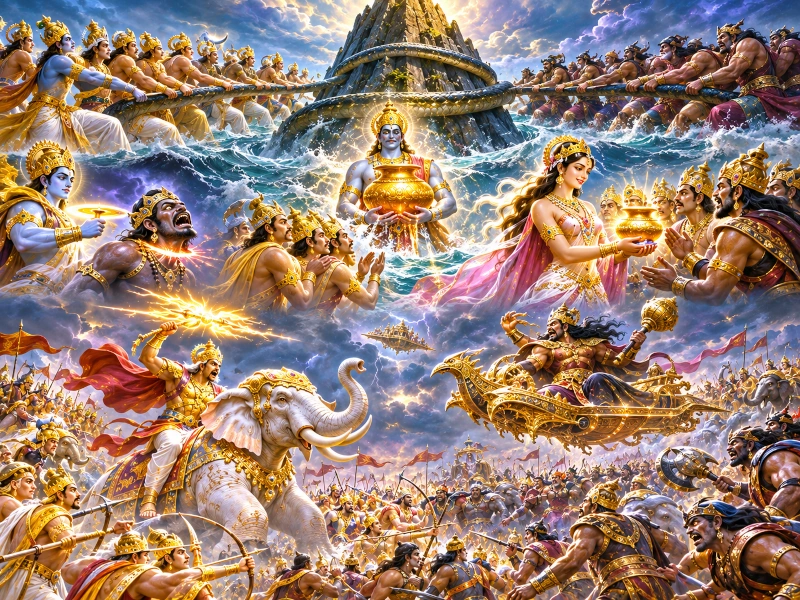
Warcraft Strategies from the Purāṇas | Śrīmad Bhāgavata Purāṇa, Eighth Skandha, Chapters 8–11
The great battle between the Devas and Asuras following the Samudra Manthana, or Churning of the Ocean of Milk, is among the most elaborate military confrontations described in the Śrīmad Bhāgavata Purāṇa. The conflict arose over the possession of Amṛta, the divine nectar associated with immortality, which both sides had sought through a temporary alliance. What began as a cooperative undertaking to obtain a valuable divine substance eventually developed into a major celestial war involving powerful commanders, large armies, supernatural weapons and extraordinary battlefield tactics.
The Devas and Asuras had cooperated in the enormous undertaking of churning the cosmic ocean. Mount Mandara served as the churning rod, while the serpent Vāsuki was used as the rope. The operation produced numerous extraordinary treasures and divine beings before Dhanvantari eventually emerged carrying the vessel containing Amṛta. The appearance of the nectar immediately changed the relationship between the two sides, as both regarded its possession as essential to strengthening their respective positions in the celestial order.
The Asuras seized the vessel containing Amṛta, but disagreement soon arose among them over its distribution. The prospect of gaining immortality created competition even within their own ranks, weakening the unity that had enabled them to participate in the churning. The military significance of this development lies in the strategic value of a resource capable of transforming the relative strength of competing powers. Control over Amṛta represented far more than possession of a treasure, as it carried the potential to alter the balance of power between the Devas and Asuras.
The Temporary Alliance Breaks Down
The cooperation between the Devas and Asuras had been established to achieve a common objective rather than to create lasting political or military harmony. Both sides needed the participation of the other to complete the churning, but their underlying rivalry remained unresolved. Once Amṛta emerged, the temporary alignment of interests gave way to competing claims over its possession, demonstrating how an alliance formed around a specific objective could collapse when the anticipated benefits became available.
Although the Asuras initially gained control of the nectar, their inability to agree upon its distribution created an opportunity for intervention. Lord Viṣṇu assumed the enchanting form of Mohinī and appeared before the Asuras. Captivated by her appearance, they requested that she distribute the nectar fairly among them. Mohinī agreed to undertake the distribution after obtaining their promise to accept her decision, and she subsequently arranged the Devas and Asuras in separate groups before distributing the Amṛta to the Devas.
During the distribution, an Asura named Rāhu disguised himself as a Deva and succeeded in obtaining a portion of the nectar. However, Sūrya and Candra identified him, and Viṣṇu severed his head before the nectar could pass completely through his body. The remaining Asuras were deprived of Amṛta despite having participated in the difficult undertaking that produced it.
The episode illustrates the strategic consequences of losing control over a critical resource after investing heavily in its acquisition. The Asuras had contributed to the operation that produced Amṛta but failed to retain control over its distribution, allowing their opponents to obtain the decisive advantage. Their anger at this outcome transformed the dispute over the nectar into open warfare.
The Asuras Mobilise for War
After the Devas received Amṛta, Lord Viṣṇu departed upon Garuḍa, leaving the two rival groups to confront the consequences of the distribution. The Asuras, angered by their exclusion, prepared for battle and advanced against the Devas with their weapons raised. The Devas, strengthened by drinking Amṛta, responded by assembling their own forces. The confrontation took place on the shore of the Ocean of Milk, where the two celestial armies gathered for an immense struggle.
The Śrīmad Bhāgavata Purāṇa describes a battlefield filled with chariots, elephants, cavalry, infantry and warriors mounted upon a remarkable variety of creatures. The opposing forces advanced beneath banners and ceremonial standards, while the sounds of conches, drums and other martial instruments accompanied their movements. Warriors equipped with bows, arrows, spears, swords, clubs and other weapons confronted one another in a succession of fierce engagements.
The fighting involved both organised formations and individual encounters between prominent commanders. Chariot warriors exchanged missiles, mounted combatants charged into the opposing ranks, and infantry soldiers fought at close quarters. The battlefield became increasingly chaotic as the two armies attempted to overwhelm one another through direct attacks and the employment of extraordinary weapons.
The military importance of this description lies in its portrayal of a large-scale confrontation involving multiple categories of fighting forces. The Purāṇic narrative presents warfare as an organised undertaking in which different types of combatants operated within the same battlefield, rather than as a contest determined exclusively by individual heroic duels.
Bali Leads the Asura Army
The Asura forces were commanded by Bali Mahārāja, the son of Virocana, who occupied a prominent position among their leaders. Bali entered the battlefield aboard a remarkable aerial vehicle named Vaihāyasa, constructed by Maya Dānava. The Śrīmad Bhāgavata Purāṇa describes this vehicle as an extraordinary creation possessing the supernatural ability to become visible or invisible, allowing Bali to move across the battlefield in a manner unavailable to ordinary warriors.
Bali was accompanied by several powerful Asura commanders, including Namuci, Śambara, Bāṇa, Vipracitti, Virocana, Jambha, Mālī and Sumālī. These warriors commanded considerable strength and possessed distinctive weapons and supernatural abilities. Their participation demonstrated the scale of the Asura mobilisation and the importance attached to the struggle for Amṛta.
The presence of numerous powerful commanders required Bali to exercise leadership over a force composed of formidable individual warriors. Although the Purāṇic account emphasises their supernatural capabilities, the narrative also depicts the difficulties associated with coordinating a large army during a prolonged confrontation involving multiple simultaneous engagements.
Bali’s role illustrates the importance of central military leadership in directing forces containing numerous subordinate commanders. His Vaihāyasa vehicle also represents a supernatural form of mobile battlefield capability, allowing the Asura leader to conduct operations from an extraordinary aerial platform. Within the mythological framework of the Purāṇa, this combination of leadership and mobility formed an important element of the Asura war effort.
Indra Commands the Deva Forces
Indra assumed command of the Deva armies and entered the battlefield mounted upon Airāvata, his celestial elephant. He was supported by prominent divine warriors, including Agni, Vāyu, Varuṇa, Yama and other commanders who represented the principal fighting strength of the Devas. The opposing armies advanced towards each other, and the battle soon developed into a series of encounters between leading warriors from both sides.
Indra confronted Bali, while Kārttikeya fought Tāraka. Varuṇa engaged Heti, Yama faced Kālanābha, and Viśvakarmā confronted Maya Dānava. These engagements formed part of the wider conflict, as each prominent warrior attempted to defeat an important opponent while the surrounding armies continued fighting.
The confrontation between Indra and Bali was particularly significant because both commanded the principal forces involved in the war. Their individual struggle therefore occupied a central position in the narrative, while the battles between other commanders reflected the wider contest for military superiority.
The arrangement of engagements between leading warriors highlights the importance assigned to command-level combat in ancient Indian epic and Purāṇic descriptions of warfare. The defeat or incapacitation of a prominent commander could influence the morale, cohesion and direction of the wider battle. Although the Devas initially gained the advantage, the Asuras responded with extraordinary methods that threatened to reverse the situation.
The Asuras Employ Māyā on the Battlefield
As the fighting intensified, the Asuras began employing Māyā, or supernatural illusion, to confuse and overwhelm their opponents. Bali used these powers to create terrifying manifestations that disrupted the battlefield and placed the Devas under severe pressure. The Śrīmad Bhāgavata Purāṇa describes extraordinary phenomena arising through these supernatural abilities, including threatening creatures, violent natural manifestations and destructive forces that made it increasingly difficult for the Deva warriors to continue their attacks.
The use of Māyā transformed the battlefield from a conventional confrontation between armed forces into an environment dominated by confusion and uncertainty. The Devas struggled to distinguish and counter the manifestations directed against them, while the Asuras attempted to exploit the disruption to regain the advantage. The supernatural attacks weakened the confidence of the Deva forces and threatened to undermine the military superiority they had previously established.
Unable to overcome the illusions through their own efforts, the Devas sought the protection of Lord Viṣṇu. Their appeal reflected the extent to which the Asuras had succeeded in changing the conditions of battle through methods that could not be countered by ordinary weapons alone.
The strategic significance of Māyā lies in its ability to disrupt an opponent’s perception, confidence and capacity to respond effectively. Within the supernatural framework of the Purāṇas, illusion functions as an offensive capability that changes battlefield conditions without depending exclusively upon direct physical attacks. The episode offers a conceptual parallel to deception and psychological warfare, in which confusion and uncertainty can be used to weaken an opposing force.
Viṣṇu Intervenes and Neutralises the Illusions
As the Devas struggled against the supernatural manifestations created by the Asuras, Lord Viṣṇu appeared upon the battlefield. His arrival transformed the situation, as the illusions that had threatened the Deva armies were dispelled through his divine power. With the supernatural obstacles removed, the Devas regained their ability to confront their opponents directly.
The Śrīmad Bhāgavata Purāṇa describes several powerful Asura warriors confronting Viṣṇu during the subsequent fighting. Among them were Kālanemi, Mālī, Sumālī and Mālyavān, who attempted to resist his intervention but were killed in the ensuing engagements. Their defeat weakened the Asura position and removed important warriors from the battlefield.
The destruction of the illusions demonstrated that the advantage obtained through supernatural methods could be reversed when an opponent possessed the means to neutralise them. Although the Asuras had temporarily disrupted the Deva forces, their success depended upon maintaining the effectiveness of their extraordinary capabilities.
The military significance of Viṣṇu’s intervention lies in the importance of countering an adversary’s specialised methods of warfare. The Devas could not restore their battlefield advantage merely by increasing the intensity of their attacks; they first required the neutralisation of the capabilities that had disrupted their operations. Once those capabilities were overcome, the balance of the battle shifted again.
Indra Confronts Bali and the Asura Commanders
The battle continued with renewed intensity as Indra confronted Bali, the principal commander of the Asura forces. Indra challenged his opponent and attacked him with the Vajra, his divine thunderbolt. The powerful strike caused Bali to fall from his aerial vehicle, temporarily removing the Asura commander from active participation in the fighting.
The fall of Bali did not immediately end the battle, as other powerful Asura warriors continued their attacks. Jambhāsura advanced against Indra and entered the confrontation mounted upon a lion. Armed with a formidable club, he struck Indra and Airāvata, incapacitating the celestial elephant and forcing the Deva commander to confront a serious disruption to his battlefield mobility.
At this critical moment, Mātali, Indra’s charioteer, arrived with a magnificent chariot drawn by a thousand horses. Indra transferred to the chariot and resumed the battle, demonstrating his ability to continue fighting despite the loss of his original mount. Jambhāsura subsequently attacked Mātali, but Indra responded by striking the Asura warrior with the Vajra and severing his head.
This sequence highlights the importance of maintaining command mobility and continuity during battle. The incapacitation of Airāvata temporarily deprived Indra of his principal mount, but the timely arrival of Mātali with an alternative vehicle allowed him to remain operational and continue directing the confrontation.
The fighting intensified further when Namuci, Bala and Pāka launched powerful attacks against Indra. These warriors directed their weapons towards the Deva commander, his chariot, his horses and Mātali, attempting to overwhelm him through repeated assaults. Their attacks demonstrated the importance attached to targeting not only a principal warrior but also the mobility and support arrangements that enabled him to remain effective in battle.
The Defeat of Namuci
One of the most unusual engagements in the battle occurred when Indra confronted Namuci, a formidable Asura warrior who possessed extraordinary protection against conventional attacks. During the confrontation, Indra employed the Vajra against Namuci, expecting the divine thunderbolt to destroy his opponent. However, the weapon failed to kill him, revealing that the Asura possessed an exceptional defence that could not be overcome through the direct application of Indra’s most powerful weapon.
An unseen celestial voice then revealed that Namuci could not be killed by anything that was either wet or dry. This restriction presented Indra with a challenge that could not be solved simply by employing greater force. He had to identify a means of attack that did not fall within the conditions protecting his adversary.
Indra considered the restriction and recognised that foam occupied an unusual position, being neither conventionally wet nor dry. He subsequently employed foam to kill Namuci, overcoming the protection that had rendered the Vajra ineffective.
The military significance of this encounter lies in the importance of tactical adaptability when a powerful weapon proves ineffective against a particular adversary. Indra’s victory depended not upon greater destructive force but upon recognising the limitations governing his opponent’s protection and identifying an unconventional means of overcoming them.
The episode illustrates a recurring principle within Purāṇic warfare: the possession of superior weapons does not automatically guarantee success against every opponent. Knowledge, judgement and the ability to adapt one’s methods can become decisive when established approaches fail.
Nārada Intervenes to End the Fighting
As the battle progressed, the Devas gained the upper hand and inflicted heavy losses upon the Asura forces. Several prominent Asura commanders had been defeated, while the surviving warriors continued to resist despite the increasingly unfavourable situation. The conflict approached a decisive stage in which the Devas possessed the military advantage necessary to continue their offensive.
However, the battle did not conclude with the complete destruction of the defeated army. At the request of Brahmā, the sage Nārada intervened and instructed the Devas to stop killing the Asuras. The Devas accepted his instruction and withdrew from the battlefield, bringing the immediate fighting to an end.
The surviving Asuras carried Bali to Asta Mountain, where Śukrācārya restored his consciousness. The Śrīmad Bhāgavata Purāṇa also describes the revival of Asura warriors whose bodies had not been completely destroyed. The defeated forces were therefore able to recover from some of the losses suffered during the battle, even though the Devas had secured the immediate advantage.
Nārada’s intervention introduces an important principle concerning the termination of warfare. Military superiority does not necessarily require the complete destruction of an opposing force, and the decision to cease hostilities can become as significant as the ability to continue fighting. The episode demonstrates that the conclusion of a battle may be determined by an authoritative decision to exercise restraint rather than by the total elimination of the defeated side.
Military Significance: Strategic Resources, Command and Battlefield Adaptation
The Battle for Amṛta presents several interconnected military principles concerning strategic resources, alliances, command structures, unconventional warfare and the termination of hostilities. Although the narrative belongs to the supernatural world of the Purāṇas, its military dimensions can be examined through the recurring challenges associated with organised conflict.
The first major lesson concerns the relationship between strategic resources and military power. The Devas and Asuras cooperated to obtain Amṛta because both recognised its extraordinary value. However, the absence of a mutually accepted arrangement for controlling and distributing the nectar transformed their cooperation into hostility. The episode demonstrates how competition over a resource capable of changing the balance of power can become a direct cause of conflict.
The second lesson concerns the vulnerability of temporary alliances formed around a common objective. The cooperation required for Samudra Manthana did not remove the fundamental rivalry between the participating groups. Once their immediate objective had been achieved, the competing interests that had remained unresolved resurfaced. The narrative therefore distinguishes cooperation based upon necessity from enduring political or military alignment.
The third lesson highlights the importance of command and coordination during large-scale warfare. Bali and Indra led armies containing numerous powerful subordinate commanders, different categories of fighting forces and extraordinary weapons. Their ability to maintain leadership while confronting direct attacks formed an important element of the battle. The episode involving Airāvata and Mātali further demonstrates the importance of preserving the mobility and operational continuity of a principal commander.
The fourth lesson concerns the employment of unconventional capabilities to overcome battlefield disadvantages. The Asuras used Māyā to disrupt the Deva armies after losing their initial advantage. The supernatural illusions created uncertainty and temporarily altered the conditions of fighting, demonstrating how methods outside conventional weapon-to-weapon combat could influence the course of the conflict.
The fifth lesson emphasises the importance of adapting tactics when established weapons fail. Indra’s confrontation with Namuci demonstrated that even the Vajra could be ineffective under particular circumstances. The solution required an understanding of the adversary’s protection and the identification of a different method of attack.
The final lesson concerns restraint and the decision to end hostilities. Nārada’s intervention prevented the continuation of the battle after the Devas had obtained the advantage. The episode demonstrates that military success and the complete destruction of an opponent are not necessarily identical objectives, and that the decision to stop fighting can possess its own strategic and moral significance.
Taken together, these principles present the Battle for Amṛta as a narrative extending beyond the direct clash of celestial armies. It examines the causes of conflict, the importance of strategic resources, the difficulties of maintaining alliances, the responsibilities of military commanders and the need to adapt when battlefield conditions change.
The Enduring Lessons of the Battle for Amṛta
The Battle for Amṛta occupies an important place in Purāṇic military literature because it connects the struggle for a transformative resource with one of the most elaborate descriptions of celestial warfare. The temporary cooperation between the Devas and Asuras enabled the emergence of Amṛta, but their inability to reconcile competing claims over the nectar resulted in renewed hostility. The subsequent conflict involved large armies, powerful commanders, supernatural weapons, battlefield illusions and repeated changes in military advantage.
The Devas eventually secured the advantage through their possession of Amṛta, the leadership of Indra and the intervention of Lord Viṣṇu. However, the narrative also demonstrates that victory required more than superior strength. The ability to withstand unconventional attacks, maintain command continuity and develop alternative methods when established weapons failed proved essential during the confrontation. The eventual intervention of Nārada added another dimension by establishing the importance of restraint once the principal military objective had been achieved.
The enduring military lesson of the Battle for Amṛta is that control over strategic resources, effective leadership, adaptability in the face of unconventional threats and sound judgement in concluding hostilities are all essential elements of warfare. Within the spiritual and mythological framework of the Śrīmad Bhāgavata Purāṇa, the conflict ultimately demonstrates that the exercise of power must be accompanied by wisdom, discipline and an understanding of the responsibilities that follow victory.
You may also like
-
The Debate Over Vibhīṣaṇa: Intelligence Assessment, Security Risks and Political Asylum
-
Dadhīci’s Supreme Sacrifice: The Creation of Indra’s Vajra and the Defeat of Vṛtrāsura
-
Indian Railways Approves Weekly Train Service Connecting Nepal’s Janakpur Dham with Ayodhya
-
Indra versus Vṛtrāsura: The Vajra, Battlefield Strategy and the Extraordinary Reversal of Defeat
-
Vibhīṣaṇa’s Defection: Rāma’s Decision to Grant Asylum to an Enemy Prince
