Warcraft from the Purāṇas Series | Divine Warfare, Military Strategy and Battlefield Tactics
Scriptural Reference: Śrīmad Bhāgavata Purāṇa, Skandha 6, Chapters 9–12
Introduction: The Battle Against an Overwhelming Adversary
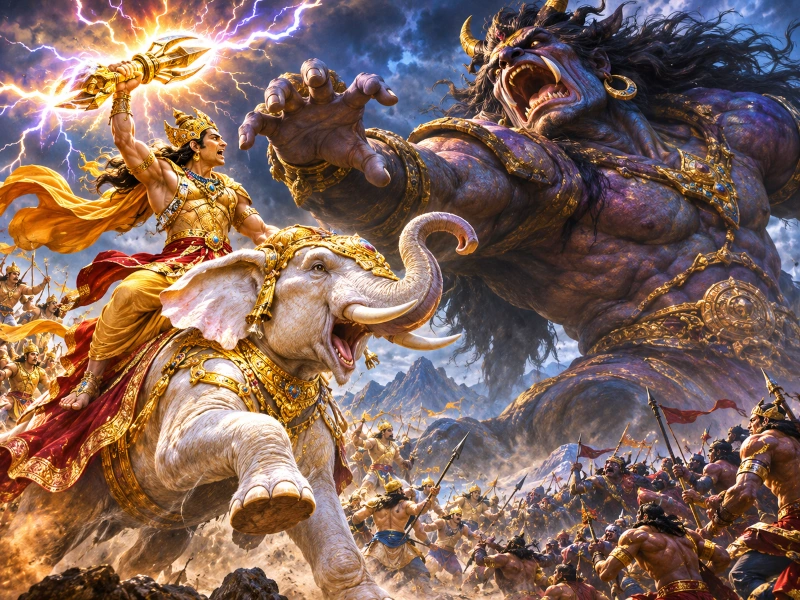
Among the great accounts of warfare in the Purāṇas, the confrontation between Indra and Vṛtrāsura occupies a distinctive position. The conflict brings together extraordinary divine weapons, opposing celestial armies, formidable battlefield commanders and a series of engagements in which the apparent superiority of one combatant repeatedly changes. The confrontation is particularly remarkable because Vṛtrāsura continues fighting despite devastating injuries and eventually swallows Indra and his celestial elephant, Airāvata, creating the appearance that the ruler of the Devas has been destroyed.
Indra confronts Vṛtrāsura with the Vajra, an extraordinary thunderbolt fashioned from the bones of the sage Dadhīci. The weapon is created specifically to overcome an adversary whose enormous physical strength and supernatural abilities have rendered the ordinary attacks of the Devas ineffective. However, possession of this exceptional weapon does not guarantee an effortless victory. Vṛtrāsura demonstrates remarkable resilience, tremendous combat strength and an ability to adapt his methods of attack when circumstances turn against him.
The battle progresses through several distinct phases, beginning with the collapse of the Asura army, followed by Vṛtrāsura’s determined resistance, his attacks upon Indra and Airāvata, the destruction of his weapons and the eventual loss of both his arms. Despite these injuries, Vṛtrāsura assumes a gigantic form and swallows Indra and his elephant. Indra survives through divine protection and subsequently uses the Vajra to pierce Vṛtrāsura’s body and emerge from within.
The military significance of this confrontation lies in its portrayal of specialised weapon development, battlefield morale, command resilience, the dangers of close-quarters combat and the capacity to recover from an apparently decisive tactical defeat.
The narrative also presents Vṛtrāsura as a warrior possessing extraordinary courage and spiritual understanding, making the confrontation considerably more complex than a conventional account of victory over an enemy.
The Emergence of Vṛtrāsura: A Threat to the Celestial Forces
The origins of the confrontation are described in the ninth chapter of the Sixth Skandha of the Śrīmad Bhāgavata Purāṇa. The conflict develops following Indra’s killing of Viśvarūpa, the son of Tvaṣṭā, who had served as a priest for the Devas. Angered by his son’s death, Tvaṣṭā performs a sacrifice intended to produce a powerful adversary capable of destroying Indra. From the sacrificial fire emerges Vṛtrāsura, an enormous and terrifying being whose growth and strength threaten the celestial forces.
The Purāṇa describes Vṛtrāsura as possessing extraordinary magnitude and destructive power. His appearance inspires fear among the Devas, while his ability to withstand their attacks makes him a formidable opponent. When Indra and the other celestial warriors confront him with their weapons, Vṛtrāsura neutralises their attacks by swallowing the weapons directed against him. The Devas consequently discover that their existing military capabilities are insufficient to overcome the new threat.
The failure of these attacks creates a serious strategic problem. The celestial forces possess numerous powerful warriors and divine weapons, yet their combined attacks cannot destroy Vṛtrāsura. Continuing to employ the same ineffective methods offers little prospect of success. The Devas therefore seek the assistance of Lord Viṣṇu, whose instructions provide the means to overcome their adversary.
From a military perspective, Vṛtrāsura represents an adversary whose defensive capabilities have rendered the established weapons of the opposing force ineffective. The Devas face a capability mismatch in which the destructive power of their available weapons cannot overcome the resilience of the intended target.
The episode demonstrates that numerical strength, established weapons and previous military superiority may become insufficient when confronting an adversary possessing capabilities for which an army has not prepared.
Dadhīci’s Sacrifice: The Development of a Decisive Weapon
The creation of the Vajra forms one of the most significant episodes of military preparation in the Purāṇas. Lord Viṣṇu informs the Devas that Vṛtrāsura can be defeated through a thunderbolt fashioned from the bones of the sage Dadhīci. The weapon is to be constructed by Viśvakarmā, the divine architect, and empowered by divine energy. This instruction provides the Devas with a specific means of confronting an adversary who has resisted their previous attacks.
The Devas approach Dadhīci and request his body for the creation of the weapon. The sage initially discusses the difficulty of surrendering one’s body and the natural desire of living beings to preserve their lives. However, recognising the larger purpose of the request, he agrees to sacrifice himself for the welfare of others. Through his yogic powers, Dadhīci relinquishes his mortal body, allowing his bones to be used in the creation of the Vajra.
Viśvakarmā subsequently fashions the extraordinary thunderbolt, which is empowered by the spiritual strength associated with Dadhīci and the divine power of Lord Viṣṇu. The weapon is entrusted to Indra for the confrontation with Vṛtrāsura.
The importance of the Vajra lies in the purpose behind its creation. It is not merely another weapon added to an existing arsenal. It is developed in response to the failure of the Devas’ previous weapons and is intended specifically to overcome the extraordinary defensive strength of Vṛtrāsura.
The military significance of this episode lies in the development of a specialised weapon against a particular strategic threat. Rather than continuing ineffective attacks, the Devas acquire a capability designed to overcome the specific strengths of their adversary.
The narrative illustrates the distinction between possessing powerful weapons and possessing the particular weapon necessary to defeat a difficult opponent. It also establishes Dadhīci’s sacrifice as the indispensable foundation of the Devas’ eventual military success.
Indra Takes the Battlefield: The Vajra and the Celestial Army
After receiving the Vajra, Indra prepares to confront Vṛtrāsura. The Śrīmad Bhāgavata Purāṇa describes him mounting Airāvata, his magnificent celestial elephant, and advancing towards the battlefield accompanied by the Devas. Armed with the thunderbolt and supported by the assembled celestial warriors, Indra assumes command of the campaign against the Asuras.
The opposing armies comprise numerous powerful beings equipped with various weapons. The battle develops into a large confrontation involving the Devas and Asuras, with both sides attempting to establish dominance through their respective warriors and supernatural capabilities.
However, the balance of the engagement begins to change when the Asura forces lose confidence and retreat before the attacks of the Devas. Their withdrawal undermines the cohesion of the army and gradually leaves Vṛtrāsura isolated.
Although Vṛtrāsura possesses extraordinary personal strength, his supporting forces are unable to sustain their resistance. The retreat of his soldiers deprives him of the advantages normally provided by an organised army, forcing him to depend increasingly upon his own combat abilities.
The strategic significance of this development lies in the distinction between individual military strength and collective battlefield effectiveness. Even an exceptionally powerful commander can be placed at a disadvantage when the army supporting him loses cohesion and abandons its positions.
The episode demonstrates that battlefield success depends upon more than the abilities of a principal warrior. The willingness of subordinate commanders and soldiers to maintain their formations remains essential to sustained resistance.
The Collapse of the Asura Army: Morale and Battlefield Cohesion
The tenth and eleventh chapters of the Sixth Skandha describe the deterioration of the Asura army’s morale. As the Devas advance, the Asura warriors begin withdrawing from the battlefield. Vṛtrāsura attempts to halt their retreat by appealing to their courage, their obligations as warriors and the honour associated with standing firm in battle.
He reminds them that victory brings the rewards of conquest, while a warrior who dies courageously may attain a higher spiritual destination. His appeal is intended to restore confidence and prevent the disintegration of the fighting force. However, his words fail to reverse the retreat, and the frightened Asuras continue to abandon their positions.
The Devas exploit the withdrawal by attacking the fleeing warriors, increasing the disorder within the Asura formations. Vṛtrāsura condemns the attack upon retreating soldiers and challenges the celestial warriors to confront him directly. His response illustrates the difference between the personal determination of the commander and the declining morale of the troops under his command.
The Asura army’s failure is therefore not presented solely as the consequence of superior enemy weapons. Its inability to maintain discipline and collective determination becomes a decisive factor in the battle.
The military lesson emerging from this sequence is that battlefield morale can determine the effectiveness of an army before its physical fighting strength has been exhausted. Soldiers who abandon their formations may render their weapons and numerical strength ineffective.
Vṛtrāsura’s experience also illustrates the limitations of leadership when fear becomes widespread among the troops. His personal courage remains undiminished, but he cannot compel the retreating warriors to restore their positions.
A commander’s individual strength cannot fully compensate for the collapse of collective discipline, cohesion and the willingness of subordinate forces to continue fighting.
Vṛtrāsura’s Counterattack: Targeting Indra and Airāvata
With his army retreating, Vṛtrāsura turns directly against the Devas. The Purāṇa describes him advancing with such force that the celestial warriors are overcome by fear. His immense strength allows him to trample opposing soldiers and disrupt their advance, demonstrating that he remains a dangerous adversary despite the deterioration of his army’s position.
Indra attempts to stop Vṛtrāsura by throwing a powerful club at him. However, Vṛtrāsura catches the weapon with his left hand and immediately turns it against Indra’s celestial elephant. He strikes Airāvata on the head with tremendous force, injuring the elephant and driving it backwards.
The action demonstrates Vṛtrāsura’s ability to transform an incoming attack into an opportunity for counteroffensive action. Rather than merely avoiding the weapon, he captures it and uses it against an important supporting element of his adversary’s battlefield capability.
Airāvata serves as Indra’s principal mount and provides him with mobility and an elevated fighting position. By attacking the elephant, Vṛtrāsura threatens Indra’s stability and ability to manoeuvre during combat.
The tactical significance of Vṛtrāsura’s attack lies in his decision to strike the commander’s supporting capability rather than concentrating exclusively upon the commander himself. By targeting Airāvata, he disrupts Indra’s battlefield position and mobility.
The incident illustrates how an opponent’s effectiveness may be weakened by attacking the elements upon which his fighting ability depends. It also demonstrates Vṛtrāsura’s remarkable physical strength and ability to respond immediately to an attack.
The narrative records Indra tending to the injured Airāvata before the confrontation resumes, introducing a brief interruption in the direct engagement between the two warriors.
The Vajra Against Vṛtrāsura’s Trident
As the battle continues, Vṛtrāsura takes up his trident and launches a powerful attack against Indra. The Śrīmad Bhāgavata Purāṇa describes the weapon as blazing with extraordinary brilliance as it moves through the air towards its target.
Indra responds with the Vajra, employing the thunderbolt against the approaching weapon. The resulting strike destroys Vṛtrāsura’s trident and severs one of his arms, inflicting a devastating injury upon the Asura commander.
The attack produces two important results. Vṛtrāsura loses the weapon with which he had attempted to strike Indra, while the destruction of his arm reduces his ability to continue fighting through conventional means.
The military significance of Indra’s response lies in the simultaneous interception of an incoming attack and the degradation of the enemy’s fighting capability. The Vajra functions as both a defensive means of neutralising a dangerous weapon and an offensive instrument against the attacker.
However, the loss of an arm does not end Vṛtrāsura’s resistance. He remains determined to continue the confrontation and demonstrates that a severe injury does not necessarily eliminate a warrior’s capacity to fight.
The episode reinforces a recurring feature of the battle: each apparent advantage is followed by an unexpected response from the opposing combatant.
Vṛtrāsura Disarms Indra: A Reversal in Close Combat
Despite losing one arm, Vṛtrāsura continues his attack. He approaches Indra and strikes him with an iron mace, also attacking Airāvata. The impact is so powerful that Indra loses his grip on the Vajra, which falls from his hand.
The incident creates a dramatic reversal. Indra possesses the specialised weapon created specifically to defeat Vṛtrāsura, yet he is temporarily deprived of it through the physical strength and determination of his injured adversary.
The Purāṇa describes Indra as experiencing deep embarrassment after dropping the Vajra. He hesitates to retrieve the weapon, even though it remains essential to completing the battle.
Vṛtrāsura then performs an extraordinary act. Rather than using Indra’s hesitation as an opportunity to press his advantage, he encourages the Deva ruler to recover the Vajra and continue fighting. He reminds Indra that the outcomes of victory and defeat are not entirely controlled by the individual warrior.
The episode demonstrates that Vṛtrāsura possesses not only physical courage but also an unusual understanding of duty, combat and the limits of personal power.
From a tactical perspective, the disarming of Indra demonstrates that possession of a superior weapon does not eliminate the dangers of close-quarters combat. A weapon’s effectiveness depends upon the warrior’s ability to retain control of it under pressure.
The incident also highlights the psychological consequences of a battlefield setback. Indra’s momentary hesitation occurs not because he has lost the physical ability to continue fighting, but because the loss of his weapon has affected his confidence.
The strategic lesson is that a temporary tactical failure can become more serious when it undermines the commander’s willingness to act. Recovering from a setback requires psychological resilience as well as physical capability.
Vṛtrāsura’s Warrior Philosophy: Courage Beyond Victory and Defeat
The dialogue between Indra and Vṛtrāsura provides an important philosophical dimension to the confrontation. Vṛtrāsura explains that victory and defeat cannot be attributed entirely to the strength, intelligence or intentions of individual warriors. He presents the outcome of battle as ultimately dependent upon the Supreme Lord.
This understanding allows him to continue fighting without becoming overwhelmed by fear or attachment to victory. Although he has already suffered a devastating injury, he neither abandons the battlefield nor regards his approaching death as a reason to surrender his principles.
Vṛtrāsura encourages Indra to recover the Vajra and fulfil his duty. His words reveal a striking distinction between the pursuit of military victory and the spiritual understanding of the warrior engaged in combat.
The Purāṇa consequently presents Vṛtrāsura as more than a powerful Asura. He is also a spiritually elevated devotee whose conduct demonstrates courage, self-control and acceptance of the consequences of battle.
The military significance of this exchange lies in its portrayal of psychological resilience. A warrior’s ability to remain composed amid injury, uncertainty and the possibility of defeat preserves the capacity to continue acting decisively.
The narrative also demonstrates that the spiritual qualities of a combatant cannot necessarily be determined from his external identity or political allegiance.
The Loss of Both Arms: Vṛtrāsura Changes His Method of Attack
The battle continues as Indra again employs the Vajra against Vṛtrāsura. The confrontation eventually results in the severing of Vṛtrāsura’s remaining arm, leaving him without either of his principal limbs.
Such an injury would ordinarily render a warrior incapable of continuing conventional armed combat. Vṛtrāsura can no longer employ his previous weapons in the manner in which he had fought earlier.
However, he refuses to abandon the confrontation. Instead, he assumes an enormous form that completely changes the nature of the engagement.
The Purāṇa describes his lower jaw resting upon the ground while his upper jaw reaches towards the sky. His mouth appears immense, his tongue resembles a gigantic serpent, and his enormous body shakes the surrounding mountains as he advances towards Indra.
Having lost the ability to fight through his arms and weapons, Vṛtrāsura transforms his entire body into the means of attack.
The tactical significance of this transformation lies in Vṛtrāsura’s adaptation after the destruction of his conventional fighting capabilities. Rather than continuing an ineffective method of combat, he changes the form of attack and attempts to overwhelm his adversary through sheer physical magnitude.
The episode illustrates that the loss of an opponent’s principal weapons does not necessarily eliminate the threat posed by that opponent. An adversary may retain the ability to employ alternative methods of attack, even after suffering injuries that appear to make further resistance impossible.
Vṛtrāsura Swallows Indra and Airāvata: The Apparent Destruction of the Deva Commander
One of the most extraordinary moments in Purāṇic warfare occurs in the twelfth chapter of the Sixth Skandha, particularly Verses 27–29.
Having assumed his gigantic form, Vṛtrāsura advances towards Indra with his enormous mouth open. The Purāṇa compares his action to that of a great python swallowing an elephant.
In a single overwhelming movement, Vṛtrāsura swallows both Indra and Airāvata.
The ruler of the Devas, carrying the Vajra and mounted upon his celestial elephant, disappears inside the body of his adversary. The sudden development creates the appearance that the central commander of the celestial forces has been destroyed.
The assembled Devas, sages and other celestial beings witnessing the confrontation react with shock and despair. Their principal warrior has vanished from the battlefield, and the immediate situation appears hopeless.
The development is particularly remarkable because Vṛtrāsura has already lost both arms. His physical condition suggests that he should no longer be capable of mounting a successful offensive. Yet his final transformation produces an attack more dramatic than any of his previous actions.
The battlefield significance of this incident lies in the apparent elimination of the opposing commander and his mount through a single unexpected attack. The disappearance of Indra creates a psychological crisis among the Devas, who believe their principal leader has been defeated.
The episode demonstrates how rapidly perceptions of victory and defeat can change. Vṛtrāsura appears to have lost the battle when his arms are severed, but his subsequent attack reverses the situation and creates the appearance of a decisive victory.
The military lesson is that a severely weakened adversary may still retain the capacity to launch an unexpected attack capable of overturning an apparent victory. The destruction of an opponent’s principal weapons does not necessarily establish that he has been completely neutralised.
Indra’s Survival: Divine Protection Within the Enemy
Although Vṛtrāsura succeeds in swallowing Indra, the Deva ruler does not perish. The Śrīmad Bhāgavata Purāṇa, Chapter 12, Verse 31, explains that Indra is protected by the Nārāyaṇa-kavaca, the divine protective armour associated with Lord Nārāyaṇa. His mystic powers also contribute to his survival within Vṛtrāsura’s body.
The protective power prevents Indra from being destroyed despite the extraordinary circumstances of his apparent defeat. More importantly, he retains the Vajra, the weapon specifically created to overcome Vṛtrāsura.
This detail becomes decisive in the subsequent phase of the confrontation. Vṛtrāsura has successfully swallowed Indra, but he has not destroyed the warrior or neutralised the weapon capable of killing him.
The situation therefore contains an important distinction between temporarily trapping an adversary and completely eliminating his ability to fight.
From a military perspective, Vṛtrāsura achieves the physical containment of his opponent but fails to neutralise his combat capability. Indra remains alive, protected and armed, allowing him to continue the confrontation from within the enemy’s body.
The narrative highlights the importance of protection and survivability during battle. Indra’s divine armour does not itself defeat Vṛtrāsura, but it preserves the warrior’s ability to employ the Vajra when an opportunity becomes available.
The strategic significance of survivability lies in its ability to preserve offensive potential during a crisis. Protection becomes decisive when it allows a threatened combatant to recover from an otherwise fatal attack and resume effective action.
The Counterattack from Within: Indra Breaks Through Vṛtrāsura
The decisive reversal is described in Chapter 12, Verse 32. Protected within Vṛtrāsura’s body, Indra employs the Vajra to pierce the Asura’s abdomen and cut his way out.
Indra emerges alive, overturning the expectation that he has been destroyed. The weapon created through Dadhīci’s sacrifice becomes the means by which the Deva ruler escapes from an apparently fatal situation.
The counterattack changes the balance of the confrontation. Vṛtrāsura’s attempt to destroy Indra by swallowing him has instead allowed the protected warrior to strike from within his body.
After emerging, Indra employs the Vajra against Vṛtrāsura’s head. The Purāṇa describes the severing of the Asura’s head, comparing it to the peak of a mountain.
However, the following verse adds an extraordinary detail concerning the final destruction of Vṛtrāsura. The Vajra continues acting upon his neck for a period described as one complete year, or 360 days, before the separation of the head is completed. The narrative therefore does not portray the final destruction of Vṛtrāsura as instantaneous.
The military significance of Indra’s recovery lies in the transformation of an apparently fatal disadvantage into a decisive counterattack. Despite being swallowed by his adversary, Indra retains the protection, weapon and determination necessary to continue fighting.
The episode also demonstrates the importance of the Vajra throughout the confrontation. It is responsible for the destruction of Vṛtrāsura’s weapons, the severing of his arms, Indra’s escape from within his body and the eventual destruction of the Asura.
The decisive strategic lesson is that a battlefield reversal does not necessarily determine the final outcome when the threatened combatant retains both survivability and the means to strike back.
The Destruction of Vṛtrāsura: The End of the Confrontation
The defeat of Vṛtrāsura concludes a battle marked by repeated changes in battlefield advantage. Indra initially enters the confrontation possessing the Vajra, but Vṛtrāsura demonstrates an extraordinary capacity to endure severe injuries and continue fighting.
The destruction of his trident does not stop his resistance. The loss of one arm is followed by an attack that disarms Indra. Even after the loss of both arms, Vṛtrāsura assumes a gigantic form and swallows the Deva commander together with Airāvata.
The final outcome is determined only when Indra survives the swallowing attack, breaks through Vṛtrāsura’s abdomen and employs the Vajra against his head.
The thunderbolt created from Dadhīci’s bones thus fulfils the purpose for which it was fashioned, bringing an end to the threat that had overwhelmed the celestial forces.
However, the Purāṇa also gives considerable importance to Vṛtrāsura’s spiritual attainment. Despite being the adversary of the Devas, he is portrayed as a great devotee of the Supreme Lord whose understanding of duty, devotion and detachment distinguishes him from an ordinary Asura warrior.
His death is therefore presented not merely as the military destruction of a powerful enemy but also as the culmination of his spiritual journey.
Military Significance: Specialised Weapons and the Defeat of Superior Adversaries
The development of the Vajra demonstrates the importance of acquiring a weapon suited to a specific military threat. The Devas initially fail because their existing weapons cannot overcome Vṛtrāsura’s extraordinary strength. Their eventual success becomes possible only after obtaining a thunderbolt specifically intended to defeat him.
The strategic principle is that military superiority cannot be measured solely by the number or variety of weapons available to a force. Victory may depend upon acquiring a specialised capability capable of overcoming an adversary’s particular defensive advantages.
This principle emerges from the relationship between the initial failure of the Devas and their subsequent acquisition of the Vajra. The weapon represents a response to an identified deficiency in their fighting capabilities.
Military Significance: Morale, Discipline and Command Effectiveness
The collapse of the Asura army demonstrates the importance of morale and cohesion in warfare. Although Vṛtrāsura possesses extraordinary personal strength, his soldiers are unable to maintain their positions against the advancing Devas.
His attempts to rally the retreating warriors fail, leaving him increasingly isolated on the battlefield. The episode establishes that the individual courage of a commander cannot automatically restore discipline among soldiers who have lost the determination to fight.
The military principle is that an army’s effectiveness depends upon collective morale, discipline and the willingness of its soldiers to maintain formation under pressure. The strength of a commander cannot fully compensate for the collapse of organised resistance.
The incident also illustrates the vulnerability of forces whose confidence deteriorates before their fighting capabilities have been physically exhausted.
Military Significance: Attacking Supporting Capabilities
Vṛtrāsura’s attack upon Airāvata demonstrates the tactical importance of targeting the supporting elements of an opponent’s battlefield capability. Rather than directing every attack exclusively against Indra, Vṛtrāsura strikes the elephant upon which the Deva commander depends for mobility and positioning.
The resulting injury disrupts Indra’s immediate fighting position and interrupts the engagement.
The tactical principle is that an opponent may be weakened by attacking the supporting capabilities upon which his effectiveness depends. Disrupting mobility, stability or other essential battlefield functions can reduce a commander’s ability to operate effectively.
The incident illustrates that military attacks may be directed against the systems supporting a combatant rather than solely against the combatant himself.
Military Significance: Weapon Retention and Close-Quarters Vulnerability
The disarming of Indra demonstrates the vulnerability of a warrior who becomes engaged in close combat, even when equipped with a superior weapon. Vṛtrāsura’s mace strike forces Indra to drop the Vajra, temporarily depriving him of the principal means by which he can defeat his adversary.
The incident shows that possession of an exceptional weapon is not sufficient unless the warrior can retain and employ it under battlefield pressure.
The military lesson is that superior weapons must be supported by effective control, readiness and the ability to withstand close-range attacks. A momentary loss of weapon control can reverse an immediate tactical advantage.
Indra’s hesitation after losing the Vajra also demonstrates how psychological reactions to unexpected setbacks can influence the continuation of combat.
Military Significance: Adaptation After the Loss of Fighting Capability
Vṛtrāsura’s transformation after losing both arms illustrates the importance of adaptation when the original method of fighting becomes impossible. Having lost the ability to employ his previous weapons, he assumes an enormous form and attempts to destroy Indra by swallowing him.
The change in method produces one of the most dangerous moments of the confrontation, despite Vṛtrāsura’s severely weakened physical condition.
The tactical principle is that an adversary may remain dangerous after losing his principal weapons or conventional fighting capabilities. A determined opponent can adopt an alternative method of attack, making premature assumptions of victory hazardous.
The episode demonstrates that the effectiveness of a combatant cannot always be judged solely by the condition of his original weapons or equipment.
Military Significance: Protection, Survivability and Battlefield Recovery
Indra’s survival within Vṛtrāsura demonstrates the importance of protective capabilities during battle. The Nārāyaṇa-kavaca prevents his destruction, allowing him to retain the Vajra and continue fighting.
His eventual emergence from Vṛtrāsura’s abdomen reveals that the apparent defeat of a warrior does not necessarily eliminate his capacity for further action.
The military principle illustrated by the narrative is that survivability preserves offensive capability. Protection can become decisive when it enables a threatened combatant to withstand an overwhelming attack and recover sufficiently to strike back.
The incident also highlights the importance of maintaining the capacity to act after an unexpected reversal. Indra does not abandon his weapon or surrender to the circumstances of his apparent defeat.
The Deeper Meaning of the Conflict: Courage, Duty and Spiritual Understanding
Although the confrontation contains extraordinary descriptions of divine weapons, supernatural strength and devastating injuries, the Śrīmad Bhāgavata Purāṇa does not present the battle merely as a contest of military power.
Vṛtrāsura’s speeches introduce a deeper understanding of courage, duty and the relationship between worldly victory and spiritual attainment. He repeatedly reminds Indra that victory and defeat are not entirely controlled by the desires or abilities of individual warriors.
His willingness to continue fighting despite overwhelming injuries is accompanied by an acceptance of death and an absence of attachment to political power.
Indra, meanwhile, must overcome moments of uncertainty and embarrassment before completing the task entrusted to him. His eventual victory depends not only upon possession of the Vajra but also upon his ability to continue fighting after suffering serious setbacks.
The contrast between the two warriors illustrates that physical strength, battlefield victory and spiritual understanding are distinct qualities.
The Purāṇic account presents warfare as a test not only of weapons and physical courage but also of psychological discipline, self-control, duty and the ability to act without becoming overwhelmed by fear or attachment to victory.
Vṛtrāsura’s conduct also demonstrates that the spiritual stature of a warrior cannot necessarily be determined by whether he belongs to the victorious or defeated side.
Conclusion: The Vajra, the Warrior and the Reversal of Defeat
The confrontation between Indra and Vṛtrāsura stands among the most extraordinary accounts of divine warfare in the Śrīmad Bhāgavata Purāṇa. It begins with the inability of the Devas to defeat an overwhelmingly powerful adversary, progresses through the creation of the Vajra from Dadhīci’s bones and culminates in a battle characterised by remarkable resilience and repeated reversals.
The retreat of the Asura army demonstrates the importance of battlefield morale and cohesion, while Vṛtrāsura’s attacks upon Airāvata and his disarming of Indra illustrate the dangers of close combat even for a warrior equipped with an exceptional weapon.
Vṛtrāsura’s transformation after losing both arms demonstrates that an opponent may remain dangerous despite suffering devastating injuries. His swallowing of Indra and Airāvata produces the appearance of a decisive victory, but the result is overturned when Indra survives through divine protection and uses the Vajra to escape.
The final destruction of Vṛtrāsura fulfils the purpose for which the Vajra was created, while the Asura’s spiritual understanding gives the narrative a significance extending beyond military conquest.
The central military lesson of the confrontation is that victory depends upon more than possessing superior weapons. Battlefield success also requires resilience, the ability to withstand unexpected reversals, the preservation of fighting capability and the effective employment of decisive force.
At the same time, the narrative demonstrates that courage, discipline and spiritual wisdom are not necessarily confined to the victorious side. Vṛtrāsura’s determination and acceptance of his fate remain central elements of the Purāṇic account.
In the military philosophy emerging from this narrative, the true significance of a warrior is revealed not merely through the destructive power of his weapons or the outcome of battle, but through his courage, discipline, adaptability and conduct when confronted by the possibility of defeat.
You may also like
-
Vibhīṣaṇa’s Defection: Rāma’s Decision to Grant Asylum to an Enemy Prince
-
Cabinet Approves ₹3,230 Crore Yuge Yugeen Bharat Museum at Historic North and South Blocks
-
PM Modi Inaugurates India’s First LED Dome Planetarium at Mysuru
-
Kārttikeya and the War Against Tārakāsura: The Rise of the Divine Commander
-
Two Envoys, Two Missions: Comparing Hanumān’s and Aṅgada’s Diplomatic Strategies
