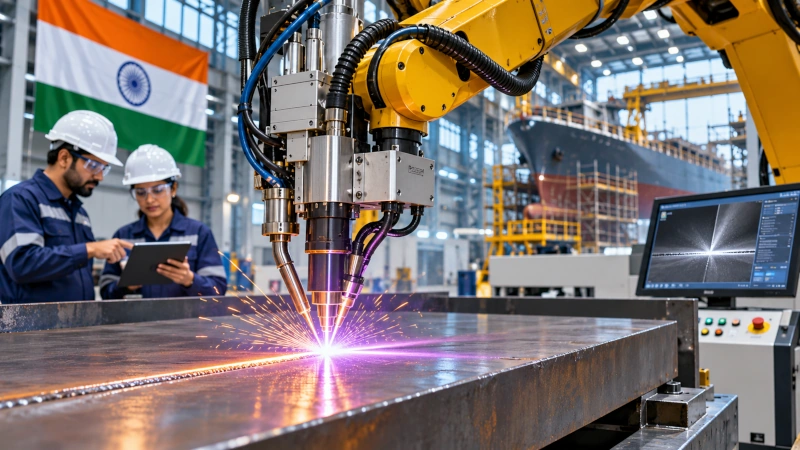
India has achieved a significant milestone in advanced manufacturing technology, with Cochin Shipyard Limited (CSL) and Kochi-based SFO Technologies Private Limited jointly developing what the companies describe as the country’s first indigenously designed and manufactured Hybrid Laser Arc Welding (HLAW) system. The technology integrates high-power fibre lasers, conventional arc welding, robotics and advanced automation to improve precision, productivity and manufacturing efficiency across strategic industrial sectors.
The indigenous welding system was unveiled in November 2026 during the inauguration of the Advanced Laser Engineering Centre and Hybrid Laser Arc Welding Research and Development Facility at NeST HiTek Park in Kalamassery, Kochi. The facility was inaugurated by Cochin Shipyard Chairman and Managing Director Jose V. J. and SFO Technologies Chairman and Managing Director Dr. N. Jehangir.
The development represents a collaboration between the public-sector shipbuilding enterprise and SFO Technologies, the flagship company of the NeST Group, to strengthen domestic capabilities in high-end industrial manufacturing. The system incorporates a high-power fibre laser source developed in-house by SFO Technologies, reducing dependence on imported technologies for a critical component of the welding platform.
Indigenous Hybrid Laser Arc Welding Technology
The jointly developed Hybrid Laser Arc Welding system combines laser welding and conventional arc welding within an integrated manufacturing process. The technology brings together the concentrated energy of a high-power laser with an electric arc welding process, supported by robotic systems and advanced automation.
The laser provides concentrated heat for deep material penetration, while the arc welding process contributes additional heat and filler material where required. The combination is designed to improve welding performance, particularly in industrial applications involving thick metal sections and complex fabricated structures.
According to the developers, the indigenous system is expected to provide faster welding speeds, deeper penetration, lower material distortion and greater consistency in weld quality compared with conventional welding approaches.
The incorporation of robotics and automation enables controlled welding operations, supporting greater repeatability and precision in industrial production. These capabilities are particularly relevant to manufacturing processes where structural integrity, dimensional accuracy and consistent weld quality are essential.
Indigenous High-Power Fibre Laser at the Core of the System
A major technological component of the HLAW platform is the high-power fibre laser source developed indigenously by SFO Technologies.
High-power fibre lasers are used in precision industrial processing because they can deliver concentrated energy to a defined area of a workpiece. When integrated with conventional arc welding, the laser enables the hybrid process to achieve deeper weld penetration while supporting higher processing speeds.
The indigenous development of the fibre laser source is an important aspect of the joint programme, as advanced laser systems constitute a critical component of modern automated manufacturing equipment.
By integrating the domestically developed laser with welding equipment, robotics and automation, the two companies have established an indigenous platform for advanced industrial welding applications.
Applications Across Shipbuilding and Defence Manufacturing
The technology has significant potential applications in India’s shipbuilding industry, where welding is an essential manufacturing process in the fabrication and assembly of vessels.
Ship construction involves extensive welding of steel plates, structural sections and fabricated assemblies. The quality and consistency of these joints are important for maintaining structural integrity and meeting demanding manufacturing requirements.
The HLAW system is designed to improve welding productivity and structural quality while reducing distortion during fabrication. These characteristics can support greater manufacturing efficiency and repeatability in shipbuilding operations.
Beyond maritime manufacturing, the technology is intended for applications across defence production, heavy engineering, railways and the energy sector. Its potential industrial uses include the fabrication of large storage tanks, railway wagons and other heavy metal structures requiring reliable welding performance.
The development expands the scope for indigenous advanced welding technologies across industries that depend on precision metal fabrication and automated manufacturing processes.
Advanced Laser Engineering Centre Inaugurated in Kalamassery
The inauguration of the Advanced Laser Engineering Centre and Hybrid Laser Arc Welding R&D Facility at NeST HiTek Park establishes a dedicated facility for the further development of advanced laser-based manufacturing technologies.
The centre will focus on research, testing, validation and commercialisation activities associated with laser engineering and hybrid welding systems.
These activities are intended to support the continued development of the indigenous HLAW platform and its application across industrial manufacturing sectors.
The facility also strengthens Kochi’s advanced engineering ecosystem by bringing together technological capabilities in fibre lasers, robotics, industrial automation and precision manufacturing.
Strengthening India’s Advanced Manufacturing Capabilities
The joint initiative reflects the growing collaboration between public-sector enterprises and private technology companies in developing indigenous solutions for specialised industrial requirements.
Cochin Shipyard contributes expertise in shipbuilding and heavy engineering applications, while SFO Technologies brings capabilities in high-power fibre lasers, engineering, manufacturing and industrial automation.
The companies have identified reducing dependence on imported laser welding platforms as an important objective of the development.
The project is aligned with the national Atmanirbhar Bharat initiative, which seeks to strengthen domestic industrial capabilities and promote indigenous technological development.
The collaboration demonstrates the ability of Indian engineering enterprises to develop sophisticated manufacturing systems by integrating critical technologies within the country.
Indigenous Innovation for Strategic Manufacturing
The development of the Hybrid Laser Arc Welding system by Cochin Shipyard and SFO Technologies represents an important advancement in India’s domestic industrial technology capabilities.
By combining an indigenous high-power fibre laser source with conventional welding, robotics and automation, the two companies have developed a platform intended to improve manufacturing productivity, precision and consistency across multiple industrial sectors.
The newly inaugurated research and development centre in Kalamassery will support further testing, validation and commercialisation of the technology.
The initiative strengthens India’s efforts to develop advanced manufacturing solutions domestically while reducing reliance on imported industrial equipment.
With applications spanning shipbuilding, defence, railways, energy and heavy engineering, the indigenous HLAW system represents a significant step towards greater technological self-reliance in India’s strategic manufacturing sector.
You may also like
-
BSF Issues ₹49.3 Lakh Tender for Drone Simulation and Maintenance Facility in Bengaluru
-
India Targets First Made-in-India Civil Aircraft Within Two Years as Indigenous Aviation Manufacturing Gains Momentum
-
India Ranks First in Macroeconomic Resilience Among World’s Ten Largest Economies: ASSOCHAM
-
BITS Pilani Develops ₹2,500 System to Convert Food Waste into Animal Feed
-
Sikkim Large Cardamom: The GI-Tagged Heritage of the Eastern Himalayas’ Aromatic Black Spice
