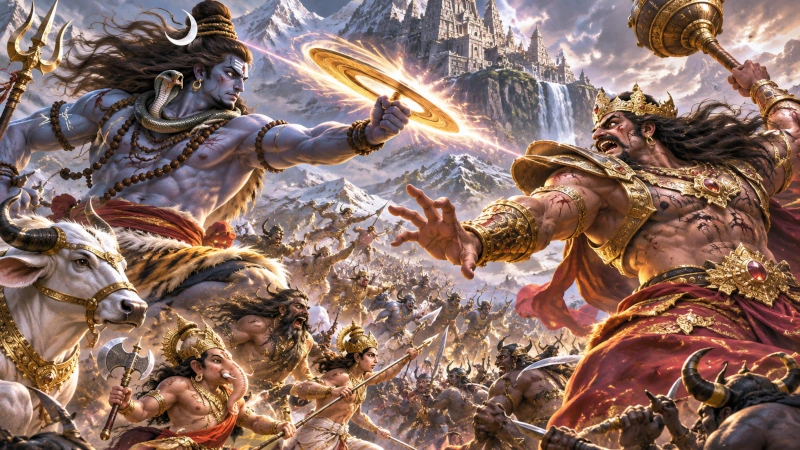
Warcraft in the Purāṇas Series | Śiva Purāṇa — Rudra Saṃhitā, Yuddha Khaṇḍa
The confrontation between Lord Śiva and Jalandhara, the enormously powerful ruler of the Asuras, stands among the most elaborate accounts of warfare in the Śiva Purāṇa. What begins as a struggle for supremacy over the three worlds eventually develops into a vast military campaign involving the conquest of celestial territories, the siege of Kailāsa, battles between powerful commanders, supernatural deception, and a decisive confrontation between Śiva and an adversary considered almost impossible to destroy.
The narrative, principally recorded in the Yuddha Khaṇḍa of the Rudra Saṃhitā, presents warfare as a struggle extending beyond physical strength. Military leadership, battlefield mobility, the preservation of morale, psychological deception, and the limitations of numerical superiority emerge as important elements of the conflict. Jalandhara’s armies repeatedly demonstrate their formidable capabilities, yet their achievements ultimately prove insufficient against an opponent whose power exceeds the ordinary boundaries of celestial warfare.
The destruction of Jalandhara illustrates an enduring principle of military strategy: extraordinary strength and battlefield success cannot guarantee victory when a commander misunderstands the capabilities of his opponent, overextends his ambitions, and fails to recognise the limitations of his own power.
The Rise of Jalandhara: The Emergence of a Formidable Military Power
According to the Śiva Purāṇa, Jalandhara originated from the fiery energy of Śiva’s third eye, which entered the ocean and eventually assumed the form of a remarkable child. Raised by the ocean, he possessed extraordinary physical strength and divine energy from the beginning of his existence. Brahmā recognised his unusual nature and foretold that he would become a powerful conqueror who could ultimately be destroyed only by Śiva.
Under the guidance of Śukrācārya, Jalandhara consolidated his authority among the Asuras and established himself as a formidable ruler. His exceptional strength attracted powerful warriors, while his leadership enabled him to unite forces that had previously suffered defeat at the hands of the Devas. His marriage to Vṛndā, the virtuous daughter of Kālanemi, further strengthened his position within the Asura world.
Jalandhara’s rise illustrates the importance of military consolidation in transforming individual strength into organised power. An exceptionally capable warrior may defeat numerous opponents, but the ability to command armies, secure the loyalty of experienced officers, and establish a stable political authority creates a far greater strategic threat. Jalandhara possessed both personal combat superiority and the organisational resources necessary to challenge the established celestial order.
His ambitions gradually expanded beyond the territories already under his control. Having consolidated the Asuras, he sought to confront the Devas and recover the power and possessions that he believed had been unjustly taken from them. This ambition transformed his kingdom into the centre of a major military challenge against the celestial powers.
The Campaign Against the Devas: Establishing Battlefield Superiority
Jalandhara’s military expansion began with campaigns against the Devas, whose armies had traditionally maintained authority over the celestial regions. The Śiva Purāṇa describes extensive fighting involving large numbers of warriors equipped with bows, swords, spears, maces, and other weapons. Both sides deployed powerful commanders and engaged in repeated attacks intended to overwhelm opposing formations.
The Asura armies demonstrated considerable fighting strength, while Jalandhara’s personal intervention repeatedly altered the course of battle. His extraordinary endurance enabled him to withstand attacks that would ordinarily have destroyed other warriors. The Devas consequently found themselves confronting an adversary whose abilities exceeded those of the opponents they had previously encountered.
The confrontation eventually brought Jalandhara into direct conflict with Viṣṇu. Entering the battlefield mounted upon Garuḍa, Viṣṇu employed his formidable weapons against the Asura ruler. Jalandhara responded with powerful attacks of his own, demonstrating his ability to survive a confrontation with one of the supreme divine powers.
The battle revealed Jalandhara’s extraordinary resilience but also established the limitations of conventional military action against him. Although the fighting inflicted considerable destruction, the Asura ruler remained capable of continuing his campaigns. The Devas were consequently unable to restore their former position through ordinary battlefield engagements.
From a strategic perspective, Jalandhara’s victories established a powerful reputation that strengthened his political authority and the morale of his armies. However, these successes also encouraged excessive confidence. His ability to resist the weapons of powerful celestial warriors gradually reinforced his belief that no adversary could effectively challenge him.
This confidence would eventually become one of his greatest weaknesses, for previous victories can provide valuable evidence of military capability without guaranteeing success against an opponent possessing fundamentally different powers.
The Strategic Crisis: Jalandhara Challenges Śiva
The confrontation with Śiva developed after Jalandhara’s ambitions extended beyond military conquest. The Śiva Purāṇa describes how Nārada’s account of Pārvatī’s extraordinary beauty intensified the Asura ruler’s desire to possess her. Jalandhara consequently dispatched Rāhu as an emissary to Śiva, demanding that Pārvatī be surrendered to him.
The demand represented a direct challenge to Śiva and transformed the existing struggle for supremacy into a confrontation involving the sanctity of his household. Jalandhara’s actions demonstrated that his ambitions had extended beyond the consolidation of military power into an attempt to impose his will upon the highest divine authority.
When his demand failed, Jalandhara ordered the mobilisation of his armies. The campaign brought together powerful Asura commanders, including Kālanemi, Śumbha, and Niśumbha, supported by numerous warriors and the guidance of Śukrācārya. The army advanced towards Kailāsa, the mountain abode of Śiva, with the intention of compelling a decisive confrontation.
This decision represented a major escalation in the conflict. Rather than defending his existing territories or consolidating the gains achieved through earlier campaigns, Jalandhara chose to carry the war directly into the stronghold of his most formidable remaining opponent. His strategy relied upon the assumption that the military superiority demonstrated against the Devas could be extended to Śiva himself.
The decision also exposed the danger of strategic overreach. Jalandhara had accumulated enormous military power, but he failed to distinguish between defeating powerful celestial armies and confronting the divine source from which his own extraordinary energy had originated. His campaign therefore began with an imbalance between the scale of his ambitions and his understanding of the adversary he intended to overcome.
The Siege of Kailāsa: Concentrating Military Power Against a Stronghold
Jalandhara’s army advanced upon Kailāsa and surrounded the mountain abode of Śiva, bringing the conflict directly into the territory defended by the Gaṇas. The Śiva Purāṇa describes the mobilisation of enormous Asura forces and their subsequent engagement with Śiva’s commanders.
The confrontation involved large numbers of supernatural warriors, powerful weapons, and repeated clashes between the leading combatants of both armies. Although the scripture does not provide the detailed engineering descriptions associated with historical siege warfare, the military situation involved an attacking army advancing against a defended stronghold and attempting to overcome the forces protecting it.
Jalandhara possessed the advantage of substantial military resources and experienced commanders capable of fighting independently. His army could sustain multiple engagements while continuing to place pressure upon the defenders. The Gaṇas, however, possessed an established command structure and commanders familiar with one another’s abilities.
The fighting consequently developed into a series of engagements between leading warriors rather than a single uninterrupted confrontation between two armies. The outcome of these engagements influenced the morale and movements of the wider forces, demonstrating the considerable importance assigned to battlefield leadership in the Purāṇic narrative.
The campaign against Kailāsa illustrates the limitations of numerical superiority when an attacking army encounters a determined defensive force. Concentrating large numbers of warriors against a stronghold creates substantial pressure, but successful conquest still depends upon overcoming the defenders’ leadership, combat capabilities, and ability to coordinate their response.
The Battle of Commanders: Nandin, Gaṇeśa and Kārttikeya Enter the War
The opening stages of the confrontation featured a succession of intense battles between the leading commanders of the opposing armies. Kālanemi confronted Nandin, Śumbha engaged Gaṇeśa, and Niśumbha fought Kārttikeya. These encounters formed an important part of the wider battle because both armies depended heavily upon the abilities of their principal warriors.
During his engagement with Kārttikeya, Niśumbha attacked the peacock serving as his mount, temporarily disrupting the commander’s mobility. Kārttikeya retaliated by targeting the horses and charioteer of Niśumbha’s chariot, demonstrating the importance of attacking an opponent’s battlefield support rather than concentrating exclusively upon the warrior himself.
Nandin employed a similar approach during his confrontation with Kālanemi. He attacked the Asura’s chariot, horses, banner, and charioteer, attempting to undermine his ability to manoeuvre and continue the engagement effectively. The destruction of these battlefield assets reduced the advantages available to the chariot-mounted warrior.
The encounter between Gaṇeśa and Śumbha followed a comparable pattern. Śumbha attacked Gaṇeśa’s mouse, causing the vehicle to suffer and throwing Gaṇeśa from his mount. Despite this disruption, Gaṇeśa recovered and continued fighting, striking his opponent with his axe.
The arrival of Vīrabhadra, accompanied by Bhairavas, Yoginīs, Vetālas, and other forces associated with Śiva, further intensified the battle. The Gaṇas regained their momentum, and several Asura commanders experienced serious reverses as the defenders pressed their counterattack.
These engagements demonstrate a sophisticated understanding of the relationship between combat power and battlefield mobility. A warrior’s effectiveness depended not only upon personal courage or the strength of his weapons but also upon the continued availability of transport, supporting personnel, and the means to manoeuvre. By attacking these capabilities, the opposing commanders attempted to reduce one another’s fighting power without necessarily achieving an immediate killing blow.
The narrative also emphasises the importance of resilience. Warriors who lost their mounts or suffered damage to their equipment frequently continued fighting, demonstrating that tactical disruption did not automatically result in defeat. The capacity to recover from an unexpected reversal remained an essential element of battlefield effectiveness.
Jalandhara’s Counterattack: The Impact of an Exceptional Commander
As the fighting intensified and his commanders encountered determined resistance, Jalandhara personally entered the battlefield. His arrival dramatically altered the balance of the engagement, demonstrating the extraordinary influence of a supreme warrior upon the morale and effectiveness of an army.
The Asura ruler advanced in his chariot and launched powerful attacks against Śiva’s principal commanders. He struck Nandin, Gaṇeśa, and Vīrabhadra with arrows, demonstrating his ability to engage several formidable opponents. When Kārttikeya attacked him with a spear, Jalandhara fell but quickly recovered and resumed the confrontation.
Jalandhara retaliated by striking Kārttikeya with his mace, bringing him down. Nandin also suffered under the force of his attacks, while Gaṇeśa intervened and destroyed Jalandhara’s mace with his axe. The loss of the weapon did not prevent the Asura ruler from continuing the battle, as he remained capable of employing other weapons and maintaining pressure upon the defenders.
Vīrabhadra subsequently engaged Jalandhara in a fierce confrontation. Although he attacked the Asura’s chariot and weapons, Jalandhara advanced with an iron club and struck him upon the head. Vīrabhadra fell, gravely wounded, and the sight of his defeat spread fear among Śiva’s forces.
The Gaṇas began withdrawing from the battlefield, marking one of the most serious reversals suffered by the defenders during the campaign. Jalandhara had succeeded in achieving through personal intervention what his commanders had been unable to accomplish through their earlier engagements.
The episode illustrates the military value of exceptional battlefield leadership. A powerful commander can restore offensive momentum, reverse the morale of opposing forces, and produce a temporary tactical advantage even when the wider army is experiencing difficulty. However, such success also creates a dangerous dependence upon the abilities of a single individual.
Jalandhara’s army increasingly relied upon its ruler to overcome the strongest resistance. His personal strength became the central element sustaining the offensive, creating a vulnerability that would become decisive during the final stages of the war.
Śiva Enters the Battlefield: Leadership and the Restoration of Morale
The retreat of the Gaṇas brought the crisis directly before Śiva. Having learned of the defeat of his leading commanders, he entered the battlefield mounted upon Nandi and assumed a formidable aspect.
His appearance immediately transformed the psychological balance of the confrontation. The Gaṇas, who had previously withdrawn in fear, recovered their confidence and returned to the battle. The Asuras, by contrast, began to experience growing anxiety as they confronted the overwhelming presence of Śiva.
Śiva attacked the leading Asura warriors with extraordinary precision and destructive power. He destroyed the weapons directed towards him and struck down powerful opponents who attempted to resist his advance. Khaḍgaromā was killed with an axe, Balāhaka was struck with a club, Ghasmara was overcome with a noose, and Pracaṇḍa was destroyed with the trident.
The rapid defeat of these warriors undermined the cohesion of the Asura forces. Several combatants abandoned their positions and began retreating, demonstrating that their earlier confidence had depended upon the belief that Jalandhara’s military power could overcome every opponent.
Jalandhara attempted to restore their courage by addressing the retreating warriors and reminding them of the duties of combat. He emphasised bravery and the inevitability of death, seeking to persuade his forces to return to the engagement. Nevertheless, his words failed to reverse their withdrawal.
The episode demonstrates the distinction between military morale sustained by confidence and morale maintained merely through exhortation. A commander may encourage his soldiers to resist, but verbal appeals become ineffective when the troops believe that the opposing force possesses overwhelming superiority.
Śiva’s intervention also illustrates the effect of decisive leadership during a defensive crisis. His presence restored the confidence of previously defeated warriors, while his immediate battlefield successes reinforced their willingness to continue fighting. Leadership, in this account, operates as both a military capability and a psychological force capable of changing the direction of an engagement.
The Direct Duel: Śiva Systematically Neutralises Jalandhara’s Capabilities
With his army withdrawing, Jalandhara challenged Śiva to engage him directly. The confrontation began with a powerful exchange of arrows as the Asura ruler attempted to employ the combat methods that had previously enabled him to overcome formidable opponents.
Jalandhara launched repeated volleys against Śiva, but Śiva intercepted the incoming weapons with his own arrows. He then attacked the Asura’s chariot, destroying its horses, banner, umbrella, and bow. The sequence progressively deprived Jalandhara of the equipment required to maintain his preferred method of warfare.
Jalandhara responded by advancing with his mace, attempting to close the distance and deliver a powerful blow. Śiva destroyed the weapon before it could achieve its objective, forcing the Asura ruler to abandon another means of attack.
The Asura then attempted to fight at close quarters and advanced to strike Śiva with his fist. Śiva responded with a volley of arrows that threw Jalandhara far from the immediate battlefield.
These exchanges reveal a systematic pattern in Śiva’s conduct of the confrontation. Rather than relying immediately upon a single overwhelming weapon, he first neutralised Jalandhara’s offensive capabilities, including his ranged weapons, chariot mobility, and close-combat equipment.
From a military perspective, the engagement demonstrates the effectiveness of progressively reducing an adversary’s options. A commander deprived of his principal weapons and mobility becomes increasingly unable to impose his preferred method of fighting. If the opponent maintains control of the engagement, the disadvantaged warrior must either withdraw, surrender the initiative, or attempt an unconventional response.
Jalandhara chose the third option, turning away from direct military superiority and towards supernatural deception.
The Gandharva Illusion: Psychological Warfare Against Śiva
Recognising the limitations of direct combat, Jalandhara employed Māyā, the supernatural ability to create deceptive appearances. He produced an extraordinary illusion involving Gandharvas and celestial dancers performing music and dance, transforming the atmosphere of the battlefield into a captivating spectacle.
The illusion temporarily distracted Śiva, allowing Jalandhara to undertake a separate operation while his principal commanders continued the fighting. Leaving Śumbha and Niśumbha responsible for maintaining pressure upon the opposing forces, the Asura ruler assumed the appearance of Śiva and approached Pārvatī.
Jalandhara’s impersonation included divine characteristics associated with Śiva, including multiple faces and arms. His intention was to exploit the temporary distraction on the battlefield and deceive Pārvatī into accepting him as her husband.
However, Pārvatī recognised the deception, and Jalandhara failed to achieve his objective. The operation demonstrated considerable cunning but ultimately failed because its success depended upon the inability of the intended target to distinguish the false identity from the genuine one.
The episode introduces a dimension of warfare extending beyond physical weapons. Jalandhara attempted to manipulate his opponent’s attention, conceal his own movements, and conduct a separate operation under the cover of a manufactured spectacle. His approach illustrates the broader military principle that perception can be deliberately manipulated to create temporary operational opportunities.
The failure of the deception also demonstrates its inherent limitations. A successful diversion may allow an attacker to reach an objective, but the operation remains vulnerable if the intended target recognises the manipulation. Jalandhara succeeded in creating confusion but failed to translate that confusion into a decisive result.
The False Capture of Pārvatī: Deception as a Battlefield Weapon
Following the failure of his earlier impersonation, Jalandhara returned to the battlefield and resumed his confrontation with Śiva. Unable to establish superiority through direct combat, he again employed supernatural deception in an attempt to manipulate his opponent’s perception.
Jalandhara created an illusory representation of Pārvatī appearing to be bound and tormented by Śumbha and Niśumbha. The sight temporarily distressed Śiva, creating an apparent moment of vulnerability that the Asura ruler immediately attempted to exploit.
Jalandhara struck Śiva with three arrows, targeting his chest, abdomen, and head. The attack demonstrated how the Asura intended to combine psychological disruption with an immediate physical assault, using the opponent’s emotional response to create a brief opportunity for offensive action.
However, the deception did not produce a lasting advantage. Śiva assumed an extraordinarily fierce form, and the illusion disappeared. The Asura warriors became frightened, while Śumbha and Niśumbha fled from the battlefield.
Śiva declared that he would not kill the retreating commanders and foretold that they would eventually meet their destruction through Pārvatī. The withdrawal of these powerful warriors further weakened Jalandhara’s military position and left him increasingly isolated in the confrontation.
The episode demonstrates the limitations of psychological operations when they are not followed by decisive exploitation. Jalandhara succeeded in producing temporary confusion and launching an attack, but he failed to convert the opportunity into an enduring military advantage.
It also illustrates the importance of recovering quickly from deception. A commander who recognises the manipulation and restores control of the battlefield can deprive the attacker of the advantage that the deception was intended to create. In this case, Śiva’s recovery eliminated the immediate effect of Jalandhara’s illusion and restored the initiative to the defenders.
Modern-Day Parallel: Operation Fortitude and the Deception Before D-Day (1944)
A remarkable modern parallel to Jalandhara’s use of Gandharva Māyā can be found in Operation Fortitude, the elaborate Allied military deception campaign conducted before the Normandy landings of 6 June 1944. The operation was designed to convince German military commanders that the principal Allied invasion of Western Europe would take place in the Pas-de-Calais region of France rather than Normandy, where the actual landings were planned.
The Allies created a fictitious military formation known as the First United States Army Group (FUSAG), supposedly commanded by General George S. Patton. To reinforce the illusion, they deployed dummy tanks, aircraft, landing craft, and other equipment in southeastern England. Fabricated radio communications simulated the activities of a large army preparing for invasion, while double agents supplied misleading intelligence to German authorities.
The deception successfully reinforced German expectations that the main Allied assault would occur at Pas-de-Calais. Even after Allied troops landed in Normandy on 6 June, German commanders continued to anticipate a larger attack elsewhere, contributing to the retention of important German forces away from the principal invasion area.
The parallel with Jalandhara’s Gandharva illusion lies in the deliberate manipulation of an opponent’s perception. Jalandhara created a captivating spectacle of celestial music and dance to divert Śiva’s attention while he undertook a separate operation against Pārvatī. Similarly, the Allies manufactured the appearance of a major military concentration to draw German attention towards a false invasion threat while preparing and executing their actual offensive in Normandy.
The crucial difference lies in the outcome. Jalandhara’s deception failed because Pārvatī recognised his impersonation, preventing him from achieving his objective. Operation Fortitude, by contrast, contributed to the success of the Normandy landings by influencing German expectations and delaying the concentration of reinforcements against the Allied beachheads.
Both episodes illustrate a fundamental principle of military deception: an adversary’s decisions can be influenced by carefully controlling what he believes to be true. However, deception achieves lasting military value only when the resulting confusion is exploited through effective operational action.
The Final Battle: Jalandhara’s Last Assault
With his illusions overcome and his leading commanders dispersed, Jalandhara continued fighting against Śiva. The Asura ruler unleashed further volleys of arrows, demonstrating that his courage and determination remained intact despite the deterioration of his military position.
Śiva intercepted the attacks, preventing the weapons from achieving their intended effect. Jalandhara nevertheless managed to strike Nandi with an iron club, causing Śiva’s mount to turn away from the fighting.
The engagement had now reached its decisive stage. Jalandhara had demonstrated extraordinary endurance, exceptional combat capability, and considerable skill in employing unconventional methods. Yet none of these advantages had enabled him to overcome Śiva or achieve the objective for which he had undertaken the campaign.
The Asura’s position had become increasingly precarious because the wider military advantages that had sustained his earlier conquests were no longer available. His commanders had been defeated or dispersed, his attempts at deception had failed, and his personal weapons had repeatedly proved ineffective against Śiva.
Despite these reverses, Jalandhara remained unwilling to abandon the confrontation. His continued resistance reflected both extraordinary bravery and an inability to recognise the strategic implications of his deteriorating position.
Śiva consequently assumed a terrible form, described in the Purāṇic narrative as possessing the destructive brilliance associated with the fire of cosmic dissolution. The confrontation was approaching its conclusion, and the extended exchanges of weapons were about to give way to a single decisive act.
The Sudarśana Discus: Śiva Delivers the Decisive Strike
The culmination of the confrontation is described in Chapter 24 of the Yuddha Khaṇḍa. Śiva created a terrible, sharp-edged discus in the waters through the power of his toe and challenged Jalandhara to demonstrate his strength by lifting it.
The Asura ruler responded with characteristic arrogance, proclaiming his victories over the Devas and boasting of his ability to destroy the inhabitants of the three worlds. His declarations revealed that the confidence generated by his previous conquests remained intact despite the repeated failures of his attacks against Śiva.
Śiva then lifted the divine discus, identified in the narrative as Sudarśana, and hurled it towards Jalandhara. The weapon blazed with extraordinary brilliance as it crossed the battlefield and struck the Asura ruler, severing his head.
Jalandhara’s enormous body fell, bringing the prolonged confrontation to an immediate conclusion. The Asura who had challenged the Devas, confronted Viṣṇu, besieged Kailāsa, and repeatedly tested the strength of Śiva had finally been destroyed by the only divine power capable of ending his life.
The decisive strike accomplished what extended military engagements had failed to achieve. Śiva did not need to destroy every surviving Asura warrior or continue the battle until the opposing army had been completely annihilated. The elimination of Jalandhara removed the central source of military power and ambition that had sustained the entire campaign.
The Purāṇa further describes Jalandhara’s radiance merging into Śiva, reaffirming the spiritual connection between the Asura ruler and the divine energy from which he had originated. The destruction of his physical form therefore also marked the return of his extraordinary power to its original source.
From a strategic perspective, the final confrontation demonstrates the importance of identifying the decisive objective in a military campaign. Prolonged fighting may exhaust armies and destroy battlefield resources, but a conflict can sometimes be resolved by neutralising the central capability upon which the opposing military system depends.
Military Analysis: Why Jalandhara’s Campaign Failed
Jalandhara’s defeat cannot be attributed to a lack of military strength. He possessed an enormous army, experienced commanders, extraordinary personal combat abilities, and the capacity to withstand attacks from some of the most powerful celestial warriors. His earlier conquests demonstrated that these capabilities could produce substantial battlefield success.
The fundamental weakness of his campaign lay in the relationship between his strategic ambitions and his assessment of the opponent. Having defeated numerous adversaries, Jalandhara increasingly assumed that the same methods could overcome Śiva. He failed to recognise that his previous victories did not establish superiority against every possible form of divine power.
His decision to attack Kailāsa also represented a major escalation that exposed his forces to an adversary whose capabilities had not been properly understood. Although the Asura armies initially achieved important successes against the Gaṇas, those achievements depended heavily upon Jalandhara’s personal intervention.
This dependence became increasingly dangerous as the conflict progressed. The Asura commanders suffered reverses, while the appearance of Śiva undermined the morale of the wider army. Jalandhara repeatedly restored the offensive through individual strength, but his interventions could not compensate indefinitely for the deterioration of the overall military situation.
His subsequent employment of Māyā demonstrated tactical adaptability. Rather than continuing exclusively with ineffective conventional attacks, he attempted to manipulate perception, distract his opponent, and pursue alternative objectives. Nevertheless, these operations suffered from a common weakness: they created temporary opportunities without producing decisive results.
Śiva, by contrast, progressively neutralised Jalandhara’s capabilities while maintaining control of the confrontation. The destruction of chariots, weapons, and supporting combat resources reduced the Asura ruler’s available options. The recovery of Śiva’s commanders and the collapse of Jalandhara’s illusions further weakened the offensive.
The final use of the Sudarśana discus brought these developments to their conclusion. Once Jalandhara’s military and supernatural methods had failed, the decisive weapon eliminated the adversary whose ambition had sustained the conflict.
The campaign consequently illustrates that battlefield strength, numerical superiority, and tactical adaptability remain insufficient when they are not guided by sound strategic judgement. An army may possess extraordinary capabilities yet still suffer defeat if its leadership pursues objectives beyond the limits of those capabilities.
Strategic Lessons from the War Between Śiva and Jalandhara
The confrontation offers several enduring lessons concerning military leadership, battlefield mobility, operational deception, and the limitations of overwhelming strength. Although the Śiva Purāṇa presents these events within a sacred and supernatural framework, the sequence of engagements provides a useful foundation for examining broader principles of warfare.
One important lesson concerns the relationship between military resources and strategic judgement. Jalandhara possessed formidable armies and extraordinary personal capabilities, but he pursued a conflict against an opponent whose powers exceeded the assumptions upon which his campaign was based. His victories against the Devas encouraged him to underestimate the risks of confronting Śiva.
The battles involving Nandin, Gaṇeśa, Kārttikeya, and the Asura commanders demonstrate the importance of battlefield mobility and supporting equipment. Repeated attacks upon chariots, horses, mounts, weapons, and charioteers show that the effectiveness of a warrior depended upon more than individual physical strength. Disrupting an opponent’s ability to manoeuvre could significantly reduce his effectiveness even when the warrior himself remained capable of fighting.
The entry of Jalandhara and subsequently Śiva into the battle illustrates the importance of leadership in sustaining military morale. Both commanders temporarily transformed the fortunes of their respective forces through personal intervention. However, Śiva’s appearance produced a more enduring change because his combat superiority progressively undermined the confidence and cohesion of the opposing army.
Jalandhara’s employment of Māyā introduces the additional dimension of psychological warfare. His illusions were designed to distract Śiva, manipulate emotional responses, and create opportunities for attacks that could not be achieved through ordinary combat. These methods demonstrated tactical ingenuity, but their failure also exposed the limitations of deception when the opponent possesses the ability to recognise and overcome it.
The final confrontation illustrates the transition from prolonged attrition to decisive action. Śiva progressively reduced Jalandhara’s battlefield options before employing the divine discus that brought the conflict to an end. The destruction of the Asura ruler eliminated the central authority sustaining the wider campaign and rendered further large-scale fighting unnecessary.
Taken together, these episodes demonstrate that military victory depends upon the relationship between capability, leadership, perception, and strategic purpose. Extraordinary strength may establish superiority over numerous opponents, but the ability to recognise the limits of one’s power remains essential to sound military judgement.
The Restoration of Dharma: Victory Beyond the Battlefield
The destruction of Jalandhara brought an end to the disorder created by his campaigns and restored the balance that had been disturbed by his ambitions. The Śiva Purāṇa describes the Devas, sages, Gandharvas, and other celestial beings rejoicing at the defeat of the Asura ruler.
The restoration of cosmic harmony is an important element of the narrative because Śiva’s victory is not presented merely as the triumph of a stronger warrior over a weaker opponent. It represents the termination of a conflict caused by unchecked ambition and the misuse of extraordinary power.
Jalandhara had emerged from the divine energy of Śiva and possessed capabilities that made him one of the most formidable adversaries in the Purāṇic tradition. Yet his strength became destructive when he sought domination beyond the legitimate boundaries of his authority.
Śiva’s intervention restored the order that Jalandhara’s conquests had disturbed. The merging of Jalandhara’s radiance into Śiva further emphasises that the conflict was not simply a contest between two independent sources of power. The extraordinary energy associated with Jalandhara ultimately returned to its divine origin.
Within the Dharmic understanding of warfare, power is not inherently illegitimate because it is overwhelming. Its legitimacy depends upon the purposes for which it is exercised and the order it seeks to preserve or destroy. Jalandhara employed his power to extend domination and violate sacred boundaries, while Śiva exercised destructive force to bring that disorder to an end.
The narrative consequently connects military victory with the restoration of Dharma, presenting the final defeat of Jalandhara as both the conclusion of a great war and the re-establishment of cosmic balance.
Conclusion: Military Strength Cannot Replace Strategic Wisdom
The battle between Śiva and Jalandhara stands as a powerful Purāṇic account of military ambition, battlefield leadership, strategic deception, and decisive force. Jalandhara possessed extraordinary combat abilities, enormous armies, experienced commanders, and the capacity to challenge the greatest celestial warriors. His campaigns demonstrated the destructive potential of a highly capable military power directed by an ambitious ruler.
Yet his final defeat revealed the limits of strength unsupported by sound judgement. His earlier victories encouraged him to believe that no opponent could resist his power, while his campaign against Kailāsa carried his ambitions beyond the boundaries of what his military capabilities could achieve.
Śiva’s intervention demonstrated the importance of restoring battlefield morale, neutralising enemy capabilities, recognising deception, and retaining the ability to deliver decisive force when the appropriate moment arrived. The destruction of Jalandhara did not require the endless continuation of battle but the elimination of the central power upon which the opposing campaign depended.
The deeper lesson of the episode extends beyond military technique. It distinguishes the possession of power from the wisdom required to employ it responsibly. Jalandhara possessed strength sufficient to challenge the celestial order, but his ambition deprived him of the judgement necessary to recognise its limits. Śiva exercised overwhelming force to terminate the resulting disorder and restore Dharma.
The enduring strategic lesson of the confrontation is that military power can secure victories and establish dominance, but lasting order depends upon disciplined leadership, accurate assessment of an adversary, moral restraint, and the wisdom to distinguish legitimate objectives from destructive ambition.
References
The principal source for this account is the Śiva Purāṇa, Rudra Saṃhitā, Yuddha Khaṇḍa, particularly Chapters 13–25, which narrate Jalandhara’s origins, military expansion, confrontation with the Devas, campaign against Kailāsa, battle against Śiva, and eventual destruction.
Chapters 13–14 describe Jalandhara’s origin, the prophecy concerning his extraordinary capabilities, his emergence as an Asura ruler, and his marriage to Vṛndā. Chapters 15–17 describe his military campaigns against the Devas and his confrontation with Viṣṇu, establishing the background to his subsequent challenge against Śiva.
Chapters 18–20 narrate the circumstances leading to the confrontation with Śiva, the mission of Jalandhara’s emissary, the mobilisation of the Asura forces, and their advance towards Kailāsa. These chapters establish the strategic circumstances surrounding the campaign.
Chapters 21–22 describe the major battlefield engagements involving Nandin, Gaṇeśa, Kārttikeya, Vīrabhadra, and the leading Asura commanders. They also describe Jalandhara’s intervention, Śiva’s entry into the fighting, and the employment of supernatural deception.
Chapter 23 narrates the episode involving Viṣṇu and Vṛndā, while Chapter 24 describes the final confrontation between Śiva and Jalandhara, including the employment of the divine discus that destroys the Asura ruler. Chapter 25 records the celebration and prayers of the Devas following Śiva’s victory.
The military terminology, strategic analysis, and modern historical comparison presented in this article are interpretative applications of the narrative rather than claims that the Śiva Purāṇa explicitly describes modern military doctrines. The account follows the Śiva Purāṇa tradition, while recognising that other Purāṇic texts preserve variations in the circumstances surrounding Jalandhara’s life and destruction.
You may also like
-
Aṅgada and Rāvaṇa: The Art of Diplomatic Communication and the Weight of Words
-
Vīrabhadra Confronts the Gods: The Celestial Battle That Overwhelmed Dakṣa’s Defenders
-
Aṅgada and Rāvaṇa: Why Diplomatic Negotiations Fail When Leaders Reject Reality
-
Tezpur University Scientists Help Solve 60-Year Chemistry Mystery Through International Research Collaboration
-
Aṅgada’s Mission to Laṅkā: Rāma’s Final Diplomatic Initiative Before War
