GI Produce of India | Maharashtra | Spices and Agricultural Heritage
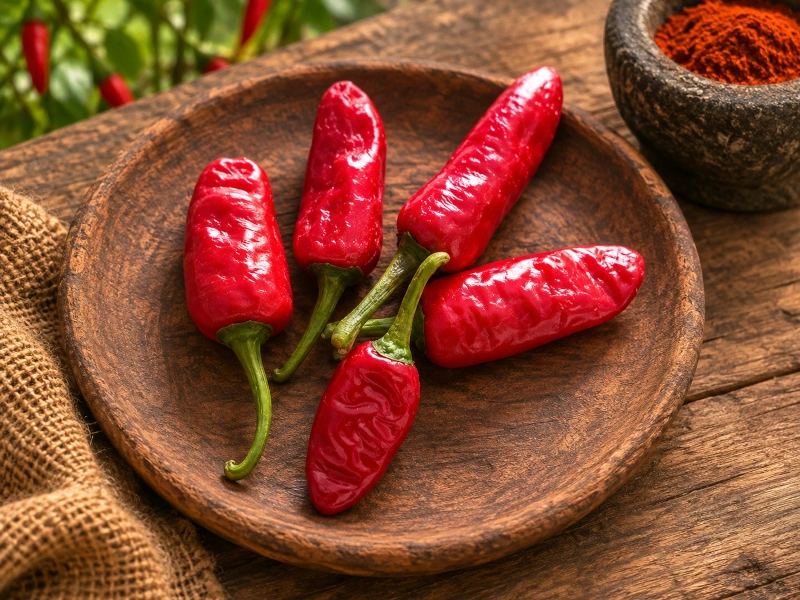
Bhiwapur Chilli, one of Maharashtra’s distinctive traditional chilli varieties, represents the agricultural heritage, culinary traditions, and farming expertise of the Vidarbha region. Recognised for its deep-red colour, pronounced pungency, compact fruit size, and comparatively thick outer covering, this chilli has established a particular reputation in the agricultural markets and traditional kitchens of eastern Maharashtra.
Named after Bhiwapur, a town in Nagpur district, the chilli is traditionally cultivated in the Bhiwapur, Umred, and Kuhi talukas. Its distinctive characteristics reflect generations of cultivation, adaptation to regional agricultural conditions, and the preservation of locally selected planting material. The chilli is particularly valued for its rich colour, strong flavour, and suitability for producing pungent red chilli powder used in traditional Maharashtrian preparations.
Unlike long and slender chilli varieties cultivated primarily for their appearance or specialised colouring properties, Bhiwapur Chilli is distinguished by its relatively short fruits, thick skin, deep-red pigmentation, and characteristic pungency. These qualities contribute to its reputation as a commercially valuable agricultural product and an important ingredient in the food traditions of Vidarbha.
Recognising its distinctive geographical identity and agricultural reputation, Bhiwapur Chilli received protection under India’s Geographical Indications system. The registration, recorded under Application No. 473, formally acknowledged the relationship between the chilli and its traditional production region in Maharashtra.
Historical Origins and the Agricultural Heritage of Bhiwapur
The history of Bhiwapur Chilli is closely associated with the development of chilli cultivation in the Vidarbha region of Maharashtra. Chillies originated in the Americas and entered India through maritime trading networks during the early modern period. Over subsequent centuries, the crop spread across the Indian subcontinent, where different agricultural regions developed locally adapted varieties suited to their climatic conditions, soil characteristics, and culinary requirements.
Vidarbha gradually developed a strong agricultural tradition based on crops capable of adapting to its seasonal rainfall patterns, warm climate, and varied soils. Farmers cultivated cotton, pulses, cereals, oilseeds, vegetables, and spices, including chillies, as part of the region’s agricultural economy. Chilli cultivation became particularly important in areas where farmers could combine locally adapted varieties with traditional crop-management practices.
The Bhiwapur region developed a reputation for producing a distinctive chilli characterised by its compact size, thick skin, deep-red colour, and pungency. Farming communities preserved the variety through seed selection and continued cultivation, maintaining characteristics that distinguished it from other commercially available chillies.
Bhiwapur also emerged as an important local centre for chilli trading. The development of agricultural markets provided farmers with opportunities to sell dried chillies to merchants and buyers from surrounding districts. Local accounts and agricultural studies associate the expansion of the Bhiwapur chilli trade with the commercial development of the region during the twentieth century.
The historical importance of Bhiwapur Chilli therefore lies in the relationship between local farming traditions, regional food preferences, and agricultural commerce. Although chillies were introduced into India centuries ago, farmers in Vidarbha developed and preserved a variety that acquired a distinctive geographical and commercial identity.
Geographical Origin and the Agricultural Landscape of Vidarbha
Bhiwapur Chilli is principally associated with the Bhiwapur, Umred, and Kuhi talukas of Nagpur district in eastern Maharashtra. These areas form part of Vidarbha, a region characterised by agricultural plains, gently undulating terrain, seasonal streams, and a predominantly tropical climate.
Nagpur district experiences hot summers, seasonal monsoon rainfall, and comparatively dry winter conditions. These climatic characteristics influence agricultural planning, particularly for crops whose growth depends on the availability and distribution of seasonal moisture.
The agricultural landscape includes black and red soils, with differences in texture, fertility, drainage, and moisture-retention capacity. Farmers traditionally adapt their cultivation practices according to local soil conditions and the availability of irrigation.
Bhiwapur Chilli has historically been associated with cultivation under relatively limited irrigation conditions. The documented GI specifications describe the variety as requiring comparatively modest irrigation and crop-protection inputs under suitable local conditions. However, actual water requirements depend on rainfall, soil moisture, planting schedules, and prevailing weather.
The relationship between the chilli and its geographical origin extends beyond natural growing conditions. Traditional seed selection, farming knowledge, harvesting practices, and post-harvest processing have contributed to establishing its distinctive identity.
What Makes Bhiwapur Chilli Unique?
Bhiwapur Chilli is recognised for its combination of deep-red colour, pungency, compact size, and comparatively thick outer covering. These characteristics distinguish it from several other commercially cultivated chilli varieties and contribute to its suitability for traditional spice preparations.
The chilli belongs to the species Capsicum annuum, a widely cultivated species that includes numerous varieties differing in fruit shape, size, colour, and pungency. Bhiwapur Chilli is relatively short, with mature fruits generally measuring approximately 1–1.5 inches in length, equivalent to around 2.5–3.8 centimetres.
One of its distinguishing characteristics is the thickness of its outer covering. The registered product description identifies this quality as an advantage because it reduces susceptibility to breakage during handling, transportation, and storage. The comparatively robust fruit structure can help maintain the physical quality of dried chillies when appropriate post-harvest practices are followed.
The chilli also possesses a deep-red colour that is described in its GI specifications as darker than that of certain other commercial chilli varieties, including Guntur Sannam. This pigmentation contributes to the attractive red appearance of chilli powder prepared from the dried fruits.
Bhiwapur Chilli is known for its appreciable pungency. Its documented characteristics include approximately 20,000 Scoville Heat Units, reflecting a substantial concentration of capsaicinoids responsible for the burning sensation associated with chillies.
The combination of rich colour, pungency, and physical durability has contributed to the chilli’s distinctive commercial reputation in Maharashtra’s agricultural markets.
Capsaicin, Colour, and the Scientific Characteristics of Bhiwapur Chilli
The pungency of Bhiwapur Chilli is associated with capsaicinoids, a group of naturally occurring compounds found in chilli fruits. Capsaicin and dihydrocapsaicin are among the principal substances responsible for the characteristic heat experienced when consuming pungent chillies.
According to the documented GI specifications, Bhiwapur Chilli has a pungency of approximately 20,000 Scoville Heat Units, with a reported capsaicin content of around 0.12%. These measurements provide an indication of the chilli’s heat intensity, although actual values may vary according to growing conditions, crop maturity, genetic characteristics, and processing methods.
The Scoville Heat Unit scale is widely used to describe the pungency of chillies and related products. Modern laboratory methods determine capsaicinoid concentrations and convert the measurements into standardised heat values.
Bhiwapur Chilli is also valued for its red pigmentation. The documented ASTA colour value is approximately 36.3, indicating its extractable colouring characteristics under the applicable testing method. ASTA measurements are used in the spice industry to assess colour properties, particularly for chillies intended for powder production and commercial processing.
The red colour of mature chilli fruits is associated with carotenoid pigments, including capsanthin and capsorubin. These naturally occurring compounds contribute to the appearance of dried chillies and prepared chilli powders.
The documented figures should be understood as product-characterisation measurements rather than fixed values applicable to every harvested batch. Nevertheless, they help distinguish Bhiwapur Chilli from other varieties and support its established commercial identity.
Traditional Cultivation and Farming Practices
Bhiwapur Chilli cultivation is closely associated with the agricultural knowledge developed by farming communities in Nagpur district. Farmers traditionally select suitable planting material from healthy crops and cultivate the chilli under conditions adapted to the region’s seasonal rainfall and soil characteristics.
Cultivation generally begins with the preparation of agricultural land and the raising of seedlings in nursery beds. Once the seedlings have developed adequately, they are transplanted into prepared fields, where appropriate spacing supports plant growth and facilitates agricultural operations.
The chilli requires sufficient sunlight, suitable soil moisture, and balanced nutrient availability. Although the traditional variety is associated with comparatively modest irrigation requirements, adequate moisture remains important during establishment, flowering, and fruit development.
Farmers traditionally manage cultivation through soil preparation, manual weeding, crop observation, and locally adapted nutrient-management practices. The use of organic materials and farmyard manure has formed part of conventional agricultural practices in many parts of Vidarbha.
Pests and diseases can affect chilli crops, particularly during periods of unfavourable weather or inadequate crop management. Thrips, mites, aphids, fruit borers, and plant diseases may influence productivity and the commercial quality of harvested fruits.
Modern agricultural extension programmes increasingly encourage improved nursery management, soil testing, efficient irrigation, balanced fertilisation, and integrated pest management. These practices can improve production efficiency while helping preserve the distinctive characteristics of traditional Bhiwapur Chilli.
Harvesting, Sun-Drying, and Traditional Processing
Harvesting is an important stage in determining the quality and commercial value of Bhiwapur Chilli. Farmers generally collect the fruits after they have reached maturity and developed their characteristic red colour, although harvesting schedules vary according to planting dates, rainfall, and local agricultural conditions.
The crop may require several rounds of harvesting because fruits do not always mature simultaneously. Careful harvesting helps reduce physical damage and preserves the desirable appearance of the chilli.
After harvesting, the chillies undergo drying to reduce moisture and prepare them for storage, transportation, and commercial use. Traditional sun-drying has long been associated with chilli cultivation in Maharashtra, where harvested fruits are spread across suitable drying surfaces and exposed to sunlight.
During drying, moisture gradually evaporates from the fruits, allowing them to develop the characteristics associated with the finished dried product. The relatively thick outer covering of Bhiwapur Chilli contributes to its physical durability, reducing the likelihood of breakage during subsequent handling.
Proper drying is essential because excessive moisture can encourage fungal growth and deterioration. Poor handling can also affect colour, aroma, and market acceptance.
Modern processing practices increasingly emphasise hygienic drying surfaces, moisture control, suitable storage conditions, and protection against contamination. Once adequately dried, the chillies are sorted, graded, packed, and transported to traders or processing establishments.
The ability of properly dried Bhiwapur Chilli to withstand handling and storage has contributed to its reputation among local merchants and spice processors.
Culinary Importance in Vidarbha and Maharashtrian Cuisine
Bhiwapur Chilli occupies an important place in the food traditions of Vidarbha, where pungent spice preparations form a distinctive part of regional cuisine. Its strong heat, deep-red colour, and characteristic flavour make it particularly suitable for traditional chutneys, chilli powders, and masala mixtures.
Vidarbha’s culinary traditions include preparations known for their pronounced pungency and robust seasoning. Dried red chillies are important ingredients in many of these dishes, contributing heat, colour, and flavour.
Bhiwapur Chilli is especially associated with Varhadi Thecha, a traditional spicy chutney preparation from Vidarbha. Thecha is commonly prepared using chillies, garlic, and other ingredients, with regional variations reflecting household preferences and local culinary traditions.
The chilli is also suitable for preparing red chilli powder used in vegetable dishes, curries, and traditional spice blends. Its relatively high pungency means that moderate quantities may be sufficient to provide the desired heat.
The deep-red colour of the dried fruits contributes to the appearance of food preparations, while the chilli’s distinctive flavour complements garlic, coriander, cumin, and other ingredients commonly used in Maharashtrian cooking.
The culinary importance of Bhiwapur Chilli therefore extends beyond its physical characteristics. It represents the connection between local agriculture and the food traditions that have developed across generations in Vidarbha.
Bhiwapur Chilli and the Traditional Spice Economy
The commercial importance of Bhiwapur Chilli is closely connected with the production and trading of dried red chillies and chilli powder. Farmers cultivate the crop for household consumption and commercial sale, while traders procure dried produce for distribution to local markets and processing establishments.
The chilli’s relatively thick skin and reduced susceptibility to breakage are valuable characteristics during transportation and storage. These qualities can help maintain marketable produce when drying and storage are managed appropriately.
The deep-red colour and pungency also contribute to its commercial appeal. The chilli can be processed into powders and masala preparations intended for household consumption, retail markets, and food-service applications.
Small-scale processing enterprises have opportunities to develop value-added products using authentic Bhiwapur Chilli. These may include hygienically packaged dried chillies, ground chilli powder, traditional chutney mixtures, and specialised regional spice products.
Such processing activities can help generate additional employment while creating opportunities for farmers to participate in agricultural value chains beyond the sale of raw produce.
Geographical Indication Recognition and the Protection of Bhiwapur Chilli
Bhiwapur Chilli received formal recognition under India’s Geographical Indications framework to protect its established geographical identity and distinctive agricultural characteristics.
The application was submitted by Bhiwapur Mirchi Utpadak Samuha Gat, a producer organisation located at Chikhalpar in Bhiwapur taluka of Nagpur district, Maharashtra.
The application was filed on 26 March 2014 under Class 30 and assigned Application No. 473. The registration process involved examination of the product’s geographical origin, characteristics, production practices, and supporting documentation.
Following examination and submission of the required responses, the application was published in Geographical Indications Journal No. 88 on 28 July 2016.
The product subsequently received GI Certificate No. 278. The certificate date is recorded differently in government publications, with the current GI Registry listing 9 March 2017 and APEDA and the Spices Board recording 30 November 2016.
The registration established legal recognition for Bhiwapur Chilli’s geographical identity and provided a framework for protecting the name against unauthorised commercial use.
The registration was subsequently renewed, with the latest renewal documentation recorded on 22 December 2023. The current registration remains valid until 25 March 2034.
GI Tag Journey of Bhiwapur Chilli
The Geographical Indication recognition of Bhiwapur Chilli reflects the formal protection of a traditional agricultural product closely associated with the farming communities of Vidarbha. Its journey combines the historical development of chilli cultivation in eastern Maharashtra, the establishment of Bhiwapur as a regional chilli-trading centre, and modern efforts to preserve the distinctive identity of locally cultivated agricultural products.
The formal registration process began in March 2014 when Bhiwapur Mirchi Utpadak Samuha Gat sought legal protection for the chilli. The application underwent examination, consultative proceedings, documentary submissions, and publication in the Geographical Indications Journal before the registration was completed.
| Period / Date | Milestone |
|---|---|
| Historical period | Chilli cultivation became established in the Vidarbha region following the introduction of chillies into the Indian subcontinent. Farmers gradually developed locally adapted varieties suited to regional agricultural conditions. |
| Generations of traditional cultivation | Farming communities in the Bhiwapur, Umred, and Kuhi areas preserved a distinctive chilli variety recognised for its compact size, deep-red colour, thick outer covering, and pungency. |
| Twentieth century | Bhiwapur developed as a regional centre for chilli cultivation and trading, connecting local agricultural producers with merchants and markets in the surrounding districts. |
| 26 March 2014 | Bhiwapur Mirchi Utpadak Samuha Gat filed GI Application No. 473 for Bhiwapur Chilli under Class 30. |
| 28 July 2014 | The Geographical Indications Registry issued its formality check report concerning the application. |
| 24 October 2014 | The applicant submitted its response to the formality check report. |
| 27 May 2015 | The GI Registry recorded the minutes of a consultative group meeting concerning the application. |
| 3 July 2015 | The Registry issued an examination report requiring further consideration and documentation. |
| 30 July 2015 | The Registry recorded documentation concerning the authorisation of representation in the application proceedings. |
| 3 September 2015 | The applicant submitted its response to the examination report, together with additional representations and supporting annexures. |
| 27 April 2016 | The Geographical Indications Registry issued a further examination report concerning the application. |
| 4 July 2016 | The applicant submitted its response to the examination report and supporting documentation. |
| 28 July 2016 | The application appeared in Geographical Indications Journal No. 88, formally publishing the proposed registration of Bhiwapur Chilli. |
| 30 November 2016 / 9 March 2017 | GI Certificate No. 278 was issued. APEDA and the Spices Board record 30 November 2016, while the current GI Registry records 9 March 2017 as the certificate date. |
| 22 December 2023 | The GI Registry recorded renewal documentation for Bhiwapur Chilli, maintaining the continuity of its legal protection. |
| 25 March 2034 | The current GI registration remains valid until this date, subject to further renewal. |
The registration timeline demonstrates the important role played by Bhiwapur Mirchi Utpadak Samuha Gat in obtaining legal recognition for the chilli. Unlike geographical indications registered by national commodity boards, Bhiwapur Chilli’s application originated from a local producer organisation, highlighting the contribution of farming communities to the protection of regional agricultural heritage.
The renewal recorded in December 2023 is particularly significant because it extends the geographical protection of the product until March 2034. The registration provides a foundation for strengthening authenticity, encouraging organised cultivation, and developing commercial opportunities for farmers producing the traditional chilli.
GI Details at a Glance
| Particular | Details |
|---|---|
| Geographical Indication | Bhiwapur Chilli |
| State | Maharashtra |
| Region | Vidarbha |
| District | Nagpur |
| Principal Cultivation Areas | Bhiwapur, Umred, and Kuhi talukas |
| Botanical Name | Capsicum annuum L. |
| Botanical Family | Solanaceae |
| Product Category | Agricultural |
| GI Class | 30 |
| Application Number | 473 |
| Date of Filing | 26 March 2014 |
| Registered Proprietor | Bhiwapur Mirchi Utpadak Samuha Gat |
| Registered Proprietor’s Address | Chikhalpar, Taluka Bhiwapur, District Nagpur, Maharashtra – 441201 |
| GI Journal | No. 88 |
| GI Journal Availability Date | 28 July 2016 |
| Certificate Number | 278 |
| GI Certificate Date | 9 March 2017 in the current GI Registry; 30 November 2016 in APEDA and Spices Board records |
| Registered Geographical Area | Maharashtra, with the traditional production belt centred on Bhiwapur, Umred, and Kuhi |
| Fruit Colour | Deep red |
| Fruit Shape | Relatively short and compact |
| Fruit Length | Approximately 1–1.5 inches (2.5–3.8 cm) |
| Outer Covering | Comparatively thick, offering resistance to breakage |
| Pungency | Approximately 20,000 Scoville Heat Units |
| Capsaicin Content | Approximately 0.12% |
| ASTA Colour Value | Approximately 36.3 |
| Characteristic Flavour | Strongly pungent, with a distinctive chilli aroma |
| Traditional Culinary Applications | Varhadi Thecha, chilli powders, chutneys, curries, and regional spice preparations |
| Commercial Applications | Dried red chillies, chilli powder, packaged spices, and traditional masala products |
| Current GI Status | Registered |
| Latest Renewal Record | 22 December 2023 |
| Registration Valid Until | 25 March 2034 |
The registration particulars are based on the official Geographical Indications Registry and APEDA records. The botanical identification, agricultural characteristics, fruit measurements, and documented pungency values are supported by ICAR publications and the registered product specifications.
Protecting Authenticity and Supporting Farming Communities
The Geographical Indication designation establishes a legally recognised connection between Bhiwapur Chilli and its traditional geographical origin. However, maintaining the commercial value of the product requires continued attention to authenticity, quality standards, and responsible marketing.
Bhiwapur Chilli’s reputation depends on its distinctive characteristics, including deep-red colour, strong pungency, compact fruit size, and comparatively thick outer covering. Maintaining these qualities is important because similar chilli products may be cultivated elsewhere and marketed without possessing the characteristics associated with the registered geographical indication.
The GI framework provides for authorised-user registration, enabling eligible producers to obtain recognition for the legitimate commercial use of the geographical indication. Such registration can help distinguish authentic products and provide greater confidence to traders, processors, and consumers.
The involvement of Bhiwapur Mirchi Utpadak Samuha Gat is particularly important because local producer organisations can support collective marketing, agricultural training, quality improvement, and preservation of traditional crop characteristics.
Improved traceability, appropriate grading systems, and better packaging can further strengthen the commercial identity of Bhiwapur Chilli. These measures can also help farmers participate more effectively in specialised markets for geographically identified agricultural products.
Economic Importance and Rural Livelihoods
Bhiwapur Chilli cultivation contributes to the agricultural economy of Nagpur district by providing farmers with a crop valued for its distinctive characteristics and suitability for processing.
The production and marketing of dried chillies support several activities beyond cultivation, including harvesting, drying, grading, transportation, storage, wholesale trading, and spice processing. These activities generate opportunities for agricultural labourers, traders, small enterprises, and rural service providers.
The commercial reputation of Bhiwapur Chilli has historically been associated with local markets serving the agricultural communities of Bhiwapur and surrounding talukas. Its distinctive characteristics provide opportunities for marketing the product as a regional speciality rather than an undifferentiated dried chilli.
However, farmers face several challenges affecting agricultural profitability. A 2017 study examining chilli growers in Bhiwapur Panchayat Samiti identified high labour costs, shortages of workers during harvesting and grading, inadequate market information, water constraints, and non-remunerative prices during periods of excessive market arrivals.
These findings highlight the importance of improving agricultural infrastructure and market access. Scientific storage facilities, efficient irrigation, better price information, and stronger farmer-producer organisations can help reduce production risks and improve commercial opportunities.
The GI registration offers a foundation for developing a more differentiated market identity, particularly when supported by consistent quality, traceability, and organised procurement systems.
Agricultural Research and Quality Improvement
Agricultural research plays an important role in maintaining the distinctive characteristics of Bhiwapur Chilli while improving cultivation efficiency and productivity.
Research institutions working in horticulture and agricultural sciences can contribute to improved planting material, better crop-management practices, and more effective protection against pests and diseases.
The development of locally suitable cultivation methods is particularly important in Vidarbha, where agricultural production can be influenced by variations in monsoon rainfall, soil moisture, and irrigation availability.
Scientific evaluation of traditional chilli varieties can help identify desirable characteristics relating to fruit size, colour, capsaicin content, and resistance to agricultural stresses.
Post-harvest research is equally important because the commercial value of dried chillies depends on moisture control, hygienic handling, and the preservation of appearance and flavour.
Improved drying technologies, scientific storage, and quality-testing facilities can reduce losses and strengthen the competitiveness of Bhiwapur Chilli in organised markets.
Research into traditional varieties also contributes to the conservation of regional agricultural biodiversity, ensuring that commercially valuable local crop characteristics are preserved for future generations.
Preserving Traditional Knowledge and Agricultural Heritage
The agricultural heritage of Bhiwapur Chilli is closely connected with generations of farmers who developed knowledge of local growing conditions, seed selection, crop management, harvesting, and drying.
Traditional farmers understand the importance of selecting suitable planting material and adapting cultivation practices to seasonal rainfall and available soil moisture. Their experience has contributed to the preservation of the chilli’s distinctive physical and culinary characteristics.
The continuation of traditional cultivation practices is particularly important as agricultural production becomes increasingly commercialised. The widespread adoption of new varieties may create challenges for preserving locally adapted crops if traditional planting material is not maintained.
Farmer-producer organisations, agricultural universities, and extension programmes can help document traditional practices while introducing suitable scientific improvements.
The GI framework provides a mechanism for recognising this accumulated agricultural knowledge and connecting it with the formal protection of geographically distinctive products.
Preserving traditional Bhiwapur Chilli cultivation therefore contributes not only to agricultural livelihoods but also to the wider conservation of Vidarbha’s regional farming heritage.
Future Prospects for Bhiwapur Chilli
The future of Bhiwapur Chilli lies in strengthening the relationship between its traditional agricultural reputation and modern opportunities for quality-oriented production and processing.
The chilli’s distinctive colour, pungency, and relatively durable outer covering create opportunities for developing differentiated products in the domestic spice market.
Greater investment in scientific drying, hygienic processing, suitable storage, and improved packaging can help farmers and processors maintain quality and reduce post-harvest losses.
The development of packaged chilli powders, traditional Vidarbha spice mixtures, and regional chutney products offers opportunities for value addition within the local agricultural economy.
Farmer-producer organisations can support these developments by improving collective marketing, access to agricultural technologies, and connections with commercial buyers.
Greater awareness of the GI designation can also help distinguish authentic Bhiwapur Chilli from other commercially available chilli varieties.
At the same time, preserving traditional seed resources and agricultural knowledge will remain essential to maintaining the distinct geographical identity of the product.
Combining regional heritage with improved agricultural infrastructure and organised processing can strengthen the long-term prospects of Bhiwapur Chilli cultivation.
Bhiwapur Chilli — The Fiery Agricultural Heritage of Vidarbha
Bhiwapur Chilli represents the transformation of a traditional agricultural crop into a product of regional identity and commercial significance. Its deep-red colour, compact size, distinctive pungency, and thick outer covering reflect the agricultural knowledge developed by farming communities in eastern Maharashtra.
The geographical indication formally recognises the association between the chilli and the Bhiwapur region, providing a framework for protecting its identity and preserving its established reputation.
For the farming communities of Bhiwapur, Umred, and Kuhi, the chilli represents generations of cultivation expertise and participation in Maharashtra’s agricultural economy. Its importance extends from traditional Vidarbha kitchens to the wider markets for dried chillies, spice powders, and regional food products.
By protecting its authenticity, preserving traditional planting material, supporting farmers, and encouraging quality-oriented cultivation, Bhiwapur Chilli can continue to represent the distinctive agricultural heritage of Vidarbha while contributing to India’s broader spice economy.
References
The principal official reference for this article is the Geographical Indications Registry, Intellectual Property India, which records Bhiwapur Chilli under Application No. 473, Certificate No. 278, and the current registration validity extending until 25 March 2034. Its application records document the formality checks, examination reports, consultative proceedings, journal publication, and renewal documentation associated with the product.
Additional institutional references include the Agricultural and Processed Food Products Export Development Authority (APEDA), which maintains information concerning Maharashtra’s registered geographical indications, and the Spices Board, Ministry of Commerce and Industry, Government of India, which documents GI-protected spices and their registered proprietors.
The botanical characteristics, geographical production areas, and traditional culinary applications are supported by the Indian Council of Agricultural Research’s publication Indian Horticulture, particularly its discussion of GI-protected indigenous chilli varieties.
Agricultural and economic context is supported by the 2017 study Constraints and Suggestions of the Chilli Farmers in Bhiwapur Panchayat Samiti of Nagpur District, published in the Journal of Pharmacognosy and Phytochemistry, and research conducted through the College of Agriculture, Nagpur, Dr. Panjabrao Deshmukh Krishi Vidyapeeth.
You may also like
-
Skyroot Aerospace Partners With International Space Companies for Second Vikram-1 Mission
-
Government Highlights ₹2,585 Crore Small Hydropower Scheme to Add 1,500 MW Capacity
-
Indian Army and ITBP Source Essential Supplies from Arunachal Border Villages to Strengthen Rural Economy
-
Mizo Chilli: Mizoram’s Fiery Bird’s Eye Chilli and Its Geographical Indication Heritage
-
Singer India to Commence Manufacturing at New Bhiwadi Facility
