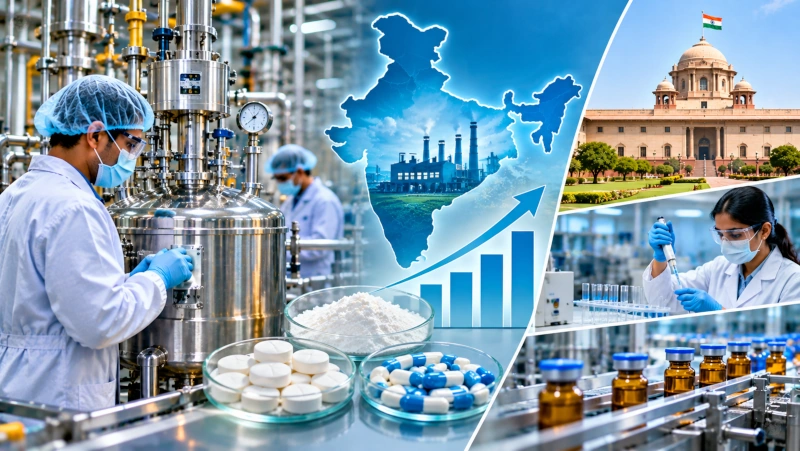
India’s efforts to strengthen domestic pharmaceutical manufacturing are gaining momentum, with investments under the Production Linked Incentive (PLI) Scheme for Bulk Drugs reaching ₹5,210.74 crore as of June 2026. The programme has supported the establishment of manufacturing facilities for critical pharmaceutical ingredients, including Penicillin G, Clavulanic Acid and several widely used active pharmaceutical ingredients, reducing dependence on imported raw materials.
According to the Department of Pharmaceuticals under the Ministry of Chemicals and Fertilizers, 48 projects have been approved under the ₹6,940 crore scheme, with 39 projects covering 28 critical pharmaceutical products commissioned by June 2026. The investments have exceeded the original committed amount of approximately ₹4,330 crore, demonstrating the pharmaceutical industry’s participation in expanding indigenous manufacturing capabilities.
The government reported cumulative sales of ₹3,792.49 crore under the programme, including exports worth ₹560.16 crore, while approximately 5,127 employment opportunities had been generated. These developments form part of India’s broader strategy to strengthen pharmaceutical supply chains, improve domestic value addition and establish manufacturing capacity for essential medicines.
Strengthening India’s Pharmaceutical Raw Material Supply Chain
India is one of the world’s major producers and exporters of pharmaceutical formulations. However, domestic manufacturers have historically depended on imports for several critical Active Pharmaceutical Ingredients (APIs), Drug Intermediates (DIs) and Key Starting Materials (KSMs) required for medicine production.
APIs are the biologically active components responsible for the therapeutic effects of medicines. Drug intermediates and key starting materials are essential inputs used during their manufacturing processes. A reliable supply of these materials is therefore important for maintaining uninterrupted pharmaceutical production.
Recognising the need to strengthen domestic capabilities, the Union Government approved the PLI Scheme for Bulk Drugs in 2020 with a total financial outlay of ₹6,940 crore. The programme focuses on promoting indigenous production of 41 identified critical pharmaceutical products through the establishment of greenfield manufacturing facilities.
The initiative seeks to address vulnerabilities associated with excessive dependence on a limited number of international suppliers. By encouraging domestic investment in strategically important pharmaceutical ingredients, the government aims to improve supply-chain resilience and strengthen India’s manufacturing competitiveness.
Investments Exceed Initial Commitments
The Department of Pharmaceuticals reported that cumulative investments under the scheme had reached ₹5,210.74 crore by June 2026, exceeding the original committed investment of approximately ₹4,330 crore.
The programme has supported 48 approved projects across several pharmaceutical manufacturing states, including Andhra Pradesh, Gujarat, Telangana, Himachal Pradesh, Maharashtra and Punjab.
Of these, 39 projects covering 28 identified pharmaceutical products had been commissioned by June 2026. The government also reported cumulative sales of ₹3,792.49 crore, including exports of ₹560.16 crore.
The investments have contributed to the establishment of new pharmaceutical production infrastructure, particularly in manufacturing segments that previously relied heavily on imported materials.
An important objective of the scheme is to develop manufacturing capacity across different categories of pharmaceutical inputs rather than concentrate exclusively on finished medicines.
This approach is intended to strengthen India’s ability to manufacture essential drugs using a larger proportion of domestically produced raw materials.
Penicillin G Manufacturing Returns to India After Three Decades
One of the most significant achievements under the PLI programme has been the restoration of large-scale domestic Penicillin G manufacturing.
Lyfius Pharma Private Limited, a subsidiary of Aurobindo Pharma, has established a Penicillin G manufacturing facility at the Kakinada Special Economic Zone in Andhra Pradesh.
The project involves an investment of ₹2,270.05 crore and has an installed production capacity of 15,000 metric tonnes annually.
According to the Department of Pharmaceuticals, the facility has generated 2,353 direct employment opportunities and recorded cumulative production valued at ₹1,191 crore.
Penicillin G is an important fermentation-based pharmaceutical starting material used to manufacture intermediates such as 6-aminopenicillanic acid, which is subsequently utilised in producing antibiotics including amoxicillin and ampicillin.
The government stated that the facility has achieved more than 90% domestic value addition and restored domestic Penicillin G manufacturing after a gap of approximately three decades.
The project represents an important development for India’s antibiotic manufacturing ecosystem because domestic production of critical starting materials can reduce exposure to international supply disruptions and fluctuations in imported raw material prices.
Himachal Pradesh Establishes Indigenous Clavulanic Acid Manufacturing
Another major development involves the establishment of India’s first fermentation-based manufacturing facility for Potassium Clavulanate.
Kinvan Private Limited, part of the DPB Group, has commissioned the facility at Nalagarh in Himachal Pradesh.
The project involves an investment of ₹504.68 crore and has an installed annual capacity of 400 metric tonnes. It has generated 465 direct employment opportunities and recorded cumulative production valued at ₹413 crore.
Clavulanic Acid is an important pharmaceutical ingredient used in combination with certain antibiotics, particularly amoxicillin.
It functions as a beta-lactamase inhibitor, helping protect susceptible antibiotics from bacterial enzymes that would otherwise reduce their effectiveness.
Domestic production of this ingredient is particularly relevant because it supports the manufacturing of widely prescribed antibiotic combinations.
The facility also demonstrates India’s growing capabilities in industrial fermentation, a specialised manufacturing process requiring advanced biological production systems and carefully controlled operating conditions.
Domestic Manufacturing Expands Across Cardiovascular Medicines
The PLI scheme has also supported manufacturing investments in active pharmaceutical ingredients used for cardiovascular treatments.
Andhra Organics Limited, a subsidiary of Virchow Laboratories, has commissioned facilities at Pydibhimavaram in Srikakulam district, Andhra Pradesh, for the production of Sulfadiazine, Telmisartan and Olmesartan.
The projects involve a combined investment of ₹151.47 crore and have generated 221 direct employment opportunities.
Telmisartan and Olmesartan are widely used medicines for treating hypertension, making their domestic manufacturing capacity relevant to India’s pharmaceutical supply chain.
The company has developed manufacturing technologies in-house and established greenfield production facilities for the identified products.
According to the Department of Pharmaceuticals, domestic production of Sulfadiazine has contributed to a substantial reduction in import dependence, with imports declining by approximately 73% compared with the FY2019–20 baseline since the company commenced supplies in 2022.
The development illustrates how targeted manufacturing investments can strengthen domestic production across different therapeutic categories.
Gujarat Strengthens Paracetamol Raw Material Production
The scheme has also supported domestic production of Para Amino Phenol (PAP), a critical starting material used in manufacturing Paracetamol.
Meghmani LLP has established a PAP manufacturing facility at Dahej in Gujarat with an annual installed capacity of 13,500 metric tonnes.
The project involves an investment of ₹60.46 crore and has recorded cumulative production valued at ₹687 crore.
Paracetamol is one of the most widely used medicines for relieving pain and reducing fever. Its manufacturing depends upon reliable access to essential chemical intermediates, including PAP.
The establishment of large-scale domestic PAP production strengthens backward integration in India’s Paracetamol manufacturing industry.
Backward integration allows pharmaceutical manufacturers to source a greater proportion of important raw materials from domestic facilities, reducing dependence on imported intermediates.
The development is therefore relevant not only to the production of Paracetamol but also to the broader objective of strengthening India’s pharmaceutical manufacturing value chain.
Punjab Develops Atorvastatin Manufacturing Capabilities
Centrient Pharmaceuticals India Private Limited has established a greenfield Atorvastatin API manufacturing facility at Nawanshahr in Punjab.
The project involves an investment of ₹161.13 crore and has an installed annual production capacity of 206 metric tonnes.
The facility has recorded cumulative production valued at ₹432 crore.
Atorvastatin is a widely prescribed medicine used to lower cholesterol levels and reduce the risk of cardiovascular complications.
According to the Department of Pharmaceuticals, the project has enabled the development of a supply chain with more than 80% domestic value addition.
The manufacturing facility demonstrates how the PLI programme is supporting the production of pharmaceutical ingredients used in treatments for major non-communicable diseases.
Together with investments in antibiotics and other essential medicines, such projects are contributing to the diversification of India’s domestic API manufacturing capabilities.
Challenges in Expanding Bulk Drug Production
Despite progress in investment and commissioning, the government has acknowledged challenges affecting the implementation of the PLI Scheme for Bulk Drugs.
In a written reply to the Lok Sabha on 7 August 2026, the Ministry of Chemicals and Fertilizers stated that ₹87.70 crore in incentives had been disbursed under the scheme as of March 2026.
The Ministry also identified several factors affecting the commissioning and commercial performance of approved projects.
These included delays in land acquisition, environmental clearances, high utility costs and the long gestation periods associated with fermentation-based pharmaceutical manufacturing.
Industrial fermentation facilities frequently require substantial capital investment, specialised infrastructure and complex manufacturing processes before commercial production can begin.
Unlike several conventional chemical manufacturing operations, fermentation-based pharmaceutical production depends on biological processes that must be carefully managed to ensure consistent quality and output.
The government’s assessment indicates that while investment commitments have translated into substantial manufacturing infrastructure, the conversion of installed capacity into sustained commercial production remains an important consideration.
Addressing these operational challenges will be essential for improving capacity utilisation and strengthening the long-term competitiveness of domestic pharmaceutical ingredient manufacturers.
Building a More Integrated Pharmaceutical Manufacturing Ecosystem
The expansion of bulk drug manufacturing is closely connected with India’s efforts to develop a more integrated pharmaceutical industry.
The production of finished medicines depends on a complex network of suppliers providing chemicals, biological materials, intermediates and APIs.
Disruptions at any stage of this supply chain can affect manufacturing schedules, production costs and the availability of essential pharmaceutical products.
By supporting indigenous manufacturing of critical ingredients, the PLI programme aims to reduce vulnerabilities associated with dependence on external suppliers.
The establishment of facilities for Penicillin G, Clavulanic Acid, PAP and cardiovascular APIs illustrates the development of production capabilities across different sections of the pharmaceutical value chain.
Domestic manufacturing can also create opportunities for specialised engineering, industrial biotechnology, chemical processing, quality testing and research into more efficient production methods.
The government’s broader pharmaceutical manufacturing initiatives include support for high-value formulations, complex generics, biopharmaceuticals and medical devices through separate incentive programmes.
Together, these measures are intended to strengthen India’s position as a major pharmaceutical manufacturing centre capable of producing both finished medicines and essential raw materials.
Research and Technology Will Shape Future Competitiveness
An important requirement for strengthening pharmaceutical self-reliance is the continued development of advanced manufacturing technologies.
Many critical pharmaceutical ingredients require specialised chemical synthesis or industrial fermentation processes, making technological capability an essential component of commercial competitiveness.
Research into microbial strains, fermentation efficiency, enzyme engineering and continuous manufacturing processes can help improve production yields and reduce operating costs.
Similarly, improvements in energy efficiency, solvent recovery, process optimisation and environmental management can contribute to the competitiveness of domestic manufacturing facilities.
The existing PLI programme has already demonstrated the importance of attracting investment into strategically important products.
Further progress will depend on the ability of manufacturers to achieve reliable production, maintain internationally accepted quality standards and operate at commercially sustainable costs.
Collaboration between pharmaceutical companies, research institutions and technology developers can play an important role in strengthening these capabilities.
India’s experience in pharmaceutical formulations, chemical manufacturing and biotechnology provides a foundation for expanding research-led production of critical pharmaceutical ingredients.
Conclusion
India’s PLI Scheme for Bulk Drugs is contributing to the expansion of domestic pharmaceutical manufacturing, with investments exceeding ₹5,210 crore and 39 projects commissioned as of June 2026.
The establishment of facilities for Penicillin G, Clavulanic Acid, Para Amino Phenol and several cardiovascular APIs represents progress in strengthening supply chains for essential medicines.
The programme has also supported employment generation, increased domestic value addition and the development of specialised manufacturing technologies.
At the same time, the government’s assessment highlights the importance of overcoming operational challenges associated with commissioning, production costs and commercial viability.
The long-term significance of the initiative lies in building a pharmaceutical manufacturing ecosystem capable of producing critical ingredients domestically while maintaining competitiveness in international markets.
As India continues expanding its pharmaceutical manufacturing infrastructure, sustained investment in technology, research and domestic raw material production will remain central to strengthening the country’s pharmaceutical self-reliance and supply-chain security.
References
Department of Pharmaceuticals, Ministry of Chemicals and Fertilizers: Production Linked Incentive Schemes Have Strengthened India’s Pharmaceutical, Bulk Drugs and Medical Devices Manufacturing Ecosystem, Press Information Bureau, 25 September 2026. Release ID: 2314746.
Department of Pharmaceuticals, Ministry of Chemicals and Fertilizers: PLI Scheme for Bulk Drugs for Resilient Pharmaceutical Supply Chain, Press Information Bureau, 25 September 2026. Release ID: 2314891.
Ministry of Chemicals and Fertilizers: PLI Scheme for Bulk Drugs, Lok Sabha Written Reply, 7 August 2026. Press Information Bureau Release ID: 2295928.
Ministry of Chemicals and Fertilizers: PLI Scheme for Pharmaceutical Sectors, Lok Sabha Written Reply, 7 August 2026. Press Information Bureau Release ID: 2295938.
You may also like
-
DRDO Awards Blockchain Security Development Project to Indian Startup Zupple Labs
-
IIT Bhubaneswar Identifies Promising Semiconductor Material for Next-Generation Spintronic Devices
-
Data Patterns Completes Indigenous Su-30MKI Self-Protection Jammer Design, Prepares for Flight Trials
-
DRDO Invites Indian Industry to Develop AI-Powered Acoustic Drone Detection System
-
India Records Highest-Ever 15.62 Crore E-Way Bills in October 2026, Registering 23.14% Annual Growth
