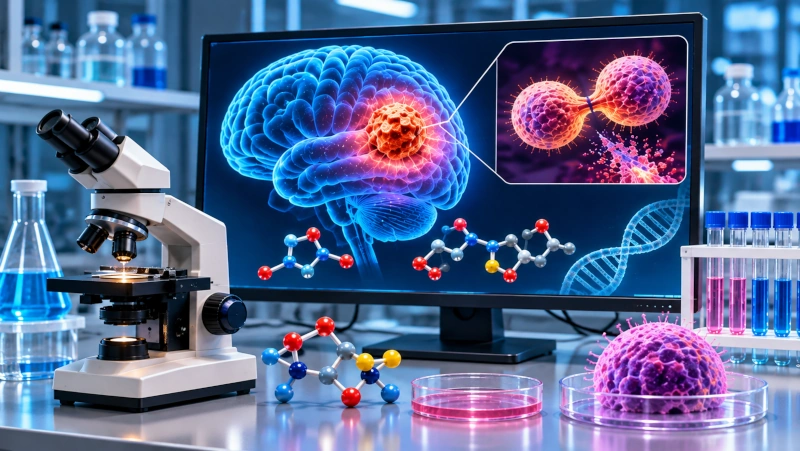
Researchers at the Indian Institute of Technology Gandhinagar (IITGN) have developed two experimental compounds capable of suppressing the growth of glioblastoma cells, opening a promising new direction for research into one of the most aggressive forms of brain cancer. The compounds, SPK17 and SPK17b, target a protein responsible for regulating cell division and have demonstrated significant activity against cancer cells that have developed resistance to conventional chemotherapy.
The research, announced by IIT Gandhinagar on 6 November 2026, focuses on overcoming resistance to temozolomide, a chemotherapy drug widely used in treating glioblastoma. Laboratory investigations showed that the two compounds could disrupt mechanisms essential for cancer-cell survival, interfere with DNA repair, and trigger cell death at substantially lower concentrations than temozolomide under the experimental conditions studied.
The findings, published in the Journal of Biological Chemistry and RSC Medicinal Chemistry, represent an important contribution to India’s growing capabilities in cancer chemical biology and experimental drug discovery. The research was conducted in IIT Gandhinagar’s Department of Chemistry under Professor Sivapriya Kirubakaran, who heads the institute’s Cancer Chemical Biology Laboratory.
Targeting One of the Most Aggressive Forms of Brain Cancer
Glioblastoma is a highly aggressive malignant brain tumour characterised by rapid cellular growth, extensive invasion of surrounding brain tissue, and a strong tendency to recur after treatment. Its complex biological behaviour and capacity to develop resistance to chemotherapy make it particularly difficult to manage.
Current treatment generally involves surgical removal of as much of the tumour as safely possible, followed by radiotherapy and chemotherapy using temozolomide. However, glioblastoma cells can develop mechanisms that allow them to survive the DNA damage caused by treatment, reducing the effectiveness of conventional therapeutic approaches.
A major challenge arises from the ability of tumour cells to repair damaged genetic material. Temozolomide works by introducing chemical modifications into DNA, interfering with the ability of cancer cells to divide and multiply. Some glioblastoma cells, however, possess efficient repair mechanisms that enable them to survive this damage and continue proliferating.
The IIT Gandhinagar researchers investigated whether interfering with a separate mechanism governing cell division could weaken the ability of resistant tumour cells to survive. Their work focused on disrupting a protein known as TTK, also called Mps1, which plays a critical role in maintaining the accuracy of chromosome distribution during cell division.
TTK Protein Emerges as a Promising Therapeutic Target
TTK is a protein kinase involved in regulating the spindle assembly checkpoint, an important cellular mechanism that monitors chromosome alignment and separation during mitosis.
During normal cell division, chromosomes must be distributed accurately between two daughter cells. The spindle assembly checkpoint helps prevent division from proceeding until the cellular machinery is properly organised, reducing the likelihood of chromosome-segregation errors.
Cancer cells frequently undergo rapid and unstable division, making them particularly dependent upon mechanisms that manage errors arising during this process. Disrupting TTK activity can interfere with these protective mechanisms and increase the vulnerability of tumour cells.
The IIT Gandhinagar team investigated whether specifically designed chemical compounds could inhibit TTK and impair the ability of glioblastoma cells to maintain their survival mechanisms.
The researchers built upon earlier investigations involving J54, a selective TTK inhibitor, and developed modified compounds intended to improve activity against glioblastoma cells.
Their work identified SPK17 and SPK17b as promising candidates capable of interfering with cancer-cell survival through related but distinct biological mechanisms.
SPK17 Demonstrates Strong Activity Against Glioblastoma Cells
The first investigation identified SPK17, designated G17 in the scientific publication, as a particularly promising compound among more than ten molecules developed and evaluated by the research team.
Laboratory tests were conducted using LN229 and U87MG, two established human glioblastoma cell lines commonly employed in experimental cancer research.
Researchers found that the concentration of SPK17 required to reduce cell viability by 50%, known as the IC50 value, was approximately 176 times lower than that of temozolomide in LN229 cells and 85 times lower in U87MG cells.
These findings indicated that SPK17 could suppress glioblastoma-cell viability at considerably lower concentrations than the conventional chemotherapy drug under the tested laboratory conditions.
The team also examined the compound’s activity against LN229 cells that had developed resistance to temozolomide.
In these experiments, SPK17 produced approximately eight times the cell-death signal when tested at a concentration of 10 micromolar, compared with temozolomide tested at 200 micromolar.
The results suggest that SPK17 may be capable of exploiting vulnerabilities in tumour cells that are no longer responding effectively to conventional chemotherapy.
Disrupting Cell Division and Preventing DNA Repair
The mechanism underlying SPK17’s activity involves disrupting the coordination between cell division and DNA-damage repair.
Under normal circumstances, cells possess checkpoint mechanisms that can delay division when chromosomes are incorrectly arranged or genetic material is damaged. These protective processes allow cells additional time to correct errors before completing division.
The IIT Gandhinagar researchers found that inhibiting TTK interfered with this coordination, preventing tumour cells from effectively responding to DNA damage.
SPK17 disrupts the checkpoint system that ordinarily allows a dividing cell to pause and manage damaged genetic material. As a result, cancer cells may continue through division while carrying unrepaired DNA damage.
The accumulation of genetic errors can compromise cellular survival and ultimately trigger cell death.
This mechanism is significant because it targets a vulnerability associated with the cellular processes that help glioblastoma survive chemotherapy-induced damage.
Rather than relying exclusively upon introducing additional DNA damage, the strategy attempts to undermine the mechanisms through which tumour cells tolerate or repair that damage.
SPK17b Shows Additional Effects on Cancer-Cell Survival and Movement
In a companion study, the research team investigated SPK17b, identified as G17b in the scientific publication.
The compound emerged as the most promising among five related molecules evaluated by the researchers.
Laboratory testing showed that SPK17b reduced glioblastoma-cell viability at concentrations approximately 81 times lower than temozolomide in LN229 cells and 59 times lower in U87MG cells.
The compound also demonstrated activity against experimentally developed temozolomide-resistant glioblastoma cells, indicating that its effects were not limited to cells sensitive to conventional chemotherapy.
Researchers observed that SPK17b increased the accumulation of reactive oxygen species within cancer cells. These chemically reactive molecules are produced during normal cellular metabolism, but excessive accumulation can damage cellular components and trigger programmed cell death.
SPK17b appeared to increase this oxidative stress beyond the ability of tumour cells to maintain their protective systems.
The researchers also observed reduced cell migration, invasion-related behaviour, and colony-forming capacity in laboratory experiments.
These findings are particularly relevant to glioblastoma because the tumour’s ability to infiltrate surrounding brain tissue is one of the major challenges associated with treatment.
Two Compounds, Different Mechanisms Against Cancer Cells
Although SPK17 and SPK17b target the same TTK protein, the two studies identified different biological consequences associated with their activity.
SPK17 primarily interferes with the mechanisms coordinating cell division and DNA-damage repair. By preventing cancer cells from effectively managing damaged genetic material, the compound increases their vulnerability during division.
SPK17b also inhibits TTK but produces additional effects involving the accumulation of reactive oxygen species, disruption of cellular survival mechanisms, and reduced migration and invasion-related behaviour.
These complementary findings suggest that TTK inhibition can influence several interconnected biological processes essential for glioblastoma survival.
The research therefore provides a foundation for investigating a family of compounds designed to exploit vulnerabilities in drug-resistant cancer cells.
Such mechanism-based approaches are increasingly important in experimental oncology, where scientists seek to identify specific molecular processes that can be disrupted to reduce tumour growth and overcome resistance to existing treatments.
Indian Researchers Advance Cancer Chemical Biology
The studies were carried out by researchers in IIT Gandhinagar’s Department of Chemistry under Professor Sivapriya Kirubakaran, Kankuben Bakshirambhai Gelot Chair Professor and head of the Cancer Chemical Biology Laboratory.
The research involved doctoral scholar Gaurav Rai, a recipient of the Prime Minister’s Research Fellowship, and doctoral researcher Deepika Khasa.
The team combined chemical synthesis, molecular-target investigation, cell-based experiments, and biological analysis to evaluate the activity of the newly developed compounds.
The work demonstrates the growing importance of interdisciplinary research connecting chemistry, molecular biology, and medicine.
Modern drug discovery increasingly depends upon understanding the molecular mechanisms responsible for disease progression and designing compounds capable of interfering with those processes.
The IIT Gandhinagar studies contribute to this approach by investigating how chemical modification of TTK inhibitors can influence the survival of aggressive brain-cancer cells.
The findings also highlight the role of Indian academic institutions in conducting original research into complex diseases and developing new molecular candidates for further therapeutic investigation.
Research Progresses Towards Preclinical Evaluation
The compounds remain at an experimental stage, with their activity demonstrated primarily through laboratory investigations involving cancer-cell models.
The next stages of research involve examining their behaviour in more complex biological systems, including animal models, to determine whether the observed anticancer effects can be reproduced under conditions that more closely resemble a living organism.
These investigations will help researchers assess how the compounds are absorbed, distributed, metabolised, and eliminated, along with their potential effects upon healthy tissues.
The ability of a compound to reach tumour tissue within the brain is particularly important because the blood-brain barrier restricts the entry of many substances into the central nervous system.
Professor Kirubakaran has indicated that animal studies examining the efficacy of the molecules are ongoing.
The results obtained so far establish SPK17 and SPK17b as research candidates rather than clinically validated medicines. Their potential therapeutic applications will require further preclinical investigation and eventual clinical evaluation.
Nevertheless, the laboratory findings provide a scientific basis for exploring new approaches to drug-resistant glioblastoma.
Strengthening India’s Contribution to Cancer Drug Discovery
The development of SPK17 and SPK17b reflects the expanding role of Indian research institutions in molecular medicine and experimental drug discovery.
Cancer research increasingly involves identifying the biological mechanisms through which tumours develop resistance to existing treatments and designing molecules capable of interfering with those mechanisms.
The IIT Gandhinagar studies demonstrate how targeted chemical research can reveal new vulnerabilities in aggressive cancer cells, particularly those that have developed resistance to widely used chemotherapy drugs.
By investigating the TTK protein and its relationship with DNA repair, cellular division, oxidative stress, and cancer-cell survival, the researchers have identified potential avenues for future therapeutic development.
The findings contribute to international scientific efforts to develop more effective approaches against glioblastoma, while strengthening India’s expertise in medicinal chemistry and cancer chemical biology.
For a disease characterised by aggressive progression and limited treatment options, such research provides valuable insight into the molecular processes that could guide the next generation of experimental cancer therapies.
The work represents another important contribution from India’s academic research ecosystem, demonstrating how fundamental scientific investigation can support the search for new medical technologies and treatment strategies.
Official and Scientific References
1. Indian Institute of Technology Gandhinagar
IIT Gandhinagar Researchers Explore a Different Attack Strategy Against Aggressive Brain Cancer (Glioblastoma).
Published: 6 November 2026.
2. Journal of Biological Chemistry
Gaurav Rai and Sivapriya Kirubakaran.
Rewiring Mitotic Checkpoint Control via Mps1 Inhibition Overcomes DNA Repair-Mediated Resistance in Glioblastoma.
Published online: 25 August 2026.
Volume 302, Issue 10, Article 113487.
DOI: 10.1016/j.jbc.2026.113487
3. RSC Medicinal Chemistry
Gaurav Rai, Deepika Khasa and Sivapriya Kirubakaran.
Development of Phenothiazine-Based Inhibitors Towards Drug-Resistant Glioblastoma.
Published online: 27 August 2026.
DOI: 10.1039/D6MD00465B
Institution: Indian Institute of Technology Gandhinagar
Research Division: Department of Chemistry – Cancer Chemical Biology Laboratory
Sector: Biotechnology | Cancer Research | Medicinal Chemistry | Drug Discovery | Molecular Biology
Research Status: Laboratory-stage experimental compounds; preclinical investigations ongoing.
You may also like
-
Geological Survey of India to Establish Advanced Geophysical Research Laboratory in Hyderabad
-
Pune University Scientists Discover How Immune Cells Influence Ovarian Cancer Progression
-
India and EU Conclude Horizon Europe Negotiations, Opening New Opportunities for Scientific Research
-
IIT Guwahati Uses Drone Data from 36,000 Vehicles to Develop Indian Traffic Models
-
Wildlife Institute of India Study Reveals How Lightning Helps Andaman Mangrove Forests Regenerate
