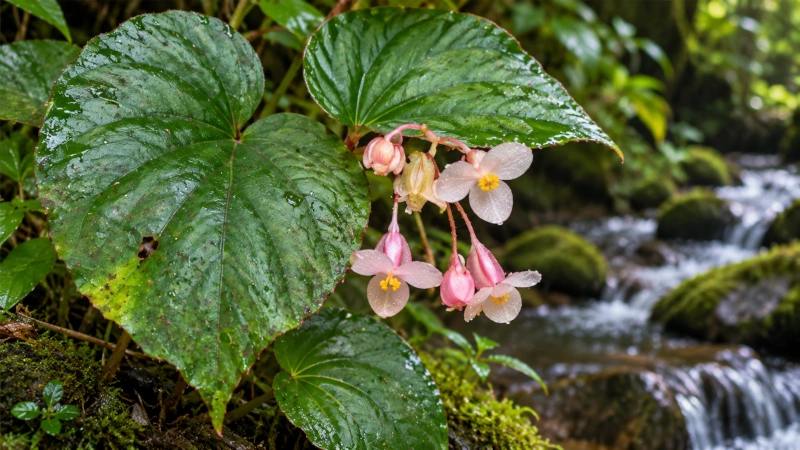
Indian botanists have discovered a new species of flowering plant in Arunachal Pradesh’s Siang River Valley, adding another important scientific record to the extraordinary biodiversity of the Eastern Himalayas. Named Begonia siangensis, the newly identified species was found growing beside a shaded mountain stream in Upper Siang district, where its distinctive dark-green leaves, delicate pale-pink flowers and unusual reproductive structures distinguish it from previously documented members of the genus.
The discovery was made during botanical exploration in 2024 by researchers associated with the Thackeray Wildlife Foundation in Mumbai. Following detailed examination of collected specimens and comparisons with existing botanical records, the scientists formally described the species in the peer-reviewed Edinburgh Journal of Botany on 27 October 2026. The research was conducted by Shivam Kishwan, Tejas U. Thackeray and Navendu V. Page, whose findings provide new information about the diversity and distribution of flowering plants in northeastern India.
The species belongs to the family Begoniaceae and has been placed within the genus Begonia, section Platycentrum. Its discovery highlights the continuing importance of field-based botanical exploration in the Eastern Himalayas, where geographically isolated habitats support numerous specialised plant communities.
Discovery Along a Remote Mountain Stream in Upper Siang
The new species was encountered during an expedition through the Siang River basin, one of Arunachal Pradesh’s most important ecological landscapes. The researchers found the plant growing at an elevation of approximately 600 metres above sea level, between Bomdo and Jengging in Upper Siang district.
The habitat consisted of a shaded streamside environment surrounded by moist vegetation. Such locations provide conditions favourable to many Begonia species, which commonly grow in humid forests, rocky slopes and sheltered environments where moisture remains available throughout much of the year.
During the expedition, the botanists observed the plant’s unusual appearance and collected specimens for further investigation. Living and preserved material allowed them to examine its leaves, stems, flowers and reproductive structures in detail.
The researchers subsequently compared the specimens with existing botanical literature and herbarium collections, including records from India and neighbouring regions. These comparisons were essential because several Himalayan Begonia species possess similar growth patterns and floral characteristics.
Their investigations established that the Siang Valley specimens represented a species that had not previously received a formal scientific description.
Begonia siangensis: A Distinctive Flowering Plant
Begonia siangensis is a rhizomatous, creeping herb that grows close to the ground. Its stems extend along the surface of its habitat, while its foliage and flowers emerge from the plant’s low-growing structure.
One of its most distinctive features is the appearance of its leaves. Unlike some related Begonia species that display striking silvery markings or iridescent foliage, Begonia siangensis possesses predominantly dark-green leaves without prominent variegation.
The underside of the leaves contains microscopic projections known as papillae. These create a textured surface that provides an important diagnostic characteristic for distinguishing the species from closely related plants.
The flowers are pale pink, with the female flowers displaying a drooping orientation. The male flowers possess a distinctive arrangement of bright-yellow stamens, contributing additional characteristics useful for identification.
The plant’s reproductive structures provide some of the strongest evidence of its distinctiveness. Its ovaries possess three wings, with the wings nearly equal in size and extending downward along the ovary. This arrangement differs from that found in certain morphologically similar species.
Together, these characteristics enabled the researchers to establish Begonia siangensis as a separate botanical species.
How Scientists Distinguished the New Species from Its Relatives
Botanical classification requires more than identifying a plant with an unusual appearance. Researchers must demonstrate that its characteristics differ consistently from those of previously described species.
The Thackeray Wildlife Foundation team compared Begonia siangensis with related members of Begonia section Platycentrum, particularly Begonia iridescens, which shares several similarities in growth habit and general morphology.
However, the newly discovered plant possesses a combination of characteristics that differentiates it from B. iridescens.
These include the absence of prominent silvery leaf markings, the presence of a papillose lower leaf surface, drooping female flowers and a distinctive configuration of the ovary wings.
The researchers documented these differences through photographs, botanical illustrations and comparative descriptions. They also prepared a taxonomic identification key to help distinguish Indian members of Begonia section Platycentrum.
Such identification tools are important because they enable future researchers to recognise the species accurately during botanical surveys, ecological assessments and herbarium studies.
Why the Siang River Valley Supports Remarkable Plant Diversity
The Siang River Valley forms part of the Eastern Himalayan biodiversity region, an area internationally recognised for its exceptional concentration of plant and animal species.
The Siang River enters India from Tibet, where its upper course is known as the Yarlung Tsangpo. Flowing through Arunachal Pradesh, it passes through mountainous terrain before joining other rivers to form the Brahmaputra system in Assam.
The river valley contains a complex landscape of steep slopes, forested mountains, tributary streams and habitats distributed across different elevations.
These geographical characteristics contribute to considerable environmental variation. Differences in temperature, rainfall, sunlight exposure, slope orientation and moisture availability can produce distinct ecological conditions even across relatively short distances.
Sheltered stream valleys are particularly important for plants requiring high humidity and protection from direct sunlight. Such environments can support specialised vegetation that may be absent from more exposed surrounding landscapes.
The discovery of Begonia siangensis demonstrates how small, geographically restricted habitats can contain botanical diversity that remains insufficiently documented.
The Importance of Begonia Diversity in Northeastern India
The genus Begonia is among the world’s most diverse groups of flowering plants, with species distributed across tropical and subtropical regions.
Members of the genus exhibit considerable variation in leaf shape, colour, growth habit and floral structure. Many occur in humid forest environments, where specialised adaptations allow them to occupy shaded and moisture-rich habitats.
The Eastern Himalayas represent an important region for Begonia diversity because the area’s complex geography and environmental conditions create opportunities for ecological specialisation.
Several Begonia species have been discovered or formally documented in Arunachal Pradesh during recent botanical investigations, including plants associated with the Siang and Dibang river valleys.
These discoveries demonstrate that the region’s botanical inventory continues to expand as scientists investigate remote forests and less-explored mountain habitats.
The identification of Begonia siangensis adds to this expanding scientific record and provides another example of the relationship between geographical diversity and plant evolution in northeastern India.
Botanical Exploration and Scientific Identification
The discovery also illustrates the importance of traditional taxonomic research in an era increasingly associated with advanced molecular technologies.
Field exploration remains essential for locating previously undocumented organisms. Researchers must examine plants in their natural habitats, record their ecological surroundings and collect sufficient material for detailed investigation.
Once specimens are collected, botanical identification involves examining structural characteristics such as leaf arrangement, stem development, floral organisation and reproductive morphology.
Comparisons with herbarium specimens and published descriptions help determine whether a plant belongs to an existing species or represents a previously unrecognised taxon.
In the case of Begonia siangensis, detailed morphological examination established a combination of diagnostic features sufficient for its formal recognition as a new species.
The researchers’ publication includes a scientific description, botanical illustrations, photographs and comparisons with related species, allowing other scientists to examine and independently assess the identification.
This process contributes to the accuracy and reliability of biological classification and establishes a scientific foundation for future ecological research.
Conservation Importance of the Newly Discovered Plant
One of the most important findings concerns the currently known distribution of Begonia siangensis.
The species has so far been documented from a single shaded stream habitat in Upper Siang district. Its complete geographical range and population size remain unknown.
The researchers have therefore provisionally treated the species as Data Deficient under the criteria used by the International Union for Conservation of Nature.
This designation reflects insufficient information for a reliable assessment of extinction risk. It does not establish that the plant is endangered, nor does it indicate that the species is secure.
Additional botanical surveys are necessary to determine whether Begonia siangensis occurs elsewhere in the Siang basin or in comparable habitats across the Eastern Himalayas.
The researchers have identified the need for further exploration of suitable environments at elevations of approximately 500–1,000 metres.
Such studies can help establish the species’ distribution, population characteristics and habitat requirements while contributing to broader assessments of regional plant diversity.
Protecting the Ecological Richness of Arunachal Pradesh
Arunachal Pradesh contains some of India’s most biologically diverse landscapes, encompassing tropical forests, subtropical vegetation, temperate ecosystems and high-altitude Himalayan habitats.
The state’s extensive environmental variation supports numerous plant species with restricted geographical distributions. Some are associated with particular mountain ranges, river valleys or climatic conditions.
Documenting these species is essential for understanding the region’s ecological characteristics and developing scientifically informed conservation strategies.
New botanical discoveries provide information that can be incorporated into biodiversity inventories, habitat assessments and future protected-area management.
They also demonstrate the scientific value of habitats that may appear relatively small or inconspicuous, such as shaded stream banks and forested ravines.
The discovery of Begonia siangensis reinforces the importance of preserving the ecological integrity of the Eastern Himalayan river valleys, particularly where specialised plant communities depend on stable moisture conditions and intact forest environments.
Indian Researchers Expand Knowledge of Himalayan Biodiversity
The formal identification of Begonia siangensis represents another contribution by Indian researchers to the scientific documentation of the country’s biological heritage.
The study by Shivam Kishwan, Tejas U. Thackeray and Navendu V. Page demonstrates the value of sustained botanical fieldwork, institutional research and careful taxonomic examination.
By identifying previously undocumented species, Indian scientists are strengthening the knowledge base required to understand the evolution, distribution and ecological relationships of Himalayan plants.
The discovery also highlights the role of independent research organisations such as the Thackeray Wildlife Foundation in contributing to national biodiversity research.
The scientific documentation of Begonia siangensis provides a reference for future studies and creates opportunities for additional exploration in the Siang River basin.
As botanical research continues across the Eastern Himalayas, discoveries of this nature are expanding understanding of India’s natural heritage and revealing the remarkable diversity of life supported by its mountain ecosystems.
You may also like
-
Wildlife Institute of India Study Reveals How Lightning Helps Andaman Mangrove Forests Regenerate
-
Satellite-Tagged Vulture Travels 600 Kilometres from Nepal to Nest in Himachal Pradesh
-
Rare Migratory White Stork Recorded at Okhla Bird Sanctuary After Seven Years
-
Jammu and Kashmir Orders Mission-Mode Conservation of Endangered Hangul Deer
-
Wildlife Institute of India Researchers Record Gaur at 3,542 Metres in Sikkim Himalayas
