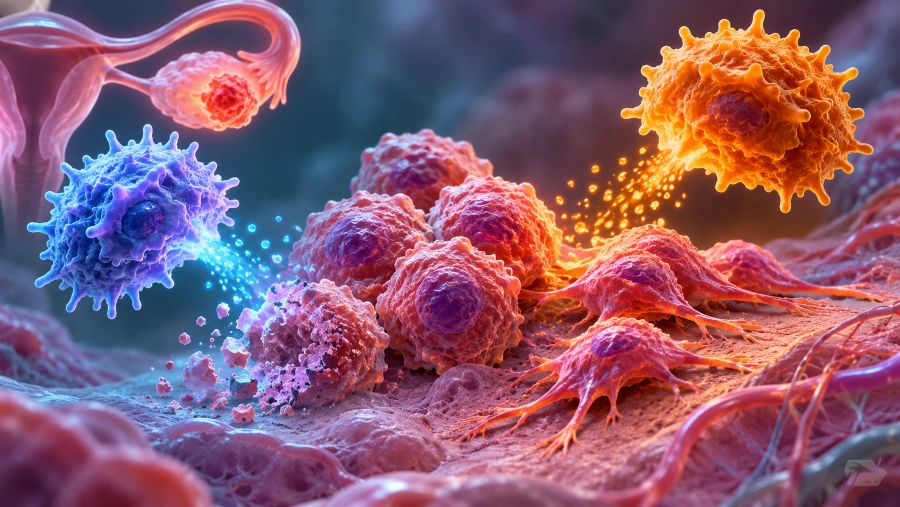
Researchers at Savitribai Phule Pune University (SPPU) have identified how different types of immune cells can influence the growth and invasive behaviour of ovarian cancer cells, offering new insights into the biological mechanisms that contribute to cancer progression. The study demonstrates that M1 macrophages can suppress ovarian cancer cell growth and migration, while factors released by M2 macrophages can promote cellular changes associated with tumour invasion and metastasis.
Conducted by Manasi S. Pote and Rajesh N. Gacche from the university’s Department of Biotechnology, the research was published in the international scientific journal Tissue and Cell. The findings were highlighted by Research Matters on 7 November 2026, drawing attention to the importance of interactions between cancer cells and the body’s immune system in determining how tumours develop and spread.
The research provides a better understanding of the tumour microenvironment, the complex biological surroundings in which cancer cells interact with immune cells and other components of surrounding tissues. By examining how different macrophage populations affect ovarian cancer cells, the scientists have identified potential directions for developing therapies that target the cellular environment supporting tumour progression.
Understanding the Role of the Tumour Microenvironment in Ovarian Cancer
Ovarian cancer is among the most serious gynaecological malignancies, partly because the disease is frequently diagnosed at an advanced stage. Early symptoms can be difficult to recognise, and the cancer may progress within the abdominal cavity before diagnosis.
The behaviour of ovarian cancer cells is influenced not only by changes within the malignant cells themselves but also by their interactions with the surrounding biological environment. This environment contains immune cells, connective tissue cells, signalling molecules and structural components that collectively influence tumour growth and progression.
Scientists refer to this complex network as the tumour microenvironment. Rather than functioning as an isolated collection of malignant cells, a tumour exists within a dynamic biological system in which surrounding cells can either restrict or support cancer development.
Immune cells are especially important because their normal function includes identifying abnormal cells, responding to infections and removing damaged tissues. However, certain immune cell populations can acquire functions that unintentionally support tumour growth.
Understanding these contrasting behaviours has become an important area of cancer research, particularly in efforts to develop treatments that modify how the immune system interacts with malignant cells.
Macrophages: Immune Cells with Different Biological Functions
The Pune University researchers focused on macrophages, specialised immune cells that form part of the body’s innate immune defence system. Macrophages normally help eliminate pathogens, remove damaged cells and coordinate tissue repair through the release of signalling molecules.
Within tumours, however, macrophages can exhibit different functional characteristics depending on the signals they receive from surrounding cells.
For experimental purposes, macrophages are commonly classified into M1 and M2 functional categories. M1-like macrophages are generally associated with inflammatory responses and mechanisms that can restrict tumour development. M2-like macrophages are more closely associated with tissue repair, immune regulation and processes that can sometimes support tumour growth.
These categories represent simplified descriptions of macrophage behaviour. In living tissues, macrophages exist across a spectrum of functional states and can respond dynamically to changes in their environment.
The researchers investigated how factors associated with these two macrophage populations influence the biological properties of ovarian cancer cells, particularly their survival, movement and ability to acquire invasive characteristics.
Scientists Recreate Immune Cell–Cancer Interactions in the Laboratory
To investigate these interactions, the research team developed a laboratory model using cultured human macrophages and ovarian cancer cells.
The scientists first differentiated macrophages into M1-like and M2-like populations under controlled experimental conditions. This allowed them to examine the effects associated with each functional type separately.
They then studied how ovarian cancer cells responded to macrophage-derived factors. Their experiments included the use of conditioned media, containing soluble substances released by the macrophages, to reproduce selected aspects of the chemical communication occurring within the tumour microenvironment.
The researchers conducted experiments using the SKOV3 ovarian cancer cell line, a laboratory model widely employed in studies of ovarian cancer biology.
By comparing cancer cells exposed to different macrophage-derived environments, the scientists could assess changes in cell growth, survival, migration, invasion and other biological characteristics associated with disease progression.
This experimental approach helped identify the contrasting effects of M1-like and M2-like macrophages on ovarian cancer cell behaviour.
M1 Macrophages Suppress Cancer Cell Growth and Migration
One of the principal findings was the ability of M1 macrophage-derived factors to suppress several characteristics associated with ovarian cancer progression.
When SKOV3 ovarian cancer cells were exposed to conditioned media from M1 macrophages, the researchers observed reduced cell growth, migration and invasive behaviour. The treated cells also displayed changes consistent with increased cell death.
Microscopic examination revealed alterations in cellular and nuclear morphology, including features associated with apoptosis-like processes. Apoptosis is a regulated form of cell death through which the body eliminates unwanted or damaged cells.
The experiments also indicated that M1 macrophage-derived factors reduced biological characteristics associated with the ability of cancer cells to move and invade surrounding environments.
These findings demonstrate that macrophages displaying an M1-like functional state can release substances capable of restricting malignant cellular behaviour under laboratory conditions.
The observation is significant because it suggests that the biological activity of immune cells surrounding a tumour may influence whether cancer cells retain or lose properties associated with invasive growth.
M2 Macrophages Promote Characteristics Associated with Cancer Invasion
The researchers observed a contrasting response when ovarian cancer cells were exposed to factors released by M2 macrophages.
Under these conditions, the cancer cells demonstrated increased migration and invasion, along with changes associated with a biological process known as epithelial–mesenchymal transition.
This process is important in cancer biology because it can enable certain tumour cells to acquire characteristics that support movement and invasion into surrounding tissues.
The findings indicate that M2 macrophage-derived factors can create conditions that encourage more aggressive cellular behaviour.
This does not mean that M2 macrophages directly cause ovarian cancer. Instead, the experiments demonstrate that signalling molecules associated with M2-like macrophages can modify the behaviour of existing ovarian cancer cells in ways associated with tumour progression.
The discovery strengthens the understanding of how the tumour microenvironment can influence malignant cells and highlights the importance of studying cancer as an interaction between tumour cells and their surrounding biological systems.
Epithelial–Mesenchymal Transition: A Key Process in Cancer Progression
A central focus of the study was epithelial–mesenchymal transition, commonly abbreviated as EMT.
Epithelial cells normally possess characteristics that allow them to remain connected to neighbouring cells and maintain organised tissue structures. During epithelial–mesenchymal transition, cells undergo changes that can increase their mobility and ability to interact with surrounding tissue environments.
In cancer, EMT-associated changes are frequently investigated because they can contribute to invasion and processes involved in metastasis.
The Pune University researchers examined how macrophage-derived factors influenced these changes in ovarian cancer cells.
They found that factors associated with M1 macrophages reduced EMT-related characteristics, while factors associated with M2 macrophages increased them.
The contrast provides a biological explanation for the different effects observed in the experiments. M1-like macrophages were associated with reduced cancer cell movement and invasion, whereas M2-like macrophages promoted a cellular state more closely associated with invasive behaviour.
The research therefore identifies macrophage-associated signalling as an important area for understanding the processes that allow ovarian cancer cells to acquire aggressive characteristics.
Potential Applications in Cancer Immunotherapy Research
The findings contribute to a growing field of cancer research examining how immune cells can be directed towards activities that restrict tumour development.
Many established and experimental cancer immunotherapies seek to strengthen the immune system’s ability to recognise and eliminate malignant cells. The Pune University study suggests that modifying macrophage behaviour could provide another avenue for investigating cancer treatment strategies.
One potential approach involves identifying ways to reduce the tumour-supporting activity of certain M2-like macrophages. Another involves investigating whether macrophages can be reprogrammed towards functional states associated with stronger anti-tumour activity.
Such approaches aim to change the biological environment surrounding cancer cells rather than targeting malignant cells alone.
The SPPU study provides experimental evidence supporting further investigation of these possibilities. However, the researchers have not developed or clinically tested a macrophage-based ovarian cancer treatment through this work.
The findings establish a laboratory foundation for examining how immune-cell signalling might eventually be incorporated into more advanced therapeutic research.
Further Research into Macrophage Signalling and Cancer Biology
The research also identifies several directions for additional scientific investigation.
The current experiments were conducted using laboratory cell cultures, which reproduce selected interactions within the tumour microenvironment but do not capture the complete complexity of cancer within the human body.
Actual tumours contain numerous immune cell populations, blood vessels, connective tissues and signalling systems that interact continuously. Macrophages also display more varied functional characteristics than the simplified M1 and M2 classifications used in many experimental studies.
Future research can build upon the Pune University findings by identifying the specific molecules released by macrophages that influence ovarian cancer cell behaviour.
Experiments involving three-dimensional tumour models, patient-derived cells and animal models could provide further information about whether the observed effects occur in more complex biological environments.
Advanced analytical approaches, including single-cell molecular profiling, may also help scientists understand how macrophage populations differ within individual tumours and how their functional states change during cancer progression.
These investigations would help establish a more detailed picture of the relationship between immune-cell behaviour and ovarian cancer biology.
Indian University Research Contributes to Cancer Biology and Immunology
The study demonstrates the contribution of Indian universities to fundamental research in molecular medicine, cancer biology and immunology.
By examining the interactions between macrophages and ovarian cancer cells, researchers at Savitribai Phule Pune University have addressed an important question concerning the biological mechanisms that influence tumour progression.
The findings complement international efforts to understand how the tumour microenvironment shapes cancer behaviour and how immune-cell signalling might be used in future therapeutic approaches.
The research also illustrates the importance of laboratory-based investigations in developing medical knowledge. Discoveries concerning cellular interactions can identify biological mechanisms that subsequently become subjects of advanced experimental studies and clinical research.
For India’s biomedical research ecosystem, investigations of this nature contribute to scientific expertise in cell biology, molecular analysis and the study of cancer-related immune responses.
Advancing the Understanding of Ovarian Cancer Progression
The research by Manasi S. Pote and Rajesh N. Gacche establishes an important distinction between the effects of M1-like and M2-like macrophage-derived factors on ovarian cancer cells.
Under the conditions examined, M1-associated factors restricted cancer cell growth, migration and invasion, while M2-associated factors encouraged biological changes linked to more aggressive cellular behaviour.
These results reinforce the understanding that cancer progression is influenced by interactions between malignant cells and their surrounding immune environment.
By identifying how macrophage-associated signalling affects ovarian cancer cell behaviour, the Pune University researchers have provided a foundation for further investigations into tumour biology and macrophage-targeted therapeutic strategies.
The study represents a valuable contribution to Indian biomedical research and advances scientific understanding of the complex relationship between the immune system and cancer progression.
You may also like
-
India and EU Conclude Horizon Europe Negotiations, Opening New Opportunities for Scientific Research
-
IIT Guwahati Uses Drone Data from 36,000 Vehicles to Develop Indian Traffic Models
-
Wildlife Institute of India Study Reveals How Lightning Helps Andaman Mangrove Forests Regenerate
-
Indian and Russian Scientists Develop Solar-Powered Ammonia Production Method for Greener Fertilisers
-
Advanced Protective Coatings to Improve Machining of Critical Superalloys can Help Aerospace, Energy & Petrochemical Sectors
